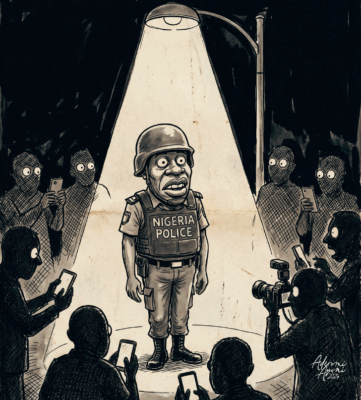
Two thousand years ago, the Roman poet Juvenal posed the timeless riddle of stewardship and power: “Who will guard the guards themselves?” His satirical jab at husbands who hired strapping young eunuchs to chaperone their wives cuts to the heart of Nigeria’s policing debate. The public fear is that decentralisation will merely replace one unaccountable force with thirty-six rogue militias, weaponised by governors to settle scores and entrench fiefdoms. This dystopian view is not baseless, but it tells only half the story. The current centralised system is already acutely unaccountable. The deeper insight is that we could turn decentralisation into an opportunity to design a system where the watchers could now be better watched.
The existing framework offers little comfort. For decades, we have accepted a centralised police force as a necessary, if flawed, pillar of national unity. Designed for control, it promised oversight through a single, clear chain of command. In theory, this should have simplified accountability. In practice, it has created a black box of impunity. The current accountability framework – including organs like the ministerial Public Complaints Committee, Police Service Commission’s Public Investigations Division, and the NPF’s Disciplinary Committee, and Complaints Response Unit – is an ineffectual echo chamber – structurally conflicted, and, in any case, poorly publicised. The result is a profound accountability deficit, evidenced by everything from the chronic extortion at checkpoints to the excesses of the now disbanded SARS unit. As the National Human Rights Commission (NHRC) reported in 2022, public confidence in police complaint mechanisms remains abysmally low, with many citizens viewing internal disciplinary processes as a closed, protective guild.
Decentralisation could, ironically, create the structural opportunities for stronger oversight precisely because it distributes power. When policing moves closer to communities, the distance between abuser and abused shrinks; the guard becomes someone the guarded can see, name, and hold to account. Proximity does not guarantee virtue, but it is vital for effective scrutiny. The real opportunity lies in designing a polycentric framework for accountability from the outset – multiple layers of supervision that make abuse harder to conceal and easier to punish.
The first layer is professional and internal oversight, which must be genuinely independent. In the UK, elected Police and Crime Commissioners hold Chief Constables to account, but operational independence is protected by law and a strong professional code enforced by the College of Policing. Each Nigerian state or regional compact exercising general policing powers should have a service commission insulated from the governor’s direct control. Membership should include respected jurists, civil-society leaders, senior citizens, and retired senior police officers of unimpeachable reputation. This commission would control senior appointments, promotions, and disciplinary processes, creating a professional buffer against partisan capture.
The second layer is local, democratic accountability. A state police commissioner would be appointed by the governor but subject to public confirmation hearings by the State House of Assembly. The service’s budget would be debated and approved line-by-line by local legislators, creating a direct, tangible link between community representation and police funding. Alongside oversight through periodic performance reviews, this could be a powerful tool to forge a police service subject to local democratic processes and responsive to citizens’ needs.
The third layer is national supervision. A National Policing Standards Commission, constituted with equal memberships of federal and state or regional authorities, should set and enforce national minimum standards for training, equipment, use of force, and complaint handling across all forces. More importantly, the office of the Inspector-General of Police (IGP) should be fundamentally reimagined. If separated from operational command of the federal force, it can be transformed into a national inspectorate modelled on the British HM’s Inspectorate of Constabulary. This new inspectorate would have the power to conduct unannounced audits of any state or regional police force, publish public report cards on their performance, and trigger constitutional intervention mechanisms where systemic abuse is found. This transforms the federal role in general policing from operational control to quality assurance and integrity safeguard.
Finally, the fourth layer is external and citizen-facing. Decentralisation brings policing closer to the people, and technology can turn this proximity into power. A national framework could mandate each state force to publish a quarterly public dashboard, modelled after US CompStat system, with key performance indicators: crime clear-up rates, response times, complaints received, disciplinary outcomes, and use-of-force incidents. Furthermore, bodies like the NHRC, working with the reimagined IGP office and appropriately strengthened and funded, can more effectively serve as an independent ombudsman.
Global experience shows that polycentric oversight works when layers reinforce rather than contradict one another. South Africa’s Independent Police Investigative Directorate, though imperfect, has secured convictions in high-profile brutality cases. The US has state-level Attorney-General oversight in many jurisdictions alongside federal civil-rights investigations. No design is perfect, but redundancy – with no single fall-through point – has always proved effective.
The fear that governors will abuse state police is a serious design challenge, not a reason for paralysis. Far from meaning weaker accountability, decentralisation could result in deeper, more distributed accountability – multiple locks on multiple doors, watched from multiple angles. If Nigeria designs the system with as much care as it has invested in fearing its abuse, the guards can finally be guarded effectively – by law, by institutions, by citizens, and by the simple, unrelenting glare of public scrutiny.

Join BusinessDay whatsapp Channel, to stay up to date
Open In Whatsapp