

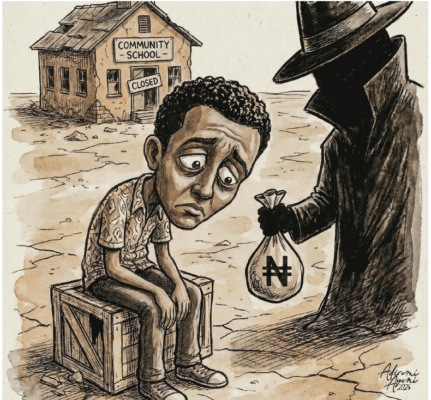
In April 2026, the Nigerian government announced the graduation of 744 “repentant” former terrorists under its deradicalisation and rehabilitation initiative called “Operation Safe Corridor”, declaring them fit to be ‘reintegrated’ into society.
The programme is designed to reform former insurgents through psychological counselling, religious reorientation, and vocational training. This initiative reflects a shift from purely military responses to a more holistic counterterrorism approach. It however raises a more critical question: can rehabilitation succeed in a society that continues to produce the conditions that made terrorism possible in the first place?
The challenge is not simply one of deradicalisation, but of structural reality. Evidence across northern Nigeria suggests that recruitment into extremist groups is rarely driven by ideology alone. Instead, it is deeply rooted in economic deprivation, social marginalisation, and weak state presence. In such contexts, participation in insurgent or criminal networks often reflects rational adaptation to constrained choices rather than purely extremist conviction.
Across large parts of northern Nigeria, the socio-economic conditions remain severe. Data from Nigeria’s National Bureau of Statistics indicate that multidimensional poverty exceeds 60 percent in several northern states, while in conflict-affected areas such as Borno, Yobe, and Adamawa, poverty levels are even higher. Basic infrastructure deficit compounds the problem, with limited access to electricity, education, and formal employment opportunities. For many young people, particularly in rural communities, pathways to upward mobility are extremely narrow. These are not marginal gaps; they define the lived experience of millions. The environment that produces recruits remains largely unchanged.
It is within this environment that extremist organisations have historically embedded themselves. Early studies from scholars such as Alex Thurston and Marc-Antoine Pérouse de Montclos on Boko Haram have shown that the group’s initial appeal extended beyond ideology. Under its founder, Mohammed Yusuf, it functioned not only as a religious movement but also as a social and economic network, providing community, informal education, and material support to marginalised youth. Over time, and especially after the group’s violent transformation following the 2009 crackdown, recruitment evolved into a more pragmatic system shaped by opportunity, pressure, and survival.
This is also reinforced by findings from several empirical research. A 2016 study by Mercy Corps showed that a significant number of former fighters joined insurgent groups following economic shocks, unemployment, or lack of livelihood opportunities. For many, enlistment was less about ideological commitment and more about survival, access to income, or protection. Similarly, the United Nations Development Programme studies in 2017 identified poverty, unemployment, and governance failures as among the most consistent drivers of recruitment into extremist movements across Africa.
Recruitment itself is rarely random. It is structured and embedded within local social systems. Peer networks play a crucial role, with many recruits introduced into extremist groups through friends, relatives, or community members. Economic incentives are also significant. Reports indicate that recruits are sometimes offered cash payments, livestock, or small business support, opportunities that are otherwise unavailable in their immediate environment. In February 2026, a freed kidnapping victim recounted how he escaped captivity after a young guard abandoned his post upon receiving his daily wage, leaving captives with access to the keys. Taken together, these dynamics reveal that extremist organisations rely not simply on ideological commitment, but more on fragile economic loyalties, functioning in practice as alternative socio-economic systems.
This raises a critical concern for reintegration efforts. Ordinary people, under sustained economic and social pressure, can turn to crime. Those who have already participated in organised violence are likely to respond to similar pressures in more dangerous ways. Rehabilitation may reshape attitudes, but it does not eliminate the structural conditions that make re-engagement possible.
These limitations become evident in practice. While initiatives like Operation Safe Corridor may successfully reshape individual attitudes, they do not fundamentally alter the environment to which these individuals return. Reintegration, in this sense, risks becoming a cycle rather than a solution. Former combatants are released back into the same conditions that initially facilitated their recruitment.
Moreover, the broader ecosystem of violent mobilisation in northern Nigeria has evolved beyond a single organisation. Groups such as Islamic State West Africa Province and Ansaru, alongside expanding bandit networks in the Northwest, continue to compete for recruits within the same pool of economically vulnerable youth. This reinforces the structural nature of the problem – it is not confined to one group, but sustained by underlying socio-economic conditions.
There are also design limitations within the programme itself. Studies and field reports have pointed out missing components in implementation, particularly around post-reintegration support. Community acceptance remains uneven, with some local populations resisting the return of former insurgents. Where livelihoods are not secured and social reintegration is weak, the risk of relapse increases.
None of this diminishes the importance of rehabilitation. Disengagement from violence and ideological reorientation are necessary steps in addressing insurgency. But they are insufficient on their own. Without parallel efforts to expand economic opportunity, strengthen governance, and rebuild local trust, reintegration risks becoming a revolving door.
At its core, the issue is structural. As long as poverty, marginalisation, and weak state presence continue to define large parts of northern Nigeria, the conditions that sustain recruitment will persist. In that context, the question is not whether former terrorists can be rehabilitated, but whether the society they return to can sustain that rehabilitation. On current evidence, that remains uncertain.

Join BusinessDay whatsapp Channel, to stay up to date
Open In Whatsapp


