

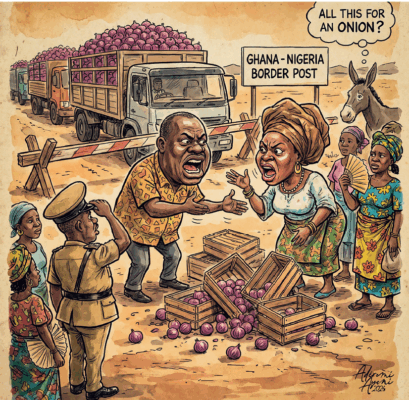
In early April, what began as a dispute over onion cargoes between Ghanaian and Nigerian traders quickly escalated into a revealing parable of Africa’s integration challenge. Reports indicated that Ghanaian traders had prevented their Nigerian counterparts from offloading consignments at an Accra market over alleged quota violations. Nigerians retaliated by holding Ghanaian trucks at the border. Tensions eased after low-level diplomacy, but not before substantial losses had been recorded in perishable goods.
This was the second international incident involving Nigerian traders within a month. In South Africa, locals attacked migrant-owned stores over an unrelated cultural incident. These episodes exposed the fragility of informal cross-border commerce across the continent – and the urgent need to prioritise this in national trade policies and formal integration initiatives.
Informal trade is among the least measured but most consequential drivers of intra-African commerce. A 2023 joint ECOWAS, Afreximbank, and UNECA study found that informal trade along the Abidjan–Lagos corridor amounted to US$22.8 million over a four-month survey period, with women accounting for 74% of traders. At continental level, informal flows were estimated to account for 30-40% of regional exchanges, contributing significantly to intra-African trade that reached US$220.3 billion in 2024. These figures reveal that regional integration is already a lived reality for millions across Africa, long before it becomes a formal policy aspiration.
Informal trade endures for many reasons. Africa’s commercial routes remain deeply rooted in older, pre- colonial continuities – long-distance commodity routes, cross-border circuits of market women, and distributive systems based on apprenticeship, shared risk, and circulating capital. For most Africans, the lived face of regional integration is not another Nigerian bank or South African telco entering into the market. It is the Hausa grain merchant moving produce across the Savannah, or the Somali corner-store owner whose presence has become part of local retail life far from home. The resilience of these traders offers buffers against political and economic shocks. In wartime, traders crossed enemy lines – as in the ‘Afia Attack’ phenomenon during the Nigerian civil war. In peacetime, borderless commutes bypass official forex restrictions.
However, this reveal an inherent contradiction. The very networks that make informal trade resilient also make it politically complex. Organised around what economist Janet Tai Landa describes as “ethnic trading networks,” informal trade often relies on kinship, language, trust, and shared norms to lower transaction costs and substitute social enforcement – clan loyalty and reputation – for formal institutions. It is partly for this social embeddedness that informal trade is sometimes celebrated as a form of integration from below.
These networks may however be double-edged, as sociologist Kate Meagher has argued. What appears from within as efficient grassroots integration may strike outsiders as cartelisation that give in-groups unfair advantage. This is particularly true as migrant and local traders now share urban retail spaces. Earlier trade routes typically linked complementary economies, moving commodities from producing to consuming communities. today’s informal trade increasingly involves imported manufactures and fast-moving consumer goods sold in shared spaces. This does not create natural alignments. Even communities with historical alliances come into tension when allies attempt to circumvent partners. This creates a fraught terrain where economic rivalry acquires xenophobic overtones.
This complexity is still not sufficiently reflected in national trade policies and continental initiatives. Beyond the usual firefighting responses after crises such as the onion war, there is hardly proactive policies around the social imports of informal trade. At continental level, the African Continental Free Trade Area (AfCFTA) was largely designed around formal economy assumptions – tariffs, customs procedures, border harmonisation, and formal market access. These are necessary but not sufficient pillars.
To be fair, AfCFTA’s simplified trade regime represents a meaningful attempt to ease compliance burdens for small-scale and informal traders. But its remains largely focused on border formalities. What it does not yet sufficiently address are the market-aisle issues – the social tensions, distributive anxieties, and legitimacy questions that arise when trade expands through ethnic networks.
This double-edged reality demands a reimagination of informal trade’s role — not as a problem to be formalised away, but as a distinct pillar of regional integration. Informal trade is not merely a trade policy matter; it shapes people-to-people diplomacy and soft power, with implications for foreign and cultural policy. Nations like Nigeria and Ethiopia, which export large numbers of informal traders, must foster harmonious commercial practices within their trade diasporas and build win-win models that integrate local partners.
There is also a knowledge dimension that relevant institutions do not yet take seriously enough. Kinship-based business models – Igba Boi apprenticeship, Esusu and Iqub thrift, and Abban guarantee mechanisms – should enter African business-school curricula as durable indigenous economic knowledge rather than cultural curiosities. AfCFTA must equally move beyond WTO-style assumptions and develop a distinct frameworks for informal trade. These should address local displacement anxieties and community-level legitimacy. Such a framework could, among other things, adapt AfCFTA’s competition protocol to in-group cartelisation, and extend its adjustment support to communities vulnerable to local displacement occasioned by informal trade flows.
Africa’s markets have long been integrated in practice. The real challenge now is whether our policies can finally catch up with that integration from below. Until our policies create a dedicated framework to address issues of trust, resentment, and culturally embedded distortions in informal trade, Africa’s organic integrated market will remain a source of integration and instability in equal measure. This is no longer merely a trade problem. It is a governance problem with economic, political, and cultural consequences.

Join BusinessDay whatsapp Channel, to stay up to date
Open In Whatsapp


