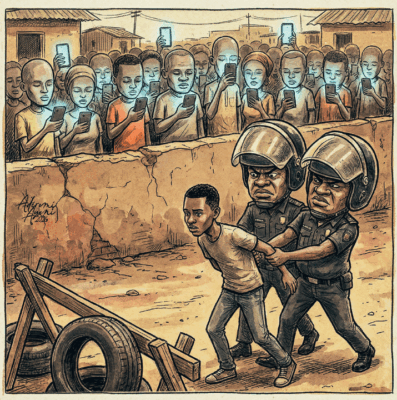
Have you been at a police checkpoint or a traffic light junction when a citizen has been stopped and accused of an infraction you know was incorrect? In several cases, many people present at the scene will simply watch, even when they know that the law enforcement officers are wrong and the citizen did not break the law. However, you and others at the scene say nothing to help the hapless citizen, call out the security agents, or challenge their false accusation. The matter is not helped by the fact that everyone now has a mobile phone, which they prefer to use to record the scene instead of standing up to defend the citizen.

This scenario reflects the collective paralysis of the bystander effect that has taken hold in our country. It is evident not only in the political or governance space, but in every sphere of life today – the “siddon look” attitude. Which one be my own? Wetin concern me?
In political terms, this condition reflects what is often described as passive citizenship, a situation where citizens formally belong to a state but withdraw from actively shaping its direction. On the other-hand, active citizenship involves sustained participation in civic, social, and public life. What is unfolding in Nigeria suggests not just a psychological bystander effect, but a broader pattern of civic withdrawal that is quietly redefining the relationship between the people and the state.

Across politics, social justice, security, human rights, and even in everyday dealings with banks, telecom networks, and service providers, Nigerians appear to be watching passively as dysfunction deepens. It is as though the conscience of the people has been numbed, leaving citizens as spectators to their own decline. Citizens lament broken promises, corruption, and poor governance, yet outrage rarely translates into sustained civic action. Elections come and go, often marred by irregularities, but the response is muted. Many shrug, convinced their votes do not matter or the system is too entrenched. This resignation reinforces passive citizenship and allows governance failures to persist without challenge.

The same paralysis is evident in social justice. Inequality festers, marginalised groups are denied opportunities, and injustice persists. Nigerians discuss issues privately and on social media but rarely organise to demand change. When protest happens, they are dismissed as politically motivated, with participants labelled enemies of the state. Democracy cannot thrive when “the people” who are its supposed guardians retreat into silence.

Security is one arena where this pattern has become entrenched. In communities plagued by banditry, kidnapping, and violence, fear has silenced resistance. Citizens retreat into detachment, hoping danger will pass them by. But insecurity thrives when communities remain passive. The cost of silence is profound: lives are lost, families are shattered, and trust is eroded. The bystander effect here is not merely behavioural; it reflects a broader civic withdrawal that undermines collective security.

Police harassment and brutality further illustrate the danger of sustained passivity. Nigerians know the stories: young people profiled, extorted, and brutalised by those meant to protect them. The #EndSARS protests briefly disrupted this pattern, demonstrating the power of active citizenship when citizens organise and demand accountability. But the momentum waned, and silence returned, reinforcing the belief that resistance is futile. Human rights violations from unlawful detentions to suppression of dissent, persist as citizens retreat into detachment. Many conclude that survival requires silence, that the system is too entrenched to challenge, and that it is safer to endure than confront. This resignation deepens passive citizenship and further weakens the civic foundations of democracy.

Even in everyday dealings with banks and service providers, this pattern is evident. Customers endure unfair charges, poor service, and opaque practices, but they rarely protest. They shrug their shoulders, convinced that nothing will change, that complaining is pointless, and that survival requires endurance. But silence in the face of exploitation only emboldens those who exploit.

Over time, this sustained pattern produces deeper structural consequences. When passive citizenship becomes the norm, public pressure weakens, institutions face less scrutiny, and leaders become increasingly insulated from accountability. Policy decisions are taken with minimal regard for public response because that response is expected to be limited or short-lived. In such conditions, democracy does not collapse suddenly; it gradually thins out. Participation declines, accountability weakens, and governance becomes less responsive. Left unchecked, this trajectory can tilt systems toward authoritarian tendencies, where power concentrates and citizen influence diminishes.

Breaking free from the bystander effect therefore requires more than awareness; it requires a deliberate shift from passive to active citizenship. It requires citizens to reclaim their agency, to rediscover the power of their voices, and to recognise that change is not the responsibility of others but of all. It requires a refusal to be numbed by resignation and a rejection of the illusion that someone else will act. The antidote to paralysis is participation — the courage to speak, to organise, to demand accountability, and to insist that Nigeria’s future is too important to be left to chance.

The bystander effect thrives on the illusion that responsibility belongs elsewhere. Historically, however, moments of transformation have depended on collective civic engagement rather than withdrawal. From the mass mobilisations that reshaped societies to the organised resistance that challenged entrenched authority, active citizenship has remained central to structural change. Where citizens participate consistently, institutions become more responsive and accountable. Nigeria’s trajectory will similarly depend on whether passive citizenship gives way to sustained, collective engagement capable of reshaping governance and public life.

Join BusinessDay whatsapp Channel, to stay up to date

Open In Whatsapp