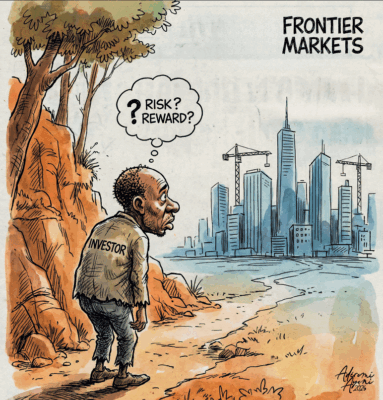
Nigeria’s return to Frontier Market status by FTSE Russell has been received with cautious relief in policy and investment circles. After a period of exclusion driven by concerns over market accessibility, particularly foreign exchange illiquidity, the country is once again deemed investable within the frontier universe. This is not a story of restoration, but of risk and how countries manage it, or fail to.

The decision followed FTSE Russell’s March 2026 interim review and will take effect in September 2026, upgrading Nigeria from “Unclassified” to “Frontier Market” status. The reclassification reflects improvements in market accessibility, regulatory oversight, settlement efficiency, and capital repatriation frameworks, with Nigeria receiving “Pass” ratings across key criteria.

Reinstatement, however, should not be mistaken for resolution. The contradiction is that Nigeria now meets several of the technical criteria for market inclusion, while still grappling with a credibility deficit in investor perception.

Frontier markets are where global capital hesitates before committing. They offer higher returns, but also carry elevated risks: currency volatility, regulatory uncertainty, weak institutions, and abrupt policy reversals. Investors enter such markets cautiously, demanding a premium for risks that cannot be fully hedged.

Nigeria’s problem is not its frontier classification, but how it amplifies the risks that define it. To frame this, a brief metaphor from Things Fall Apart is quite helpful. In contrasting industry with indolence, Chinua Achebe describes those who venture across difficult terrain to cultivate fertile but uncertain land. Frontier investors are those who journey outward, accepting uncertainty in pursuit of higher returns. But even the boldest investor will not enter a market if exit is uncertain. This is where Nigeria’s difficulty begins.

At the centre of the issue is policy credibility. When the Central Bank of Nigeria allowed the foreign exchange market to fragment into multiple windows, with widening gaps between official and parallel rates, it introduced uncertainty beyond standard frontier market risk. Investors could no longer price assets with confidence. More critically, exit could no longer be guaranteed.

In global capital markets, entry risk is tolerated; exit risk is not. This distinction is operational. Investors accept volatility and the possibility of losses, but on the assumption that exit allows asset liquidation, currency conversion, and repatriation without obstruction.

In Nigeria, that assumption broke down. Foreign portfolio investors exiting positions found themselves holding Naira they could not convert. Even foreign airlines were unable to repatriate revenues as FX demand outstripped supply. At the peak of the crisis, unmet foreign exchange obligations ran into billions of dollars, reinforcing concerns over trapped capital.

Multiple exchange rate windows compounded the problem. Investors did not know which rate would apply or when access would be granted. At that point, risk ceased to be priceable; uncertainty dominated. A market where entry is possible but exit is uncertain is not merely high-risk; it is functionally impaired.

Nigeria’s removal from the FTSE Russell Frontier Market index was therefore not an overreaction, but a rational response to an opaque and unpredictable system. For index providers, ease of capital repatriation is a minimum requirement; once it fails, classification becomes untenable. The consequences were immediate. Passive funds tracking the index divested, while active investors followed as liquidity risk crossed a critical threshold. As concerns over trapped capital spread, behaviour shifted from caution to withdrawal, deepening market stress.

Recent reforms, such as exchange rate unification, improved FX liquidity, and enhancements to trading and settlement infrastructure on the Nigerian Exchange Group, have helped restore a degree of order. FTSE Russell’s decision acknowledges this shift. Importantly, however, the restoration reflects improvements in market infrastructure and access conditions, not a full resolution of underlying credibility concerns.

Peer markets such as Kenya, Vietnam, and Bangladesh have built reputations for relative policy consistency. Their frameworks are not perfect, but sufficiently predictable to support long-term investment. Nigeria, by contrast, has oscillated between reform and control. Each reversal resets expectations and introduces new uncertainty. Over time, this creates a structural risk premium – a persistent discount on Nigerian assets. Consequently, Nigeria pays more for capital due to perceived unpredictability.

The deeper concern is not that these distortions occurred, but that they persisted without institutional correction.

Faced with currency pressures, policymakers often resort to administrative controls to stabilise outcomes. In the short term, such measures may reduce volatility. Over time, however, they distort market signals, discourage participation, and erode trust. This is the policy contradiction in frontier markets: the tools used to manage risk in the short term often intensify it over the long term.

To break this cycle, Nigeria must adopt rule-based frameworks. This requires institutionalising three core mechanisms: a unified and transparent foreign exchange market, credible repatriation guarantees, and clearly communicated intervention rules under stress conditions. In particular, foreign exchange management must move from discretionary allocation to rules-based liquidity provision, where access, pricing, and timing are predictable and market-driven. Investors do not require perfection, only predictability.

Credibility is not built through announcements, but through consistency across cycles. This places responsibility not only on the Central Bank of Nigeria, but on the broader policy architecture. There is also a competitive dimension. Global capital is not captive; it flows to where risk-adjusted returns are most attractive. In a crowded frontier landscape, capital does not reward potential; it rewards reliability.

Nigeria is back on the list, but still on trial. The test is not retention of status, but whether it can replace episodic reform with institutional consistency – because in global capital markets, credibility, once discounted, is costly to rebuild and easy to lose.

Join BusinessDay whatsapp Channel, to stay up to date

Open In Whatsapp