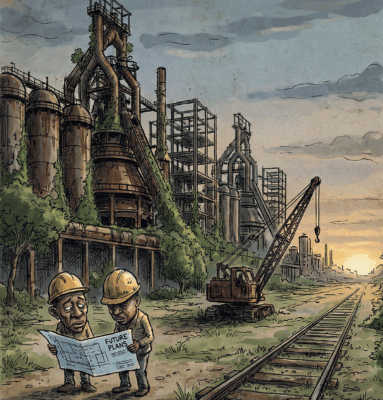
In the quiet industrial town of Ajaokuta, on the banks of the River Niger, stands a symbol of promise and betrayal. The Ajaokuta Steel Complex, once envisioned as Nigeria’s bedrock of industrial revolution, remains one of Africa’s most ambitious and symbolically potent, but unrealised projects. Conceived in 1979 and reaching near-completion by the mid-1990s, the plant was designed to anchor a fully integrated steel economy to power construction, transport, defence and manufacturing. However, it remains an “idle giant” that has neither produced steel at scale nor fulfilled its transformative promise.

The urgency now is not to recount its failures, but to decisively chart a pathway to success. Ajaokuta’s troubled history is well documented: decades of policy inconsistency, failed concessions, legal disputes, and infrastructure gaps, have kept the complex in limbo. Over $8 billion has reportedly been spent, but the plant however remains largely dormant, with obsolete equipment and disconnected supply chains undermining its viability. This figure does not include the significant opportunity lost (cumulative impact) in terms of industrial output, direct investment, employment, and technological capability over several decades, which experts estimate at between $670 billion and $1 trillion.

Nigeria currently produces about 1.2 million metric tonnes of steel annually, far below its estimated demand of over 10 million tonnes, while relying heavily on scrap-based production rather than primary steel from iron ore. This structural gap translates into billions of dollars in annual imports of steel and industrial materials. Nations that command industrial power, including China and India, once faced similar uncertainty, but transitioned through coordinated policy, long-term financing, and disciplined industrial execution, offering Nigeria a framework to adapt.

There is much to learn from countries like China, India and South Korea, which built steel-driven industrial economies despite earlier classifications as third world nations. China now produces over one billion tonnes of steel annually, driven by long-term state coordination, massive infrastructure investment, and state-backed financing tied to industrial clusters. India, the second-largest producer with over 140 million tonnes, expanded output through governance reforms, technological modernisation, and private-sector participation. South Korea demonstrated how disciplined governance, technological adaptation, and infrastructure integration can scale global competitiveness. The denominators here are policy coherence, infrastructure, finance, and synergy in governance. This is precisely where Ajaokuta has faltered, and where Nigeria must now focus.

Nigeria must stop treating Ajaokuta as a standalone project. Steel plants do not thrive in isolation; they operate within industrial ecosystems. Ajaokuta’s original design already recognised this, linking iron ore from Itakpe, rail transport to Warri, and downstream industries across the country. To succeed, this integrated vision must be restored and modernised. The Itakpe-Ajaokuta-Warri rail corridor must be secured and made fully operational to guarantee raw materials and products movement. The ongoing Ajaokuta-Kaduna-Kano gas pipeline presents a critical opportunity to ensure stable and cost-effective energy supply, which is central to steel competitiveness. Around the plant, Nigeria should deliberately cultivate industrial clusters, including automotive assembly, fabrication, construction materials, and defence manufacturing, to transform Ajaokuta into the nucleus of a broader industrial corridor rather, than an isolated facility.

A lesson Nigeria must internalise is that steel plants do not fail in isolation; they fail within weak governance environments. Ajaokuta’s history of concession disputes and costly arbitration settlements underscores the dangers of weak contractual frameworks, policy reversals, and political interference. The path forward demands a technocratic, autonomous management structure insulated from short-term political cycles, with transparent benchmarks, enforceable contracts, and merit-based leadership replacing entrenched patronage.

Rather than outright privatisation or full government control, Nigeria should pursue a hybrid public-private partnership (PPP) framework that balances efficiency with national strategic interest. Encouragingly, recent developments suggest a shift in direction. The government is pursuing a production-sharing partnership with Chinese investors, anchored on a proposed $2 billion rehabilitation plan that preserves national ownership while leveraging foreign expertise. However, a critical question remains: what constraints prevent a similar resolution with the original Russian builders of the complex?

Simultaneously, new policy thinking is emerging. A landmark 2025 agreement between the Ministries of Steel Development and Defence seeks to transform part of Ajaokuta into a military-industrial complex, linking steel production directly to national security and manufacturing capability. This approach reflects a more strategic understanding of steel, not merely as an industrial input, but as a foundation for sovereign capability in infrastructure, defence, and heavy manufacturing. These initiatives signal a growing recognition that Ajaokuta must be embedded within a broader, coordinated industrial strategy.

Reviving Ajaokuta is not merely about steel; it is about structural transformation. Steel underpins infrastructure, housing, transportation, and energy systems, while enabling value addition across multiple sectors. The economic multiplier effects are substantial, including large-scale job creation, technology transfer, foreign exchange savings, and increased industrial output. More importantly, it offers a pathway for Nigeria to transition from a resource-exporting economy to a production-driven one with stronger domestic value chains.

Like sleeping giants, Ajaokuta can only be awakened through deliberate and disciplined action. Financing is not the primary constraint; credibility, policy consistency, and execution capacity are more decisive. Nigeria stands at a moment where investor interest and infrastructure development are beginning to align. If these elements are harnessed with clarity and commitment, Ajaokuta can become the catalytic core of Nigeria’s industrial future. If not, it risks remaining a monument to inconsistency and unrealised national potential.

QUOTE:  Nigeria must stop treating Ajaokuta as a standalone project. Steel plants do not thrive in isolation; they operate within industrial ecosystems. Ajaokuta’s original design already recognised this, linking iron ore from Itakpe, rail transport to Warri, and downstream industries across the country

Join BusinessDay whatsapp Channel, to stay up to date

Open In Whatsapp