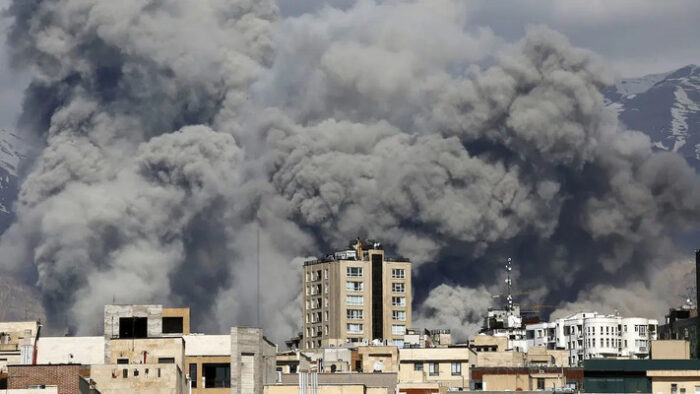
The war between the United States, Israel, and Iran has entered its fifth day with no clear path to de-escalation, as air strikes pound Iranian cities and Tehran expands its retaliation across the region.

Iranian authorities say the human cost is mounting rapidly. The semiofficial Tasnim News Agency reported that the death toll from United States and Israeli attacks has reached 1,045. The figures could not be independently verified.

Read also: US Embassy cancels Abuja visa appointments over protest fears amid escalating US-Iran conflict

Explosions were heard across Tehran on Wednesday, according to Tasnim, while state television broadcast images of rubble from a damaged building in the city centre. Strikes were also reported in the holy city of Qom and in several other urban centres, suggesting a widening list of targets.

As the bombardment intensified, concern turned once again to Iran’s nuclear infrastructure. The International Atomic Energy Agency said visible damage had been observed at two buildings near the Isfahan nuclear site. However, it stressed that facilities containing nuclear material were not hit and there was no risk of a radiological release at this time.

Read also: Trump and Rubio give conflicting accounts of why the US struck Iran

Moscow also raised the alarm. The Ministry of Foreign Affairs of the Russian Federation warned that Iran’s Bushehr nuclear power plant was under threat from air strikes, adding that explosions had been heard near its perimeter. Any direct hit on an operational nuclear power station would mark a dangerous escalation with global implications.

Tehran has continued to respond with missile and drone attacks aimed at Israel and at countries across the Gulf. Qatar has been among those affected. The fighting now stretches well beyond the original exchange between Israel and Iran, drawing in regional actors that host United States military assets.

Donald Trump, the United States President  has said the conflict could last as long as a month, raising fears of a prolonged confrontation in one of the world’s most strategically sensitive regions.

Read also: Fertilizer prices may spike as Iran bans food, agricultural exports

In Doha, Mohammed bin Abdulrahman bin Jassim Al Thani, Qatari Prime Minister held a phone call with Mohammad Javad Zarif Iranian Foreign Minister, also known as Abbas Araghchi, on Wednesday, according to the Qatari Foreign Ministry. Araghchi reportedly told the Qatari leader that Iran’s attacks were directed at United States interests and were not aimed at Qatar itself.

Mohammed rejected that explanation. He said the facts on the ground showed that strikes had hit civilian and residential areas inside Qatar. He called for the immediate cessation of Iranian attacks on Gulf states and warned that the assault showed no goodwill toward Iran’s neighbours.

While affirming that Qatar prefers dialogue and diplomacy, he said the country would confront any aggression and that such attacks could not go unanswered.

The current round of fighting, widely reported by Al Jazeera and other international media, signals a dangerous shift. What began as a direct confrontation between Israel and Iran now risks becoming a broader regional war, with nuclear sites, civilian areas, and multiple states caught in the crossfire.

Faith Omoboye is a foreign affairs correspondent with background in History and International relations. Her work focuses on African politics, diplomacy, and global governance.

Join BusinessDay whatsapp Channel, to stay up to date

Open In Whatsapp