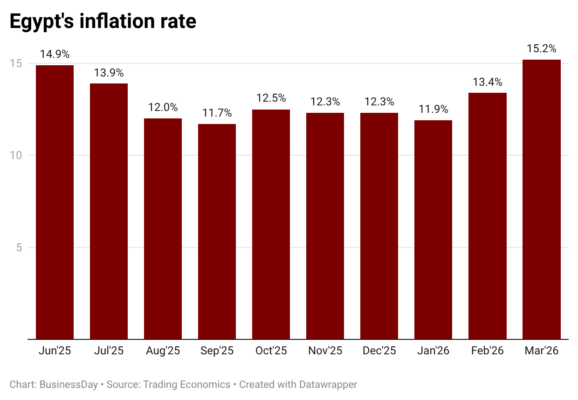
Egypt’s annual inflation accelerated to a 10-month high in March, as surging global energy prices linked to the Middle East conflict and a weaker currency pushed up the cost of living.
Consumer prices in urban areas rose to 15.2 percent, up from 13.4 percent in February, according to data released Thursday by the Central Agency for Public Mobilization and Statistics (CAPMAS).
Food and beverage prices were the main driver, rising 5.2 percent month-on-month. Vegetable prices surged 21.8 percent, while meat and poultry increased 5.9 percent and fruit prices rose 2.0 percent.
Transport costs also climbed sharply, rising 8.0 percent on a monthly basis, driven by higher spending on private transport (8.7 percent) and transport services (8.5 percent), alongside a 3.3 percent increase in vehicle prices.
Housing-related costs added further pressure, with the housing, water, electricity, gas and fuel segment rising 3.6 percent. This was driven by higher rents (2.1 percent) and a 6.5 percent increase in electricity and fuel prices.
The inflation spike follows a fresh round of fuel price hikes in Africa’s second-largest economy, where authorities raised domestic fuel prices by up to 30 percent on March 10 in response to global energy market volatility and heightened geopolitical tensions.
Natural gas for vehicles recorded the steepest increase at 30 percent, while gasoline and diesel prices rose between 14 percent and 17 percent, partly reflecting reforms tied to an $8 billion programme with the International Monetary Fund.
Since the launch of the Arab nation’s subsidy reform programme in 2016, fuel prices have risen by as much as 820 percent to 1,200 percent, depending on the product.
Other categories also recorded increases, with restaurant and hotel prices rising 2.1 percent and clothing and footwear up 1.7 percent. In contrast, healthcare prices declined 0.6 percent during the month, as a drop in medical products and equipment offset increases in outpatient and hospital services.
On an annual basis, transport recorded one of the steepest increases at 29.3 percent, followed by housing and utilities at 28.3 percent, underscoring persistent cost pressures in essential services.
Education prices rose 20.0 percent year-on-year, while healthcare increased 17.1 percent and restaurants and hotels climbed 13.7 percent.
Food and beverages recorded a more moderate annual increase of 6.2 percent, despite a sharp 41.6 percent rise in vegetable prices, as declining fruit prices helped moderate overall food inflation.
Last week, the Central Bank of Egypt held its benchmark interest rates steady, pausing its easing cycle amid rising global uncertainty. The bank left its deposit rate unchanged at 19 percent and lending rate at 20 percent, in line with market expectations.
Global oil prices have since eased, falling below $100 per barrel after a ceasefire between the United States and Iran reduced immediate supply concerns. Brent crude and United States West Texas Intermediate (WTI) dropped between 14 and 17 percent to the low-to-mid $90 range, as markets unwound the geopolitical risk premium built up during weeks of escalation.
Before the ceasefire, the conflict had pushed oil prices above $100 per barrel, exacerbated by disruptions to tanker traffic through the Strait of Hormuz—a key passage for roughly a fifth of global oil supply.
For many African economies dependent on imported fuel, the earlier surge in oil prices had already translated into higher transport and food costs, threatening to reverse recent disinflation gains and erode consumer purchasing power.
Join BusinessDay whatsapp Channel, to stay up to date
Open In Whatsapp