Nigeria grows food but still imports much of what it consumes. For Germany, the gap is not in the soil but in what happens after harvest, a challenge it has been addressing for years, now drawing renewed focus.

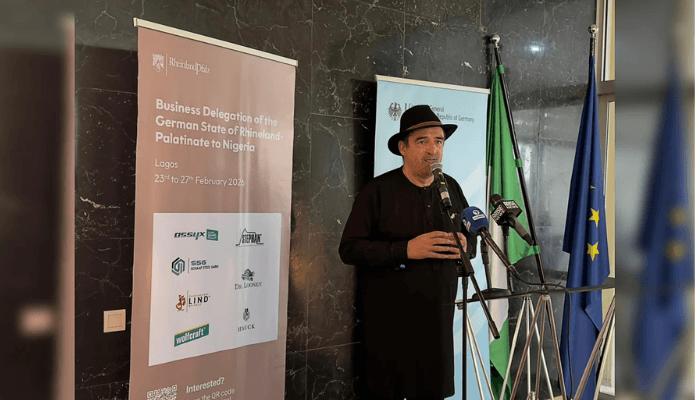
At a reception at the German Consulate in Lagos alongside Agrofood Nigeria 2026, Daniel Krull, German Consul General to Lagos, said Nigeria’s food challenge lies less in production and more in processing.

“We believe the food sector is very important for the future stability and resilience of Nigeria,” he said.

Read also: Steel minister seeks EU investment at Germany economic forum

Despite vast agricultural potential, Africa’s most populous nation relies heavily on imported processed and packaged goods. Data from the National Bureau of Statistics shows Nigeria spent N7.65 trillion on food and beverage imports in 2025, up 63 percent from N2.86 trillion in 2022.

Krull captured the contradiction bluntly: “Why do I buy tomatoes from China in a country like Nigeria, where tomatoes grow everywhere?”

The answer lies beyond the farm gate. It sits in factories, storage, and supply chains where capacity remains thin. The Organisation for Technology Advancement of Cold Chain in West Africa estimates post-harvest losses at between N3.5 trillion and N5 trillion in 2025, largely due to weak storage and limited processing.

A strategy built on machines, not aid

Germany has been addressing that gap, focusing on industrial capacity rather than farm output.

From bottling lines to processing systems, the approach helps Nigerian businesses preserve, scale, and compete. Germany’s development cooperation portfolio in Nigeria stands at about €570 million, alongside credit schemes allowing firms to access equipment from roughly $5,000.

Krull framed the model simply: “Germany is one of the biggest exporters of coffee, but we do not grow coffee. We process it.”

Read also: Germany’s largest bank says reforms restoring confidence in Nigerian economy

Nigeria can cut imports and waste by moving up the value chain, while German firms tap into rising demand from a large, urbanising consumer market.

A market drawing global attention

For Paul Marz, managing director, Fairtrade, organisers of the Agrofood Conference and Exhibition, the shift is already visible.

“Large quantities of the food currently consumed in Nigeria are imported,” Marz added. “We want to change that.”

Read also: Germany’s growing foreign enrolments signal Nigeria’s emergence as a key source country

The route  according to Marz is practical rather than policy driven, better machinery, stronger packaging, longer shelf life, and lower post harvest losses.

This year’s exhibition features 137 companies from 17 countries, reflecting growing international interest in Nigeria’s food economy.

Why companies are coming

German firms say they are responding to a clear demand.

“It is a very promising market,” said Daniel Delleman, project manager for market intelligence and international markets at VDMA, citing population growth and shifting consumer expectations.

“The population is large and growing. There is increasing demand for quality food products; that creates a need for an efficient food production system,” he said.

For firms like Blow Moulds, the opportunity is more specific. “We see Africa, and especially Nigeria, as a fast-growing market,” said Hendrik Labjuhn, sales manager for Blow Mould, noting rising demand for beverages and packaging systems.

But entering the market isn’t without challenges; companies face difficulty identifying decision-makers, building trust, and navigating regulation. Currency volatility and financing gaps also slow deals.

“Companies need a predictable environment to invest confidently,” Delleman said.

Foreign exchange pressures add another layer, with equipment priced in euros while many clients earn in naira.

Skills, speed, and scale

Concerns about technical capacity persist, but industry insiders frame the issue differently.

“Nigerians are highly capable,” said Daniel Olorode, technical sales manager, Krones LCS Center West Africa. “The real challenge is the speed of technological change.”

At Krones, about 80 percent of the technical workforce in Nigeria is local. But as equipment evolves, skills must keep pace.

“Without continuous training, even skilled workers can fall behind,” Olorode said.

A bet with high stakes

Germany’s approach reflects a broader shift from aid to industrial partnership.

If it succeeds, the gains could be significant: lower imports, reduced waste, stronger local industries, and more jobs.

“The objective is to create jobs, create wealth, and build industry,” Marz said.

The outcome will depend on how well Nigeria integrates new capacity into its systems, from power to logistics to regulation.

Nigeria’s food future will depend more on what it can keep and turn into value than on what it grows.

Faith Omoboye is a foreign affairs correspondent with background in History and International relations. Her work focuses on African politics, diplomacy, and global governance.

Join BusinessDay whatsapp Channel, to stay up to date

Open In Whatsapp