States in Nigeria have been on a borrowing binge for decades. While states use the vast majority of debts to finance infrastructures rather than immediate consumption, the federal government issues bonds and finances current operating programs through debt finance. There is a significant and fundamental difference in sub-national debts.
Debt in itself is not bad but it must be managed efficiently to address critical sectors that can drive economic expansion at the state level. However, accumulated debts, a consequent of poor management of loans if not service will lead to precarious fiscal health of states—debt crisis.
Nigeria’s total states’ debt accumulated n4.98 trillion by the end of 2018. Prior to this time, the states’ total debts had increased in three consecutive years from N3.03 trillion in 2015 by 32.92 per cent, 11.79 per cent and 10.65 per cent to N4.02 trillion in 2016; N4.50 trillion in 2017 and N4.98 trillion in 2018 respectively.
Report released by the National Bureau of Statistics (NBS) shows that a major challenge confronting all the states is the management of domestic and foreign debts. Similarly, Ayodele Teriba, the chief executive officer of the Economic Associates mentioned that the high debt of sub-nationals reflected a major problem with domestic liquidity; what he called a “liquidity glut”: this he said in a seminar on the Nigerian Economic outlook 2019.
In no particular order, the five most indebted states in Nigeria since 2015 to 2018 are Lagos, Delta, Rivers, Akwa Ibom and Cross River. Particular, Lagos and Delta states had been the highest and second highest most indebted states respectively within the period under review except in 2018 where Rivers
state became the second most indebted state after Lagos. However, Lagos had remained the most indebted state within the period under review accumulating N967.73 billion debts.
In 2018, the top five most indebted states are: Lagos with N382.18 billion; Rivers with N112.78 billion; Ogun, N84.55 billion; Delta, N58.44 billion; Kano, N44.11 billion; Kaduna N29.45 billion and Edo with a total debt of N28.43 billion.
On the other hand, the five least indebted states are: Adamawa, N6.20billion; Ebonyi, N6.14 billion; Taraba N5.97 billion; Kebbi, N4.88billion while Yobe state seats at the base with a total debt of N4.38billion in 2018.
From all the states excluding the Federal Capital Territory (FCT), the indebtedness of 13 states are in the region less ten hundred billion, 21 states have less than a hundred billion each while only Lagos and Rivers owed debts the most: thus by far showed a high level of accumulated debts.
Most of the states’ debts have exceeded 50 per cent of their annual revenues while salaries of public sector workers are unpaid in some states. The Fiscal Responsibility Commission (FRC) report indicated that states borrowing consistently violated the Debt Management Framework set by the Debt Management Office (DMO), as well as the Investment and Securities Act 2007 which stated that the debt status of each state should not exceed 50 per cent of the statutory revenue (Internally Generated Revenue and Federal Account Allocation Committee (IGR+FAAC)) in the previous 12 months.
The states with the highest Debt to Revenue (DTR) ratios exceeding 200 per cent are: Osun (537.32 per cent), Cross River (414.36 per cent), Ekiti (325.85 per cent), Adamawa (214.76 per cent), and Bauchi (209.45 per cent). Twenty states have DTR ratios that exceed 100 per cent where Lagos tops with a DTR of 193.08 per cent. The remaining 11 states have a DTR greater than 50 per cent but less than 100 per cent.
The five least states with DTR ratios are: Ondo (82.27 per cent), Katsina (72.74 per cent), Sokoto (69.15 per cent), Jigawa (64.65 per cent) and Yobe with the least DTR of 63.23 per cent.
When the data sourced from the National Bureau of Statistics (NBS) was further analysed, the results revealed that all the states exceeded a healthy DTR of 50 per cent. Hence, there is need for each of these states to work towards bringing their respective consolidated debts within the 50 per cent threshold of their total revenue in order to guarantee general public debt sustainability in the country and also to avoid debt crisis.
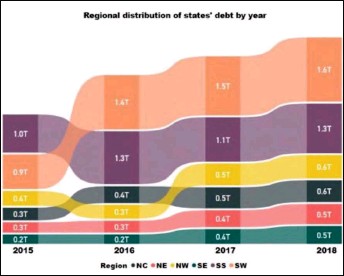
Regional distribution of debts
The regional distribution of debts aggregated by states in the chart showed the South West region as the most indebted region in the country. Generally, the highest amount of debts was recorded in 2018 with N1.6 trillion in the South West region; N1.3 trillion in the South-south, North West and North Central with N0.6 trillion each; while the states in the North East and South East are the least indebted regions with N0.5 trillion each.
Year on year from 2015, the debt gaps between the regions are: South West, N0.4 trillion from 2015 to 2016; N0.1 trillion from 2016 to 2017 and N0.1 trillion from 2017 to 2018; South-south, N0.3 trillion, -N0.2 trillion, N0.2 trillion; Northwest, -N0.1 trillion, N0.2 trillion, N0.1 trillion; North Central, N0.1 trillion each within the period and North East remained unchanged within the first period but increased by N0.1 trillion each in the successive periods.
On the other hand, the South East region which had remained the least indebted region only increased by N0.1 trillion each from 2016 to 2017, and 2017 to 2018.
The debts across the regions have increased because little or no efforts are put in by the states to clear them. Hence, there is need for a radical overhaul of the structure of governance with regards to how debts are utilised in states across the federation.

Join BusinessDay whatsapp Channel, to stay up to date
Open In Whatsapp