

The Dangote Refinery has projected about 600 tanker calls annually as it moves toward full production capacity of 650,000 barrels per day (bpd) and its expansion, a development that could reshape Nigeria’s refined products trade and maritime activity.
Officials at the refinery’s marine terminal said the facility has already handled roughly 800 vessels since operations began, describing the milestone as evidence of strong early operational performance.
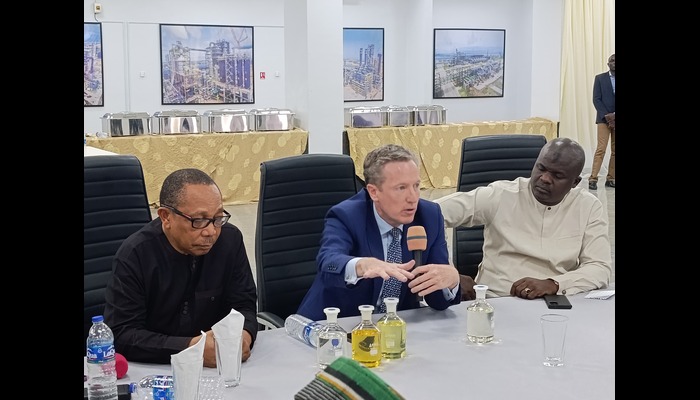
“So far we have done 800 tankers, which in itself is a big success story,” Satendra Rana, Head of Marine, Dangote Refinery and Petrochemical, said during a facility tour on Tuesday.
“Going forward, as the refinery ramps up to full capacity of 650,000 barrels per day, we expect about 600 tankers per year. This is a combination of crude and refined products, which we can easily handle,” he added.
The Dangote Petroleum Refinery officially commenced production on January 12, 2024, initially focusing on diesel and aviation fuel. The $20 billion facility began Premium Motor Spirit (PMS), also known as petrol, production in September 2024 and has been scaling up ever since.
Throughput drives vessel traffic
At full capacity, the refinery is expected to process 650,000 bpd of crude oil into petrol, diesel, jet fuel and other derivatives. The projected 600 tanker movements annually will include inbound crude carriers and outbound refined product tankers.
According to terminal operators, the infrastructure is designed to support high-frequency vessel turnaround.
“Our capacity is designed in such a manner that we can finish a ship normally within 24 hours. Very large vessels may take 36 hours, but normally every ship is turned around here within a day,” Rana said. “Even the vessel here now will sail out within 24 hours.”
Offshore design and deepwater advantage
The refinery operates five Single Point Mooring (SPM) buoys offshore, two dedicated to crude imports and three to product exports. The SPMs are located in deepwater zones.
“Why we have it offshore is because we get natural depth,” he explained. “If you bring it closer to land, there will be very deep dredging and maintenance all the time. That is very expensive. Here, there is no maintenance dredging.”
He added that the offshore configuration allows the terminal to receive some of the world’s largest crude carriers. “One ship brought in three million barrels, which is about twice Nigeria’s daily production. We regularly get two-million-barrel vessels.”
A potential trade shift
Officials described the projected 600 tanker calls annually as transformative for Nigeria’s energy logistics.
“This is a game changer, not only for Nigeria but for the entire African continent,” the terminal official said. “For a new refinery and terminal combination to start and handle 800 tankers within a short period is significant.”

Join BusinessDay whatsapp Channel, to stay up to date
Open In Whatsapp


