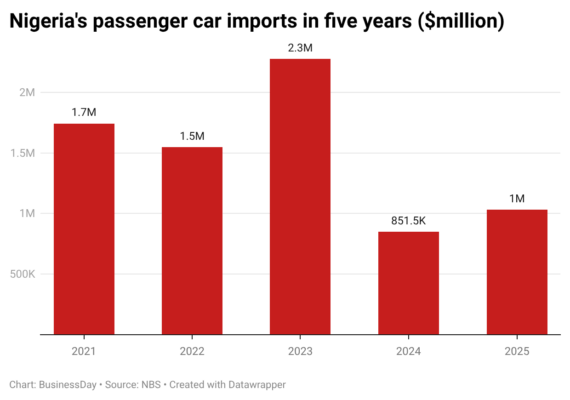
Nigeria’s passenger car imports have surged to $1.03 million, driven by rising vehicle and import costs and foreign exchange volatility, according to the latest National Bureau of Statistics (NBS) foreign trade report.

The data showed that passenger car imports increased by 21.38 percent from $851,535 recorded in 2024.

Automotive experts stated that the increase reflects the continued impact of foreign exchange volatility, a combination of higher vehicle prices globally and currency-related pressures locally that have significantly raised the cost of importing vehicles.

Read also: Cars going out-of-reach for working-class Nigerians

Promise Ndem, automotive tech and marketplace leader, said that over the past year, the weakening of the naira has significantly increased the landing cost of vehicles, noting that even in dollar terms, vehicle prices have risen due to global supply chain adjustments, inflation, and higher logistics costs.

Ndem added that while the import value has increased, actual unit volumes may not have grown at the same rate and, in some cases, may have declined or remained flat.

“The increase is largely cost-driven rather than demand-driven. Foreign exchange volatility has made it more expensive for importers to source vehicles.

“Importers are now pricing in risk, leading to higher retail prices and purchase of accident-titled vehicles, and many consumers have experienced reduced purchasing power, which limits real demand,” he said, noting that there is still underlying demand for vehicles in Nigeria. Still, it is currently suppressed and not expanding significantly.

In 2025, the naira traded at an average of N1,518.9/$, up from N1,479.68/$ in 2024, highlighting the continued weakness of the local currency and its impact on import costs.

Ndem added that foreign exchange availability has also affected car imports through limited access to FX at official windows, forcing many importers to rely on the parallel market at higher rates, increased cost of capital, as financing vehicle imports has become more expensive due to risk, and reduced inventory turnover, as dealers become more cautious about stocking vehicles.

Read also: NADDC pushes automotive industry bill to stimulate investment

Car import values have fluctuated in recent years, rising to $2.27 million in 2023 before dipping in 2024 amid FX scarcity and high import costs.

“Recent policy changes aimed at unifying exchange rates and improving FX liquidity are positive in the long term. However, in the short term, they have increased price discovery volatility, led to temporary spikes in vehicle prices, and created uncertainty for importers and buyers,” Ndem said.

He added that until purchasing power improves and FX stabilises, growth in actual car ownership will likely remain constrained, despite rising import values.

Fawaz Abdul, autotech and fintech expert, said that the increase likely reflects a combination of factors, including higher vehicle and landing costs, a possible shift toward higher-value imports, and some recovery in importer activity as foreign exchange market conditions became relatively more structured and predictable.

“It is more likely a mix of elevated costs, changing import composition, and some improvement in trade activity. So while the market may be showing signs of recovery, the data alone does not yet prove a broad-based surge in actual consumer demand,” Abdul said.

Further analysis of the report showed Nigeria’s growing dependence on automotive imports, with imports of transport equipment rising to $4.3 million in 2025, up from $3.2 million in 2024.

Transport equipment imports in five years

The data showed that the bulk of imports came from passenger vehicles, spare parts, and industrial transport equipment.

Nigeria imported $1.74 million worth of industrial transport equipment in 2025, up from $1.08 million in 2024, while spare parts and accessories imports rose to $1.03 million in 2025, from $899,200 in 2024.

Juliet Onyema is a transport journalist who reports on Nigeria’s transport and automobile industry. She covers emerging Electric Vehicles (EVs), ranging from adoption to usage, automobile firms and transport policies which affect them, and also recurring trends affecting commuters’ mobility interstate and intrastate.

Join BusinessDay whatsapp Channel, to stay up to date

Open In Whatsapp