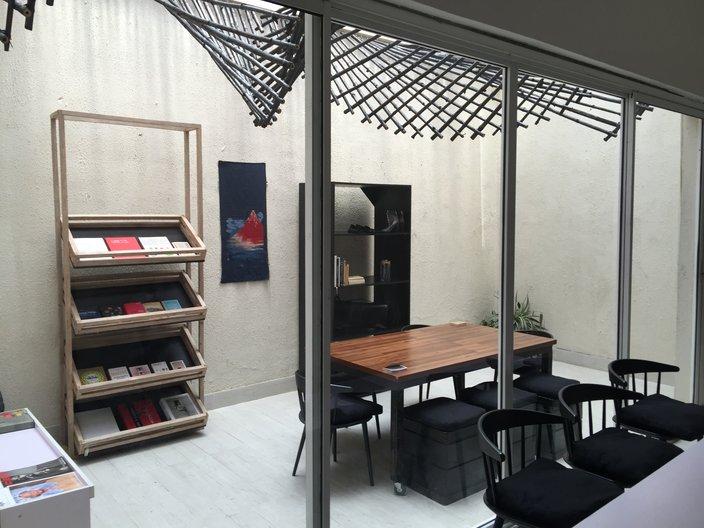
How would you like to make things, show them, and interact with other creative people in your city? The British Council Maker Library Network makes this and a lot more possible.  The network partners with existing spaces that combine a maker space, a library, and a gallery to provide an artistic defining experience for visitors free of charge.

The traditional method of making clothes in Nigeria skips the crucial step of pattern making. A tailor takes your measurement with a tape and transforms your fabric into a wearable piece. Pattern making adds an additional but crucial step in the sewing process. Last weekend, I did a hands-on 4-hour course on pattern making at Stranger, Lekki Phase 1, Lagos. Stranger is the most recent addition to the British Council’s Maker Library Network and one of the seven partnered libraries in Africa.

The workshop was led by Peter Chife, an energetic, unassuming young man. Following, a thirty minute discussion on fashion I agreed with Chife that for the most part fashion is something generally acceptable.  His enthusiasm and respect for the art of making patterns flowed in his words. Patterns enhance uniformity and accuracy in garment production. This is what clothing lines utilize when they doll out a collection that features an identical design in varied sizes and lengths. Pattern making makes this possible.

The table in our workspace looks like a day at an architectural firm. Our pattern is under construction. Pencils, erasers, french curves substituted with a flexible broom stick, steel rulers, fabric and paper scissors, pins, brown paper, chalk and a white calico fabric. Chife explains his preferred order of importance when making female garments. The skirt comes first, then the bodice, and by choice not compulsory are the sleeves. We are going to make a straight cut midi-skirt.

My measurements are used and the accurate method of taking measurements explained. Measure in front of a mirror; Wiggle the hips and wait for the tape to settle on the roundest part; Use your natural waist measurement; Hip lengths vary from 6 to 8 inches even without measuring with a tape. As Chife rules line after line, accounting for curves with broken lines and etching the corners of the skirt ever so lightly, he says, “Most tailors that see me in the process of pattern making have no idea what I am doing until the end.” I am no tailor, but I am hanging in there, performing calculations that require me to divide my measurements into two, so we can sketch out a half pattern on the brown paper.

What initially starts out as two disjointed rectangular boxes starts to take form when we draw a raised arc for the waist line above the hip length.  V-patterns are drawn in the middle of the boxes for what will become darts. Each measurement represented by drawn lines is labeled- Center back; Center front; Side seams; Hem line. I marvel at the 2D construction we have laid out on the table. It is beautiful. “Never cut from this main sheet”, Chife cautions. “It is your treasured master sheet.” So we trace. The back is transferred to a brown paper, and the front to another. We draw the lines and curves on the calico fabric, add sewing allowance, and cut the pieces of the skirt. The front is cut on fold in one piece and the back is cut in two pieces. “Manage your fabric wisely, while cutting”, advises Chife. I struggle to contain my excitement about wearing my soon-to-be sewn skirt.

I walked into the Stranger maker space that Saturday eager to explore another creative outlet and learn something new. After the class, I am awash with the satisfaction of making something useful. I love it and add 10th September, Saturday’s Stranger Maker event to my calendar. Let us do this again.

Nigeria's leading finance and market intelligence news report. Also home to expert opinion and commentary on politics, sports, lifestyle, and more

Join BusinessDay whatsapp Channel, to stay up to date

Open In Whatsapp