Conservationists and faith leaders have warned of consequences in neglecting forests, land, and ecosystems, stressing that such action threatens national stability, as can be seen in worsening insecurity and climate disasters.

At the S.L. Edu Memorial Lecture in Lagos recently, Desmond Majekodunmi, chairman of the Lekki State Urban Forest and Animal Shelter Initiative, noted that environmental destruction inevitably returns as violence, poverty, and insecurity.

“What you sow is what you reap. Those who plunder the environment will face the repercussions,” he said, linking rising social unrest to deforestation and land misuse.

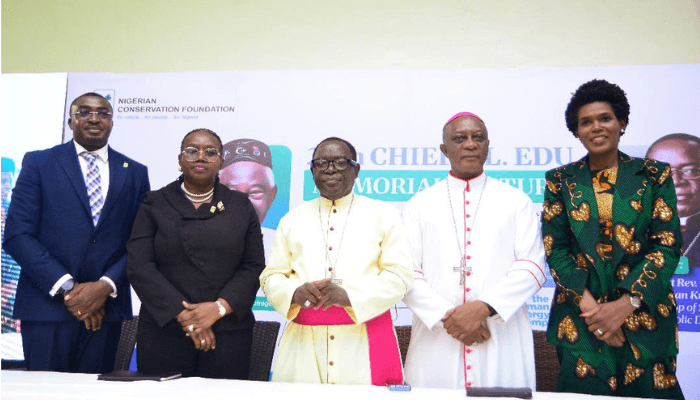
The lecture, now in its 24th edition, was organised by the Nigerian Conservation Foundation (NCF). It focused on the theme “To Have and To Hold: Faith and Care of the Environment,” and brought together religious leaders, policymakers, and environmental advocates to examine how moral failure has deepened Nigeria’s ecological crisis.

Delivering a goodwill message, the Metropolitan Archbishop of Lagos, Most Rev. Alfred Adewale Martins, said environmental care is no longer a choice, but a moral obligation. He stressed that environmental degradation and social injustice are inseparable, noting that the poor bear the brunt of flooding, pollution, and climate change. “Care for our common home is integral to faith and social justice,” he said.

Martins outlined steps taken by the Catholic Archdiocese of Lagos, including youth-led environmental networks, tree-planting campaigns, advocacy against single-use plastics and promotion of renewable energy. He said these efforts demonstrate how faith communities can shape values and behaviour beyond the pulpit.

In his keynote address, Bishop Matthew Hassan Kukah of the Catholic Diocese of Sokoto noted that environmental exploitation, driven by greed and weak governance, fuels conflict across Africa.

He argued that many disputes described as ethnic or religious are rooted in ecological injustice. “When land is taken, water poisoned and livelihoods destroyed, grievances accumulate, and violence follows,” Kukah said.

Kukah criticised unchecked capitalism and poor resource management, citing the Niger Delta as an example of how extraction without restoration devastates communities. He urged religious leaders to speak boldly against environmental crimes, describing them as violations of divine trust.

Chairman of NCF’s National Executive Council, Justice R.I.B. Adebiyi, said the memorial lecture honours the legacy of S.L. Edu, widely regarded as the father of conservation in Nigeria. He said Edu believed environmental protection was a moral responsibility rooted in faith, discipline and service.

Speakers agreed that Nigeria’s escalating floods, erosion, deforestation, and biodiversity loss demand urgent action anchored in ethics and restraint. They warned that without a renewed commitment “to have and to hold” the Earth in trust, environmental collapse would continue to undermine peace, livelihoods, and national cohesion.

Athekame Kenneth is a politics, economy, and finance reporter whose work is anchored in sharp investigative storytelling. He brings analytical depth to every piece, drawing on a strong academic foundation that includes a degree in Economics, an MBA in International Trade, and a minor in Petroleum Economics from Lagos State University, Ojo. His reporting blends rigorous research with a keen eye for hidden truths, delivering stories that illuminate power, policy, and the forces shaping everyday lives.

Join BusinessDay whatsapp Channel, to stay up to date

Open In Whatsapp