

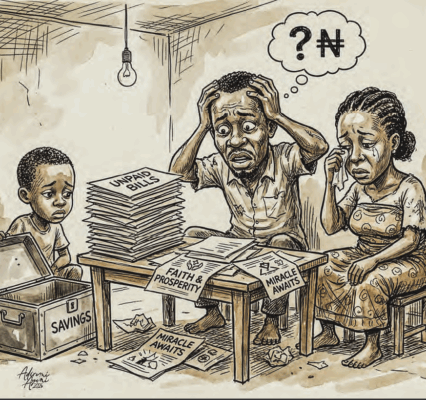
The exploitation of faith and religion for financial gain, coercion, and abuse has become a significant governance and social concern in Nigeria. Religious exploitation thrives in Nigeria because weak regulatory systems, economic vulnerability, and unchecked charismatic authority converge to create an accountability vacuum. In this environment, faith functions not only as a spiritual resource but also as an economic and psychological instrument that can be misused. While religion continues to serve as a powerful force for moral guidance, charity, and community cohesion, institutional fragility has enabled certain actors to weaponise belief for financial advantage, coercion, and, in some cases, criminal abuse.
One of the most visible tactics used to capture public loyalty is the staging or exaggeration of miracles to establish spiritual credibility and emotional dependence. Rather than dismissing genuine spiritual experiences, the concern here lies with orchestrated performances designed to manipulate trust. In several documented cases, fabricated healings and rehearsed testimonies have been presented as divine manifestations in order to attract followers and financial contributions.
A notable example is the case of Bishop Katung Jonas, the general overseer of The Living Stone Assembly International in Jos, Plateau State. As reported by the Economic and Financial Crimes Commission, he allegedly lured members into a Cooperative Society investment scheme promising a 10 percent monthly dividend, even advertising it on Plateau Radio Television Corporation immediately after his sermons. Approximately N178 million was reportedly invested, yet no returns were delivered. There are several other cases, including that of a Prophet Jeremiah who was reported to be ‘selling’ tickets called ‘Gate pass’ to heaven for N500,000 each, while another Pastor Abraham had a lesser fee of N310,000 for visa to heaven; an extreme version was the church leader who said he had plots of land in heaven for sale to his members.
The arrest of Oladele Ayuba, an Islamic cleric in Ondo State accused of defrauding a follower of four million naira under the pretext of special prayers, illustrates how such manipulation transcends religious boundaries. Similarly, the case of Bose Olasunkanmi, who confessed to being paid to stage fake healing videos across multiple churches in Lagos, Port Harcourt, and Abakaliki, reveals how religious performances can be deliberately engineered for financial gain.
Another dimension of this exploitation involves the distortion of doctrinal teachings. Giving out money, property, and other possessions is a recognised aspect of many faith traditions and is not inherently fraudulent. However, abuse arises when leaders deliberately manipulate doctrines of generosity, sacrifice, and tithing to pressure followers into excessive or coerced giving. By selectively invoking some scripture passages, some church leaders portray financial contributions as compulsory guarantees of divine favour or protection from curses. In several cases, members are encouraged to sell personal assets or incur debts under spiritual intimidation.
Beyond financial exploitation, unchecked spiritual authority can create environments where other forms of abuse flourish. In Lagos, Islamic cleric Alani Rafiu was sentenced to life imprisonment for raping a 14-year-old girl inside a mosque in Ikotun. Such cases underscore how reverence for religious authority, when shielded from scrutiny, can delay accountability and silence victims. The issue, therefore, is not theology but power — specifically, power exercised without oversight.
The rise of social media has significantly amplified these vulnerabilities. Digital platforms enable charismatic figures to cultivate persuasive personas, circulate miracle narratives, and solicit financial “seeds” from audiences far beyond physical congregations. Emotional storytelling, edited videos, and cherry-picked scriptures can rapidly build trust without institutional verification. In a context marked by unemployment, inflation, and economic hardship, promises of supernatural financial breakthrough or healing resonate deeply with vulnerable populations seeking hope. Social media thus expands both reach and risk.
The consequences are severe and multidimensional. Victims may suffer financial ruin, psychological trauma, and social isolation. Families can be fractured by excessive financial commitments to religious schemes. At a broader level, repeated scandals erode public trust in religious institutions, damaging even ethical leaders committed to genuine service. When accountability mechanisms fail, faith communities risk reputational decline that affects societal cohesion.
Addressing this problem requires structural, not purely moral, responses. Financial activities conducted under religious platforms should comply with national regulatory standards, particularly when investment schemes or profit promises are involved. Transparent financial reporting, independent auditing of large religious organisations, and clear separation between spiritual services and financial ventures would significantly reduce abuse. Religious exemptions should not translate into financial opacity.
Religious institutions themselves must also strengthen internal accountability. Interfaith councils, denominational bodies, and umbrella associations can develop enforceable ethical codes, disciplinary frameworks, and transparent complaint mechanisms. Media literacy initiatives within congregations can empower followers to critically evaluate extraordinary claims without undermining sincere belief.
Government enforcement must be consistent and impartial. Existing laws on fraud, sexual abuse, and financial misconduct should apply equally regardless of religious status. Secure reporting channels and victim protection frameworks are essential to ensure that those harmed are not retraumatised or silenced by social pressure.
Religion retains immense potential as a catalyst for compassion, justice, and social transformation. The challenge lies not in faith itself, but in the accountability vacuum created when regulatory weakness, economic desperation, and charismatic authority intersect. Protecting the integrity of religious expression requires closing that vacuum by ensuring that devotion remains sacred while exploitation is decisively confronted.

Join BusinessDay whatsapp Channel, to stay up to date
Open In Whatsapp


