Lagos State’s decision to move its individual annual income tax return deadline from March 31 to April 14, 2026 has drawn attention not because filing is unusual, but because the extension was explicit, public and tied to a clearly digital compliance push through the LIRS eTax channel. The bigger national picture is that resident tax filing is now increasingly online across Nigeria, yet still far from uniform in execution. Under Nigeria’s 2025 tax reform architecture, states remain central to administering personal income tax for most residents, while the Joint Revenue Board coordinates reforms and the new national Tax ID portal went live on January 1, 2026. That means the legal obligation is broadly shared, but the taxpayer experience still depends heavily on where one lives. In practice, what Lagos has exposed is not an isolated event; it is the uneven maturity of digital tax administration across the federation.
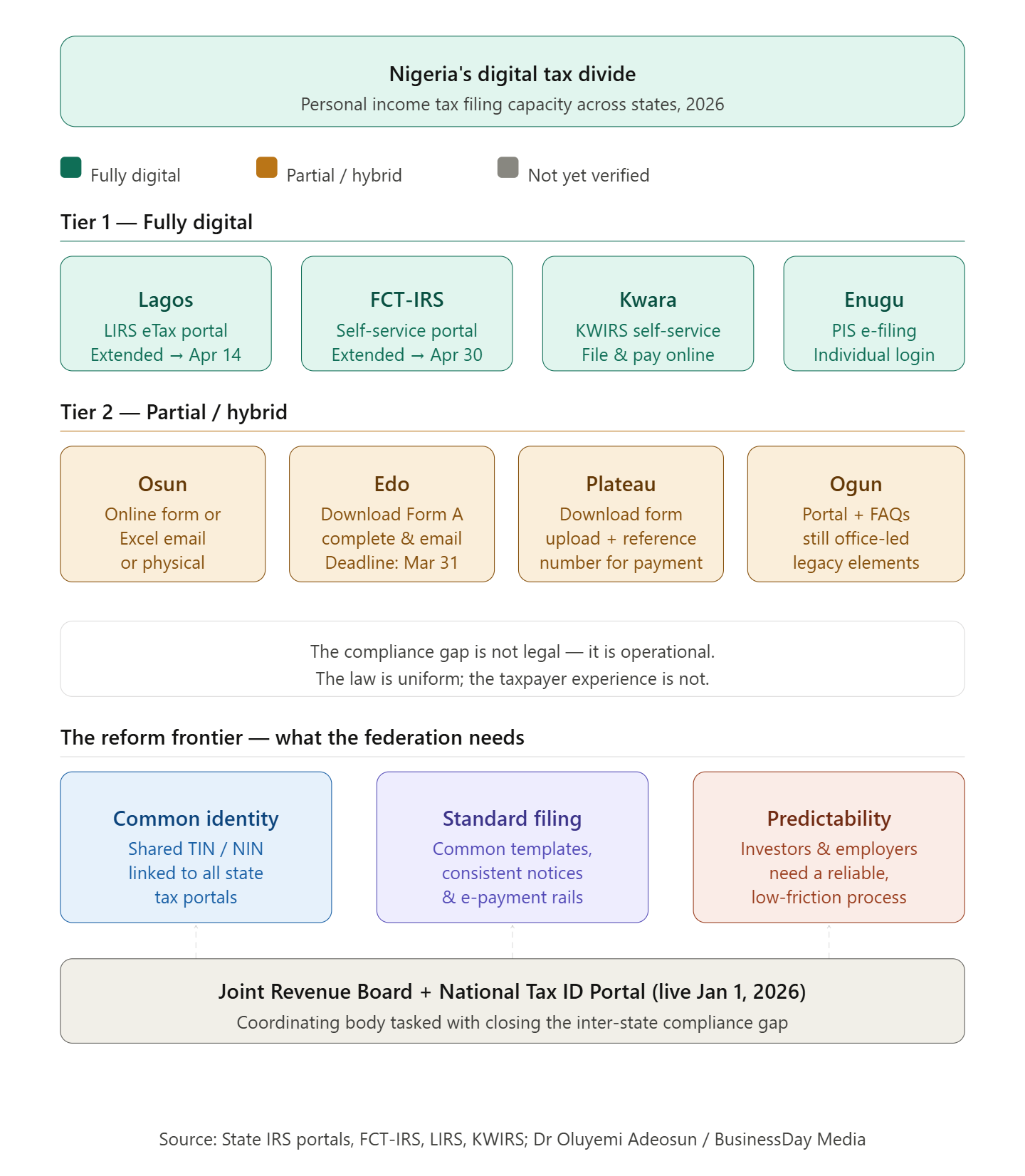
The Rule Is Common, the Practice Is Not
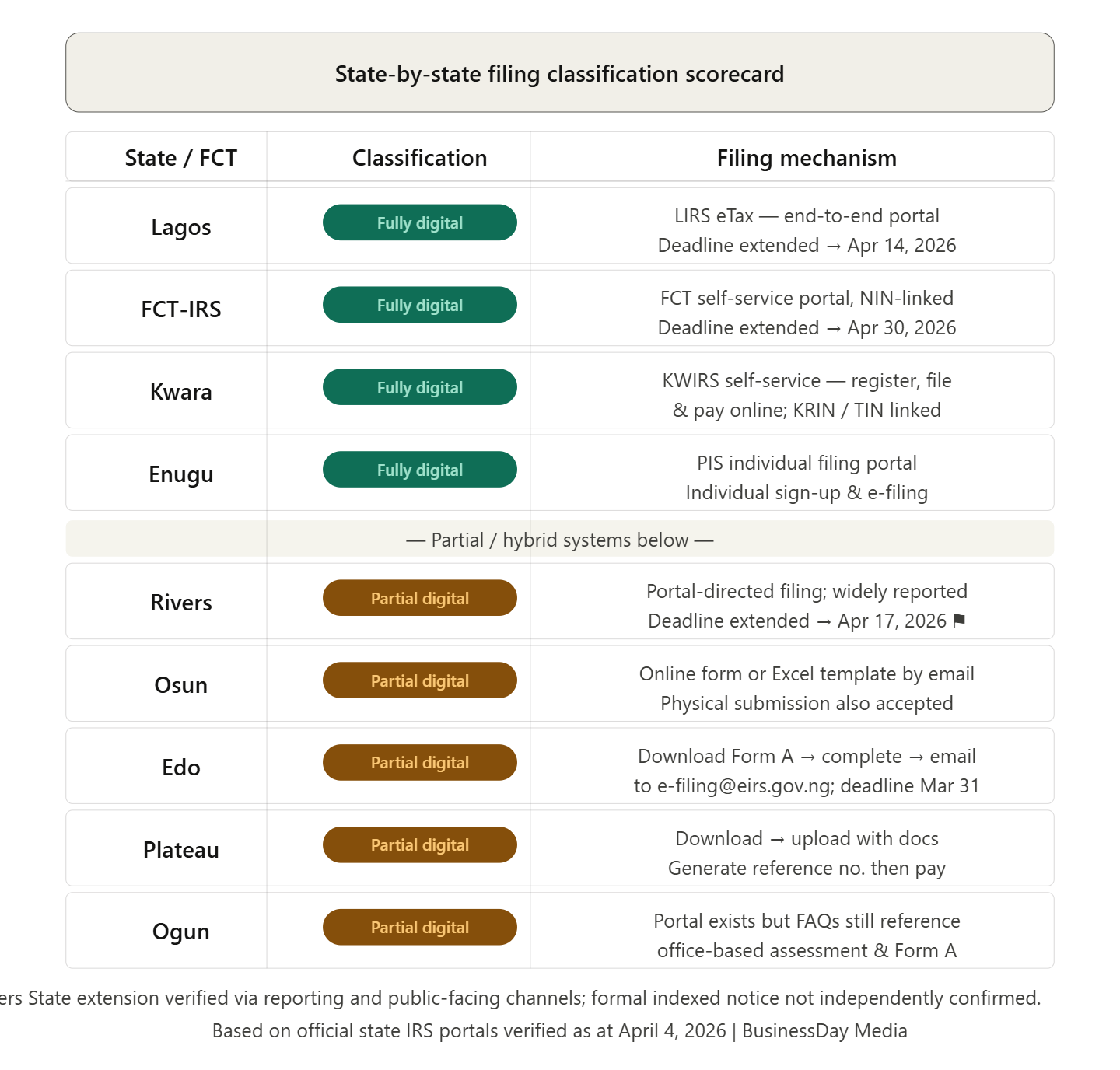
Across the other 35 states and the FCT, the broad pattern is that residents are still expected to file annual returns with their relevant state tax authority, but the process ranges from fully digital self-service to hybrid systems that still depend on downloadable forms, email submissions or in-person assessment support. FCT-IRS has officially extended its own individual filing deadline by one month to April 30, 2026 and insists that filing be done through its tax portal. Edo, by contrast, publicly retained the March 31, 2026 deadline, but shifted taxpayers into an electronic system in which Form A is downloaded, completed with supporting documents and then submitted by email. Osun provides an online annual returns submission path and a dedicated individual annual returns page, while Kwara’s self-service portal explicitly allows users to register, obtain identification details and file annual tax returns online.
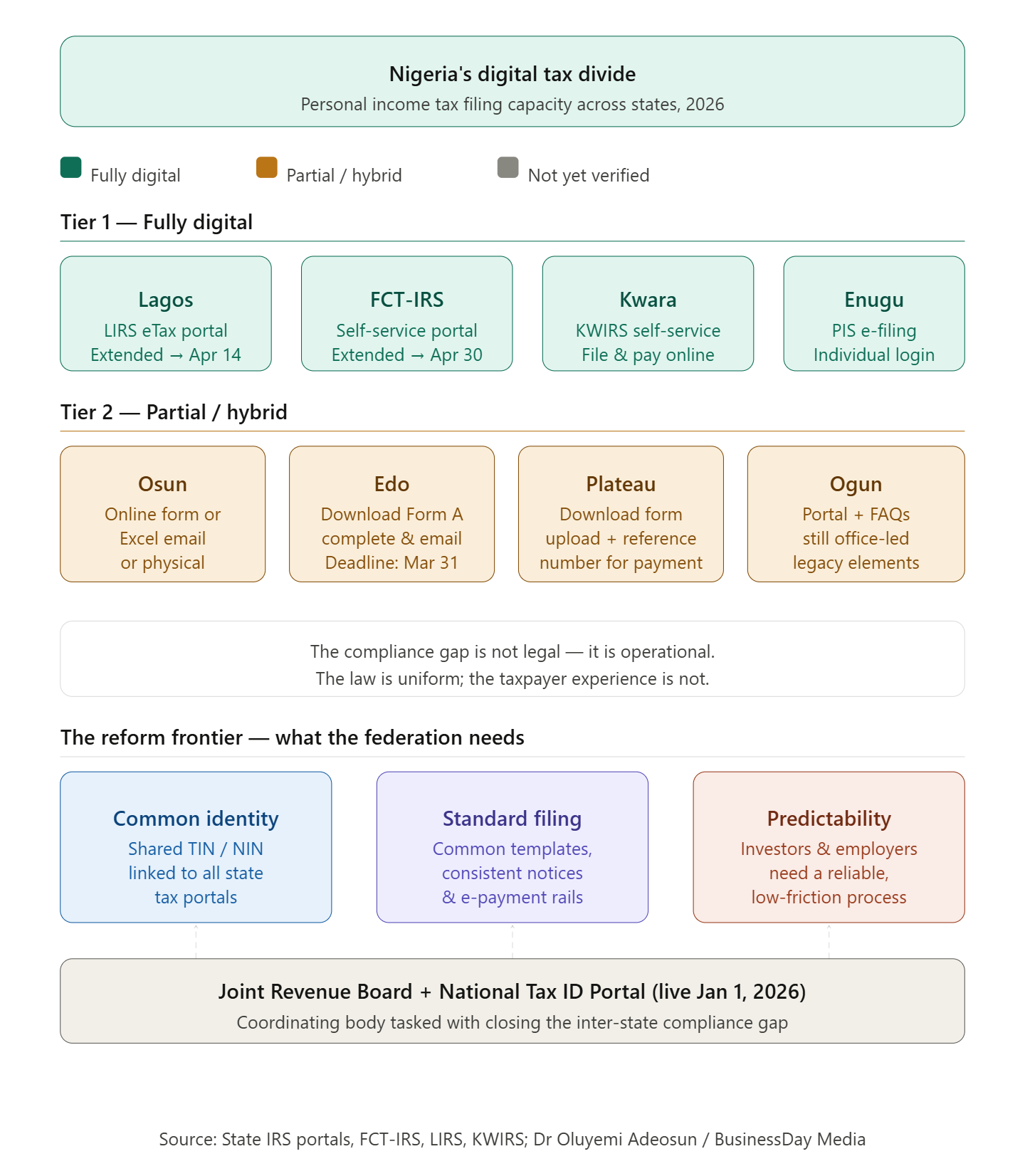
What Residents Are Actually Being Asked To Do
For residents, the practical filing process is converging around a familiar sequence even where the interface differs. First, the taxpayer must identify the correct authority by state of residence. Next comes onboarding or verification, increasingly through a TIN or the new nationally linked tax identification ecosystem. Then follows return preparation: income from employment, business or profession, relief claims, tax computation, and in some cases audited or supporting financial statements for trade income. FCT-IRS says taxpayers should use its portal and ensure key onboarding data such as NIN, phone number and address are correctly stated. Edo requires taxpayers to download and complete Self-Assessment Form A, attach evidence of total income, reliefs, tax computation, taxpayer ID and evidence of payment, and then email the package. Kwara presents a cleaner portal model, where sign-up, profile update, KRIN or TIN linkage, filing and payment all sit in one self-service flow.
The States Are Moving at Different Digital Speeds
The strongest reason for the differences in approach is administrative capacity, not legal philosophy. Some states have built true taxpayer-facing platforms; others have digitised only parts of the workflow. Enugu’s platform shows structured e-filing and individual login capability. Ogun presents a more transitional model, offering self-service pages, downloadable return forms and a process that still leans on assessment authorities and bank payment evidence. Osun similarly blends portal infrastructure with templates and submissions tied to official channels, while Edo’s system reflects a digital shift that still carries a document-heavy compliance culture. These differences matter economically because compliance costs rise when filing is fragmented. A salaried worker in a state with single-sign-on digital filing faces a lower compliance burden than a professional in a state where forms must be downloaded, completed manually, emailed, validated and then followed up physically. The tax law may be national in spirit, but the user journey remains distinctly subnational.
Extensions Are the Exception, Not Yet the Standard
What can be verified publicly as of April 4, 2026 is that Lagos and the FCT have formally announced extensions for individual annual returns, to April 14 and April 30 respectively. Rivers has also been widely reported as extending its filing deadline to April 17, 2026 and directing taxpayers to its official portal, although that notice was easier to verify through reporting and the service’s public-facing channels than through a clearly indexed formal notice page. Edo publicly urged compliance by the original March 31 date, and several other state sites reviewed show portal access or filing guidance without a similarly prominent extension notice. That is an important distinction. The absence of a visible extension should not be read as non-enforcement; in many states it more likely means the statutory date still stands unless the local authority says otherwise. In a federation with uneven website quality, silence is not the same thing as leniency.
Why This Matters for Investors and Employers
For investors and organised private sector employers, the significance goes beyond compliance mechanics. Where filing systems are coherent, governments receive cleaner data, faster remittances and stronger audit trails. That improves revenue predictability and lowers the informal friction that often discourages business formalisation. Where systems are clunky, tax authorities lose time reconciling records, employers face higher payroll administration costs, and residents are more likely to delay or under-file. Ogun’s FAQs still reflect an older, office-driven compliance model in parts of the process, even as the state also offers digital tools. By contrast, FCT-IRS and Kwara present a clearer self-service logic, and Edo’s current approach shows a state in transition from paper-era administration to electronic compliance. The policy lesson is simple: the design of the filing channel is now part of the investment climate. A tax authority’s portal architecture increasingly signals the seriousness of the state’s broader economic governance.
The Real Reform Task Ahead
Nigeria does not need 37 entirely different personal income tax experiences. It needs a common minimum standard with room for local innovation. The Joint Revenue Board’s coordinating role and the new Tax ID portal point in that direction, but the evidence from state portals suggests the country is still in an uneven transition. Some tax authorities now offer end-to-end digital filing; some provide partial automation; others still wrap digital front ends around legacy back-office processes. The result is a compliance map that is legally unified but operationally patchy. For governments, the next reform frontier is interoperability: common taxpayer identity, shared data standards, standard filing templates, consistent public notices and reliable electronic payment confirmation. For residents, the priority is clarity. For investors, it is predictability. For employers, it is a reduction in administrative duplication. Lagos has started an important conversation, but the bigger national challenge is not whether filing is online; it is whether online filing is truly simple, credible and portable across Nigeria.
Conclusion
The most defensible conclusion from the available official evidence is that the other 35 states and the FCT are not abandoning annual resident tax returns; they are administering the same obligation through very different operational models. FCT is fully portal-led and has extended the deadline. Lagos is portal-led and granted a two-week extension. Edo requires electronic filing but through downloaded forms and email submission. Osun and Ogun show hybrid systems that combine online access with templates, official links and in some instances office-based assessment support. Kwara and Enugu point more clearly toward self-service digital administration. The differences are therefore best explained by the varying depth of digital capacity, website maturity, taxpayer database quality and administrative readiness across states, not by a major divergence in tax policy itself. That is why the next phase of reform should focus less on announcing deadlines and more on standardising the citizen experience of filing, payment, record verification and dispute resolution.

Join BusinessDay whatsapp Channel, to stay up to date
Open In Whatsapp