Few geographical locations illustrate the fragility of global trade as clearly as the Strait of Hormuz. This narrow maritime corridor has become one of the most strategic arteries of the global economy, carrying roughly a quarter of the world’s seaborne oil trade along with significant flows of liquefied natural gas and fertilizers. Any disruption here reverberates across continents, influencing everything from shipping costs to the price of bread in distant markets.
Recent tensions in the region have sharply disrupted maritime activity, triggering immediate responses across commodity markets and logistics networks. Oil prices have surged past $90 per barrel while shipping flows through the Strait have collapsed dramatically. The ripple effects extend well beyond energy markets, touching transport costs, insurance premiums and food supply chains. For many economies, particularly in the developing world, the implications go far beyond geopolitics and enter the everyday realities of inflation, household spending and economic stability.
Read also: Tinubu reveals economy was too broke to pay airline debts

The Fragility of Global Supply Chains
The Strait’s importance becomes clearer when viewed through the scale of trade that depends on it. In 2024 alone, roughly 20 million barrels of oil per day passed through the passage, representing about 25 percent of global seaborne oil trade. A large share of liquefied natural gas shipments also depends on the route, particularly those destined for energy-hungry economies in Asia. The sudden slowdown of vessel movement through the Strait illustrates how quickly geopolitical tensions can transform logistics networks that normally operate with remarkable efficiency.
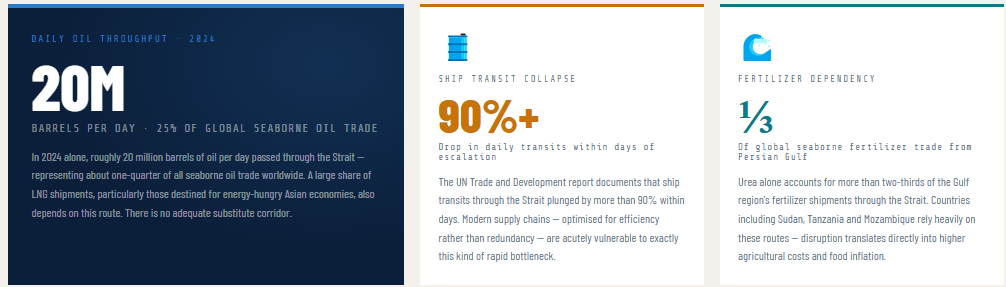
The UN Trade and Development report shows that daily ship transits through the Strait plunged by more than 90 percent within days of the escalation. Such a collapse is not merely a maritime statistic; it signals a bottleneck capable of destabilizing global commodity flows. Modern supply chains, optimised for efficiency rather than redundancy, are particularly vulnerable to these disruptions. The pandemic revealed similar weaknesses, and the war in Ukraine reinforced them. The Strait of Hormuz now offers another reminder that global trade remains heavily dependent on a handful of critical corridors.
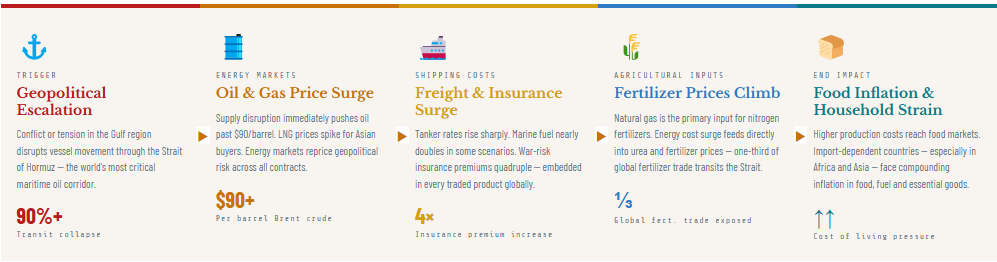
When Energy Shocks Become Food Shocks
Energy shocks rarely remain confined to energy markets. History repeatedly shows that rising oil and gas prices tend to cascade through the broader economy, eventually reaching food markets and household budgets. Fertilizer production, for instance, is closely tied to natural gas prices, meaning that higher energy costs quickly translate into more expensive agricultural inputs. When fertilizer prices climb, farmers reduce usage or face higher production costs, which ultimately feed into food prices.
The report highlights this relationship clearly, showing that surges in oil prices have historically coincided with increases in global food price indices. The link is even stronger in fertilizer markets, where nitrogen-based fertilizers move almost in lockstep with natural gas prices. In effect, a conflict affecting an oil shipping route can end up reshaping agricultural costs thousands of kilometres away. This interconnectedness is one of the defining features of modern globalisation, where the boundaries between energy security, food security and economic stability have become increasingly blurred.
Read also: Generator economy shaken by diesel price surge
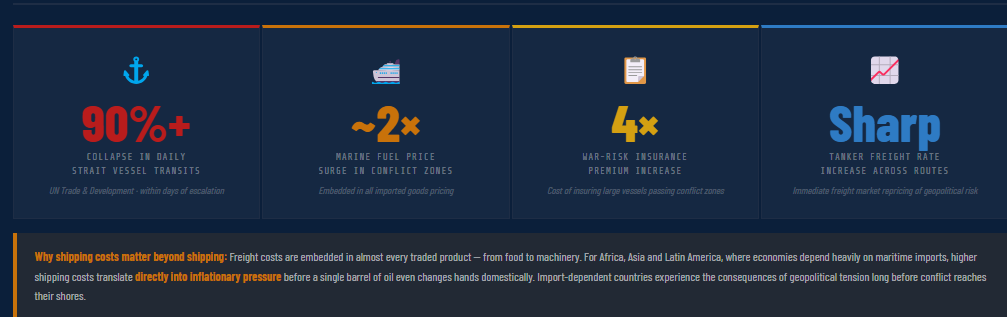
Shipping Costs: The Hidden Transmission Channel
Another dimension of the crisis lies in the rapid escalation of shipping costs. As geopolitical risk increases, freight markets respond immediately. Tanker freight rates have risen sharply while marine fuel prices have surged close to doubling in some cases. War-risk insurance premiums have also increased dramatically, in some scenarios quadrupling the cost of insuring large vessels passing through conflict zones. These developments matter because shipping costs are embedded in almost every traded product. Higher freight costs raise the price of imported goods, from food to machinery. For economies heavily dependent on maritime trade, such increases translate directly into inflationary pressure. Import-dependent countries in Africa, Asia and parts of Latin America therefore experience the consequences of geopolitical tension long before the conflict itself reaches their shores.
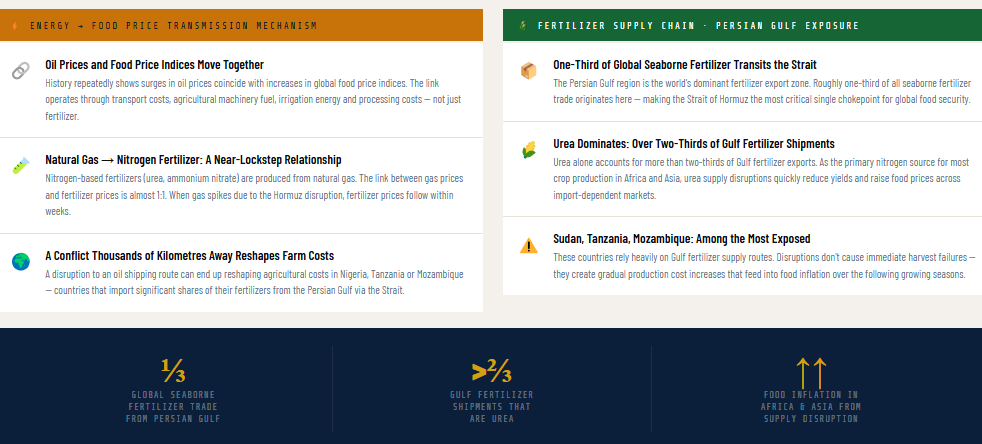
Fertilizer Supply and the Agricultural Risk
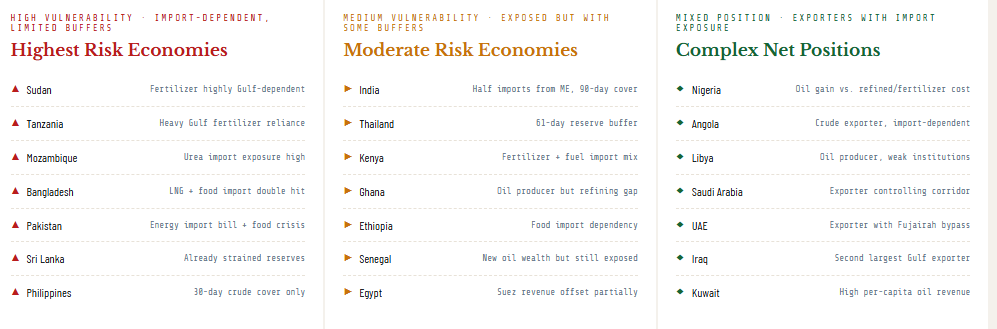
One of the most underappreciated aspects of the Strait’s disruption is its impact on fertilizer markets. Roughly one-third of global seaborne fertilizer trade originates from the Persian Gulf region and passes through the Strait. Urea alone accounts for more than two-thirds of these shipments, making the corridor particularly important for global agriculture. For developing economies, this dependency creates serious vulnerabilities. Many low-income countries import a significant share of their fertilizers from the Gulf region. Countries such as Sudan, Tanzania and Mozambique rely heavily on these supply routes, meaning disruptions could quickly reduce fertilizer availability and raise prices for farmers. The consequences are not immediate harvest failures but gradual increases in production costs that eventually feed into food inflation. In regions already grappling with food insecurity, even modest increases in fertilizer costs can have outsized socio-economic consequences.
Debt, Inflation and the Developing World
For developing economies, the timing of such shocks could hardly be worse. Many countries are already grappling with high debt service obligations, limited fiscal space and constrained access to global capital markets. Rising energy prices, higher freight costs and more expensive food imports therefore compound existing macroeconomic vulnerabilities. In this environment, governments face difficult policy trade-offs. Subsidizing energy or food prices can help protect households but strains public finances. Allowing prices to rise may preserve fiscal stability but risks social unrest and political pressure. The balance between these priorities is rarely easy to maintain, particularly in economies where a large share of household income is spent on food and transportation.
Read also: Why the rich get richer and the poor get poorer in Nigeria manipulative faith economy
What This Means for Nigeria and Sub-Saharan Africa
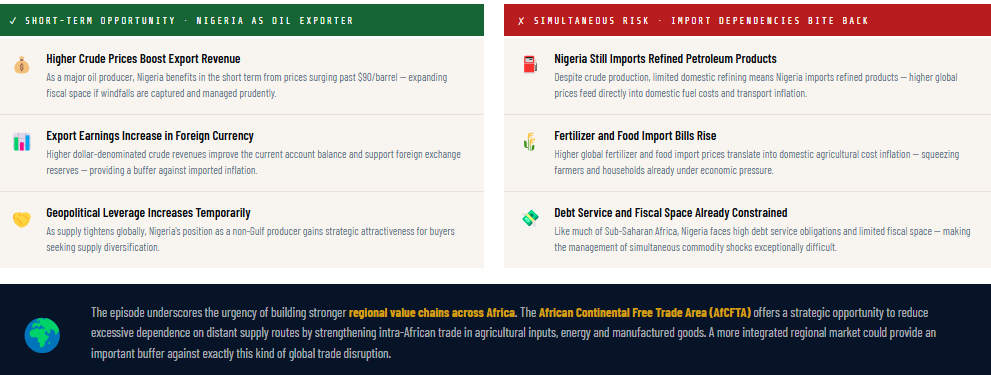
For Nigeria and the wider Sub-Saharan African region, the implications are complex. As a major oil exporter, Nigeria might benefit in the short term from higher crude prices. Yet the country also imports refined petroleum products, fertilizers and large volumes of food, meaning higher global prices can still translate into domestic inflation. The net economic outcome therefore depends on how effectively export revenues are managed and how resilient domestic supply chains prove to be.
The episode also underscores the importance of building stronger regional value chains across Africa. The African Continental Free Trade Area offers an opportunity to reduce excessive dependence on distant supply routes by strengthening intra-African trade in agricultural inputs, energy and manufactured goods. A more integrated regional market could provide an important buffer against global trade disruptions.
Strategic Lessons for the Future
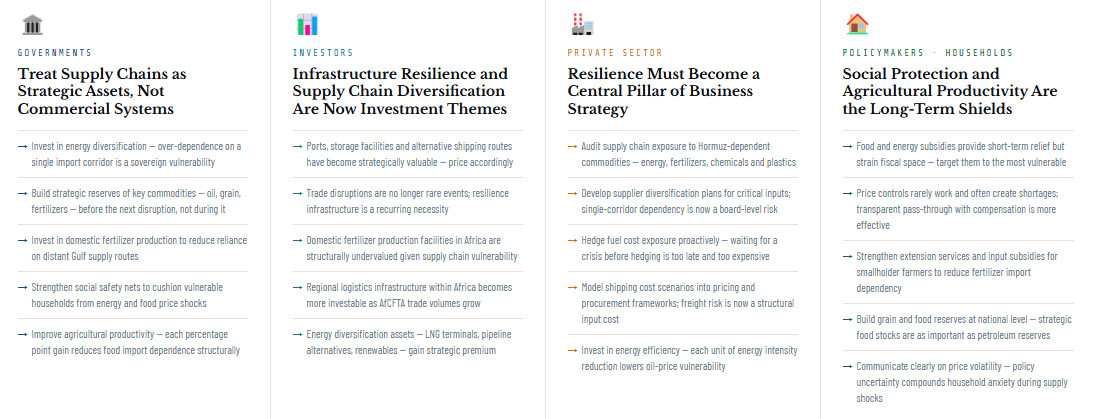
Several lessons emerge from this episode. Governments must treat critical supply chains as strategic assets rather than purely commercial systems. Investments in energy diversification, fertilizer production and regional logistics infrastructure can reduce vulnerability to external shocks. Strategic reserves of key commodities may also become more important as geopolitical risks intensify.
For investors, the situation highlights the growing value of infrastructure resilience and supply chain diversification. Ports, storage facilities and alternative shipping routes will become increasingly strategic assets in a world where trade disruptions are no longer rare events but recurring features of the global economy.
Households, meanwhile, are likely to face continued volatility in energy and food prices. Policymakers must therefore focus on strengthening social safety nets and improving agricultural productivity to cushion vulnerable populations from external shocks.
A World of Interconnected Risks
Ultimately, the disruption of a single maritime passage reveals a broader truth about the global economy. In a tightly interconnected world, local conflicts can quickly evolve into global economic shocks. The Strait of Hormuz is merely one example of how geography, geopolitics and globalisation intersect to shape economic outcomes.
The lesson for policymakers and investors alike is that resilience must become a central pillar of economic strategy. Efficiency remains important, but a system optimized only for efficiency can quickly unravel when confronted with geopolitical stress. Building redundancy, diversification and institutional strength may therefore be one of the most important economic priorities of the decade ahead.

Join BusinessDay whatsapp Channel, to stay up to date
Open In Whatsapp