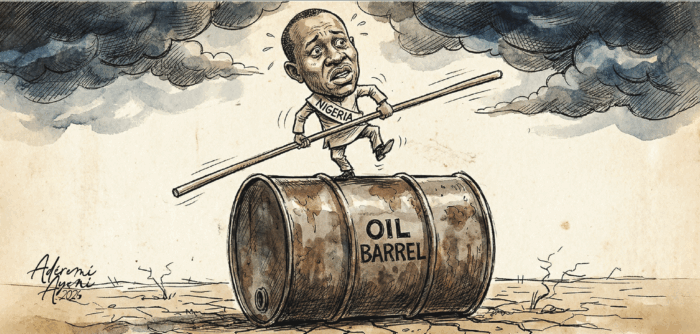
Nigeria’s economy can no longer depend on a single product. And it should not, as has often been repeatedly stated by several persons and institutions that mean well for the country. The nation cannot depend on oil alone.
For decades, crude oil has dominated Nigeria’s export earnings and foreign exchange inflows, crowding out other productive sectors and exposing the economy to repeated external shocks. As a result, fluctuations in global oil prices continue to place severe pressure on the naira and government finances.
However even today, oil continues to dominate Nigeria’s export composition, constituting the majority share of export earnings, while non-oil sectors account for a significantly smaller portion. Recent data indicate that oil exports made up around 56% of total export value in Q3 2025, with non-oil exports accounting for roughly 12 – 14 per cent of total export value in the same period. Within this narrow non-oil slice, cocoa has emerged as one of the leading contributors, while manufacturing and other goods continue to lag far behind.
This imbalance matters because the crude oil boom, while lucrative, has failed to translate into broad-based economic resilience. According to Statista estimates, the oil sector contributed about 5–6 percent of GDP in 2024, yet generated the bulk of foreign exchange earnings. This disconnect reflects a classic Dutch disease dynamic: easy oil revenue has distorted incentives across the economy, undermining agriculture, mining and manufacturing, and leaving Nigeria vulnerable to swings in global energy prices.
Nigeria’s agricultural and mineral potential once underpinned its economy. In the 1950s and 1960s, the country thrived on cocoa, groundnuts, palm oil and other export crops. Historical records confirm that cocoa was Nigeria’s dominant foreign exchange earner from the 1950s through the early 1970s, financing infrastructure and regional development, particularly in the Western Region. Together with groundnuts, palm produce and mineral exports, agriculture formed the backbone of national output.
today, cocoa is again showing promise. Agricultural export revenues have risen sharply in recent years, with Q1 2025 exports estimated at about N1.7 trillion, driven largely by cocoa, which accounted for over N1.2 trillion of that total. Non-oil exports grew by nearly 20 percent in the first half of 2025, reaching approximately $3.2 billion, led by cocoa, urea fertiliser and cashew nuts. This resurgence points to latent capacity in sectors long neglected. Nigeria is now among the world’s major cocoa producers and could better harness this advantage by expanding processing, branding and value addition rather than exporting raw beans alone.
The mining sector offers another underutilised opportunity for foreign exchange. Nigeria possesses rich deposits of gold, lithium, iron ore, zinc and limestone, yet mining contributes less than 5 per cent of GDP. Recent cooperation agreements, including partnerships aimed at geological mapping and sector reform, signal renewed interest, but sustained policy clarity, infrastructure investment and regulatory credibility are essential if mining is to move from the margins to the mainstream.
Tourism also remains largely untapped despite Nigeria’s cultural, historical and ecological assets. Other African countries illustrate what is possible. Egypt, for instance, has leveraged tourism into a major foreign exchange earner, attracting millions of visitors annually and converting heritage into hard currency. Angola’s emerging focus on ecotourism, though still developing, also highlights alternative pathways for resource-rich economies seeking diversification.
Comparative cases reinforce this lesson. Algeria, while still dependent on hydrocarbons, complements oil and gas exports with petrochemicals and light manufacturing. South Africa’s export base is dominated by mining products and manufactured goods rather than oil, demonstrating how resource wealth can be translated into a more resilient external earnings structure.
Recent data from the National Bureau of Statistics indicate that Nigeria’s economy grew by nearly 4 per cent in Q3 2025, driven largely by services and agriculture even as oil production recovered. This suggests that diversification can sustain growth if backed by credible policy and execution. However, ambition must be matched with reform: incentive frameworks that reward production rather than rent-seeking, infrastructure investment that lowers the cost of doing business, and regulatory certainty that attracts long-term capital into non-oil sectors.
Countries that diversify successfully align policy tools with clear comparative advantages. Expanding cocoa processing capacity and agro-industrial clusters could transform Nigeria’s agricultural export profile, retaining more value domestically while strengthening foreign exchange resilience. Strategic investment in logistics, quality standards and access to finance will be indispensable.
Similarly, a revitalised mining agenda requires more than exploration agreements. Transparent licensing, environmental safeguards and value-chain infrastructure are needed to ensure mineral extraction translates into export earnings and jobs. Tourism growth, meanwhile, depends on improved security, transport infrastructure and international marketing to position Nigeria as a viable global destination.
Continued reliance on oil exposes Nigeria to recurring boom-and-bust cycles that undermine fiscal stability and public confidence. Diversification is not an abstract ideal; it is a strategic imperative for currency stability, employment generation and poverty reduction in a country of over 200 million people.
Nigeria must move beyond rhetoric to decisive action. The path to a diversified foreign exchange base runs through agriculture, mining, manufacturing and services. Without a shift in policy and practice, the next global oil shock will again leave the economy exposed. The resources, workforce and markets exist. What remains is the political will to harness them. Diversification is not only an economic necessity but a national promise: a more stable currency, fuller factory floors, productive farms and vibrant service sectors can redefine Nigeria’s place in the global economy.
Join BusinessDay whatsapp Channel, to stay up to date
Open In Whatsapp