


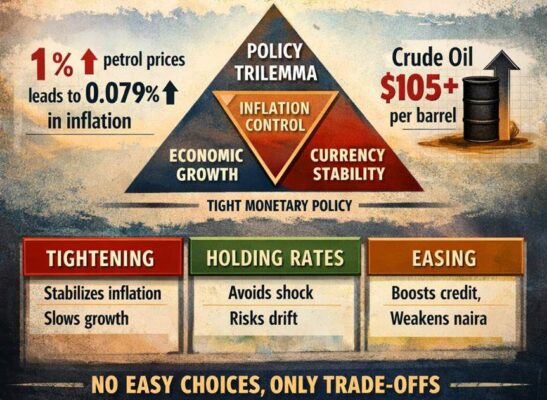
Nigeria’s Central Bank could face a potential tightening dilemma, where every choice carries a measurable cost, driven by a policy trilemma that requires balancing inflation control, economic growth, and currency stability as global shocks intensify.
What had seemed like a steady disinflation path over the past 11 months risks disruption if fuel prices continue to climb, triggered by the ongoing US–Iran oil tensions. These increases are already feeding directly into transportation and food costs, threatening to stall or even reverse recent gains.
Bismarck Rewane, economist and Ceo of Financial Derivatives Company (FDC), warned at a Lagos economic summit that inflation could rise further if current trends persist. “Every 1 percent increase in petrol prices leads to a 0.079 percent rise in transport costs and inflation,” he noted, highlighting the direct pass-through from energy markets to household budgets. Diesel prices are up sharply, petrol prices even more so, while transport and logistics costs have surged, tightening the room for policy manoeuvre.
Supply-side pressures limit CBN tools
The inflationary challenge is driven largely by supply-side factors: energy shortages, constrained refining capacity, currency volatility, and distribution inefficiencies. Interest rate adjustments alone cannot resolve these structural constraints, though monetary policy remains the key lever for anchoring expectations.
Tightening further signals commitment to price stability, but at the cost of slowing investment and straining firms already contending with high energy prices. Muda Yusuf, Ceo of the Centre for the Promotion of Private Enterprise, cautions that aggressive tightening in a supply-driven environment could weaken the real sector without addressing root causes.
Holding rates steady avoids adding immediate pressure but risks allowing inflation expectations to drift. Firms may raise prices more frequently, and wage pressures could embed inflation into the economy. Olugbenga Olaoye, energy economist, observes that delayed responses to global shocks allow cost pressures to cascade across sectors.
Easing rates under current conditions seems least viable. While it could provide short-term relief, it risks undermining CBN credibility and pressures the naira further.
Monetary tightness shapes the trade-off
Emeka Ucheaga, head of strategy, research, and financial inclusion at Credit Direct Finance Company, says Nigeria’s monetary environment is unusually tight. “With the MPR at 26.5 percent, CRR at 45 percent, and liquidity ratio at 30 percent, policy has been restrictive for some time. This helped bring inflation down from over 30 percent to the mid-teens,” he explained.
On the next move, Ucheaga expects caution. “Rates are more likely to stay put than rise. The CBN is holding to avoid triggering a rebound in inflation. At the May 19 and May 20 MPC meeting, the focus will likely be on supporting the naira rather than cutting rates.”
He stressed the link between the exchange rate and price stability: “A stronger naira is the most effective way to ease inflationary pressures, particularly those driven by refined fuel costs. Ensuring crude oil windfalls bolster foreign reserves will give the government room to defend the currency and support the economy.”
Global shocks amplify the policy dilemma
Global energy volatility intensifies the challenge. Crude prices above $105 per barrel are pushing domestic fuel costs higher, further tightening the CBN’s policy space. The central bank cannot directly address fuel import dependence, limited refining capacity, or persistent electricity shortages, which transmit energy costs rapidly across the economy.
Sheriff Abdulsallam, corporate finance and alternative investment analyst, adds that Nigeria faces an acute trade-off. “Every rate decision risks either fueling price spirals or constraining GDP growth. Petrol hikes have tripled transport costs in some sectors, while SMEs face diesel price jumps that erode margins.
Targeted liquidity measures, such as CRR hikes on public sector deposits and as well pausing MPR, can absorb excess funds without broadly stifling credit,” he explains. “Supply-side measures, such as temporary fuel import waivers, alongside diaspora remittances and bond inflows, provide buffers. The key is balancing inflation control with growth, a tightrope the CBN must walk carefully.”
No perfect solution, only trade-offs
Each policy choice redistributes pressure: tightening supports stability but risks slowing growth; holding steadies’ activity but may allow inflation to persist; easing could relieve credit markets but threaten currency stability.
In this high-stakes environment, the central question is which economic costs Nigeria can bear and how swiftly the economy can adjust. The next CBN decision will reveal the limits of monetary policy and the resilience of households and businesses facing rising costs. Every rate move carries consequences, from stalled investment to sharper price increases in food and transport.
For Nigeria, the challenge is clear: navigating a global energy shock with finite tools, balancing credibility against economic pain, and buying time while structural reforms lag. In this delicate balance, every option comes with a price.

Join BusinessDay whatsapp Channel, to stay up to date
Open In Whatsapp


