


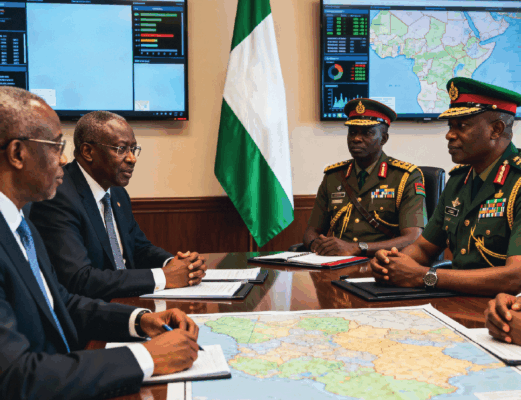
For decades, Nigeria has treated diplomacy and defence as two separate worlds, one speaking the language of protocol abroad, the other fighting visible and invisible battles at home. But the events of recent years have shown clearly that the country’s internal insecurity and its global posture are inseparable. The Chibok girls kidnapping, the Kebbi mass abduction, the Abuja–Kaduna train attack, the Kuje prison break, among other incidents, did more than shock the nation; they eroded trust, weakened Nigeria’s standing in ECOWAS and exposed how fragile diplomacy becomes when domestic security fails. A nation that cannot protect itself at home cannot project influence or secure development abroad.
The Chibok girls kidnapping laid the foundation for modern Nigeria’s diplomatic–defence dilemma. The trajectory Nigeria has followed ever since has worsened the situation. Incessant Boko Haram attacks, the rise of herdsmen–farmer conflicts, the Owo Christian massacre, the 2022 Kuje prison attack, and the Kebbi, Kogi and Niger school mass abductions all did more than shake domestic confidence; they exposed vulnerabilities in the nation’s intelligence and crisis response systems to the international community. Each unaddressed incident chips away at Nigeria’s credibility within ECOWAS, diminishes its influence in AU peace and security discussions, and constrains its voice in global counterterrorism efforts. These failures drew international attention, including US President Trump’s remark calling Nigeria a “disgraced country.” When a nation’s internal structures appear fragile, its diplomacy loses weight, and every erosion of credibility translates into diminished negotiating power abroad.
For ordinary Nigerians, these shortcomings are tangible and immediate. Insecurity has uprooted families, disrupted agricultural production, discouraged transportation along key corridors, and driven businesses away from high-risk areas. Beyond national borders, Nigerians encounter the consequences of weak domestic security in the form of missions ill-prepared to support citizens facing discrimination, wrongful detention, or emergencies abroad. These experiences reinforce public frustration and perpetuate the perception of a state struggling not only to protect its people at home but also to defend their rights and dignity internationally.
This carries ripple effects. Citizens seeking help at foreign missions often face slow processes and embassies too weak to defend their rights. Such weaknesses influence visa regimes, intelligence cooperation, investment decisions, and crisis response. Meanwhile, border communities from Illela to Mubi endure porous frontiers that enable trafficking and militant movement beyond the reach of diplomacy alone.
Comparative experience shows such fragmentation is neither universal nor inevitable. Rwanda’s post-1994 transformation demonstrates how integrating intelligence, diplomacy, and defence can stabilise a country internally while elevating its global relevance. Ghana’s diplomatic reforms, introducing performance benchmarks for ambassadors, strengthened negotiation outcomes. South Africa’s parliamentary oversight of defence and foreign affairs exemplifies how accountability can prevent institutional drift. These nations show that states aligning diplomacy and defence do not simply respond to crises; they shape the environment in which crises occur.
Nigeria needs more than rhetorical commitments; it needs an integrated blueprint that consciously links defence and diplomacy into a single architecture of national strategy. A National Security–Diplomacy Coordination Framework is essential. Such a structure must institutionalise continuous intelligence and information-sharing among the Ministries of Foreign Affairs and Defence, Military Headquarters, the intelligence community, immigration services, and key missions abroad. A credible framework must operate through permanent joint task groups dedicated to regional security cooperation, counterterrorism diplomacy, intelligence harmonisation, and crisis response, all backed by legislation and accountable to the National Assembly.
A stronger foreign service is equally vital. Nigeria’s diplomatic corps cannot fulfil its mandate while weighed down by uneven appointments, limited specialisation, and a culture that rewards political loyalty above competence. A modern foreign policy demands envoys with expertise in regional security, economic negotiation, migration governance, cybersecurity, and defence diplomacy. Countries such as Turkey, Brazil, and India embedded diplomats within national security planning, empowering them to negotiate strategic defence and intelligence agreements. Nigeria must follow suit to shape regional outcomes rather than watch them unfold.
Reclaiming leadership in ECOWAS is another step. Nigeria’s diminishing influence has created openings for insecurity in the Sahel to spill into its northwest corridor. Restoring credibility demands joint border patrols, harmonised sanctions for armed groups, shared biometric systems, and regional intelligence hubs capable of anticipating threats. Internal coherence is the first step to effective regional leadership.
Transparency must serve as the backbone of this renewal. South Africa’s oversight structure shows that defence procurement, mission operations, and foreign-service performance can be monitored without undermining national security. Nigeria needs a similar mechanism – one that evaluates budgetary discipline, operational efficiency, and mission outcomes, and provides the public with confidence that representation abroad is professional, accountable, and aligned with national interests.
Nigeria must build a foreign policy centred on its citizens. A reformed diplomatic–defence nexus should ensure every Nigerian, from farmers facing insecurity to students abroad, feels the state’s presence and protection. Embassies need rapid-response systems, digital consular platforms, and yearly deliverables linked to security cooperation, diaspora engagement, economic intelligence, and crisis management.
Diplomacy without security is ceremonial; security without diplomacy is futile. National renewal depends on merging these pillars into a single engine of statecraft. With coordination, transparency, and a citizen-focused mission, Nigeria can restore regional influence, strengthen its global posture, and rebuild public confidence.

Join BusinessDay whatsapp Channel, to stay up to date
Open In Whatsapp


