

The message popped up at 11:47 that night. “Please, I need urgent 2k.” For Tunde, a young banker in Lagos, it was the third plea in just one week. A cousin who hadn’t eaten all day. A neighbour whose child was sent home over fees. Now his younger brother, stuck after another fruitless job search. Tunde let out a quiet sigh, not from irritation, but from knowing he wasn’t alone in this. In today’s Nigeria, millions like him have become the quiet safety nets holding up entire households.
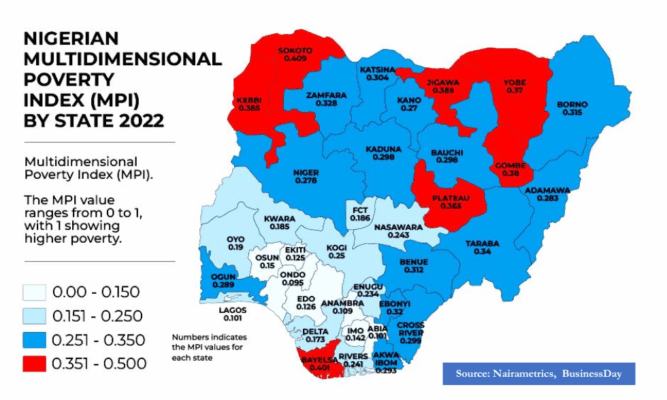
This is the hidden economy of obligation, shaped by multidimensional poverty, where over 133 million Nigerians are classified as poor, and 63% of the population lacks access to basic education, healthcare, housing, and employment opportunities. In such a landscape, the “black tax” isn’t just a cultural relic; it’s survival finance. The “urgent 2k” isn’t just internet talk, it’s a distress signal from a generation drowning in economic precarity.

Within this burden lies a profound truth: Nigerians support one another where the system falls short. But at what expense? As the cost of living rises, incomes stagnate, and social safety nets are limited, the emotional and financial strain on the working class is reaching a breaking point.
This is the story of a nation leaning entirely on its people, and the strain it creates.
The Rise of Black Tax: Nigeria’s Informal Social Welfare System
Black tax has become one of Nigeria’s most widespread yet least acknowledged financial systems, an informal safety net created not by policy but by necessity. With over 80% of Nigerians lacking any formal social security, families rely almost entirely on the income of a few working relatives. According to World Bank social-protection analysis, the average Nigerian breadwinner supports between 5 and 7 dependents, a burden that most heavily impacts the urban middle class.
In major cities like Lagos, Abuja, and Port Harcourt, informal survey data indicate that remittances from employed Nigerians to extended family have increased by 20–35% since 2022, driven by inflation, food insecurity, rising school fees, and declining real wages. For many households, these transfers cover essentials such as rent top-ups, emergency hospital bills, transportation costs, feeding allowances, and school levies. What should be government-led social protection has almost entirely shifted to private sources.
This expanding dependency has created a parallel welfare economy, one that strains household budgets, depresses savings, and traps many middle-class workers in a state of perpetual financial fragility. As the state recedes, family charity becomes mandatory rather than voluntary, blurring the line between support and survival.
Black tax is no longer a cultural obligation; it is structural compensation for systemic failure.
“Urgent 2k” and the Survival Economy of Young Nigerians
The “urgent 2k” plea, once dismissed as youthful frivolity, has become a shorthand for the economic desperation of millions of young Nigerians. Far from a moral failing, it is a rational response to structural deprivation.
According to SBM Intelligence, 7 out of 10 Nigerian youths depend on irregular transfers from friends, siblings, or extended family to cover daily expenses. This reliance is understandable: the cost of basic urban survival now exceeds ₦3,000 per day, driven by rising transport fares, increasing food prices, and expensive mobile data—the three essentials needed for work, mobility, and communication.
More than 50% of young Nigerians in major cities are engaged in gigs, informal, or unstable jobs, with earnings that fluctuate widely and often fail to cover living costs. The result is a generation locked in financial fragility- constantly borrowing small sums to plug daily deficits. The viral “urgent 2k” therefore reflects a more profound structural imbalance: low wages, high cost of living, job insecurity, and the absence of social support for young adults transitioning into independence.
The Hidden Cost: How Informal Support Masks a Broken State
Nigeria’s reliance on black tax and the “urgent 2k” economy is more than a cultural response; it serves as a structural substitute for an almost nonexistent welfare system. Social protection spending in Nigeria makes up only 0.7% of GDP, ranking it among the lowest in Africa and falling behind countries like Kenya and South Africa, which provide more comprehensive support systems. The result is clear: families, not institutions, shoulder the main burden of funding the nation’s welfare.
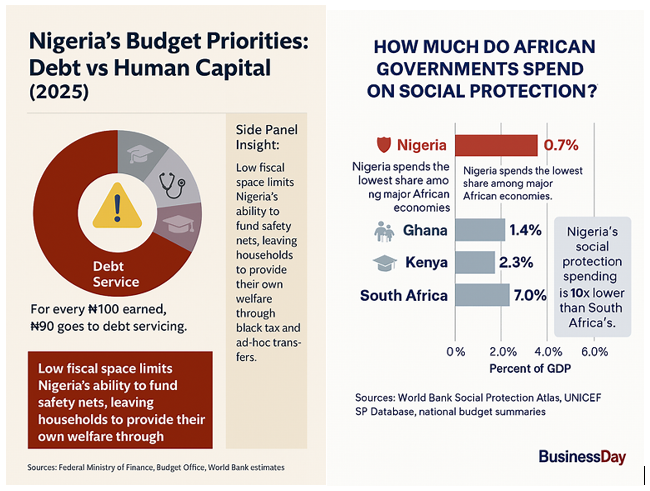
Even where social programmes exist, only 44% of benefits reach the poorest Nigerians, according to the World Bank, reflecting weak targeting, inadequate data, and fragmented delivery channels. Meanwhile, the federal budget prioritises survival over development: public debt servicing consumes nearly 90% of government revenue, leaving little room for health, education, youth employment, or social safety nets. As formal systems shrink, informal obligations expand- placing crushing pressure on workers already battling inflation and stagnant wages.
This situation creates a fragile, unsustainable private safety net. Households deplete savings, postpone investments, and mortgage their future to cover the state’s abandoned responsibilities. The burden feels personal, but its roots are deeply systemic. Without structural reform, Nigeria risks normalizing a model where the poor depend on the struggling, and the struggling sustain the entire country.

Join BusinessDay whatsapp Channel, to stay up to date
Open In Whatsapp


