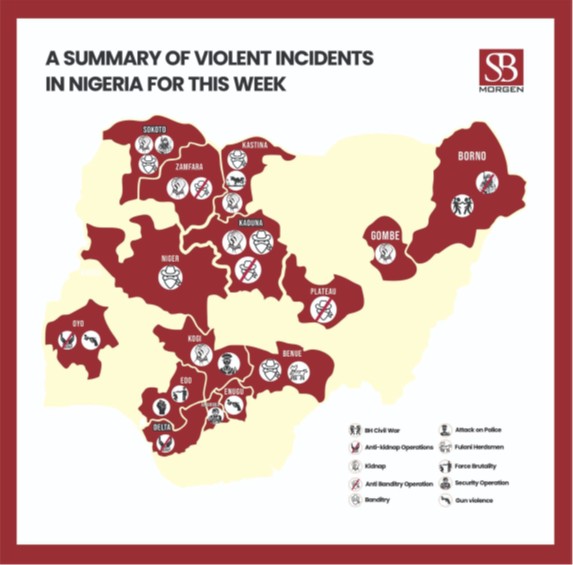
A new map of insecurity is emerging in Nigeria as insecurity and violent incidents extend to new locations. SB Morgen’s Nigeria Security and Political Economy weekly report for 9 to 15 January 2026, seen by BusinessDay reveals that the week in review featured several violent incidents emerging in hitherto safe areas.
In the South East, for instance, recent security incidents show a looming threat to human capital retention, particularly in high-skill sectors. The abduction and killing of Dr Andrew Orovwigho in Enugu East illustrates how insecurity is reinforcing the exit of medical professionals, adding a security dimension to long-standing concerns over pay and working conditions.
SBM Violence Tracker data shows that between 2021 and 2026, at least 36 kidnapping incidents involving medical practitioners were recorded across 18 states, indicating that the threat is structural rather than episodic.
The circumstances of Dr Orovwigho’s death suggest a shift in the risk profile of kidnapping, and that ransom compliance may not minimise fatal outcomes. Reports that ransom negotiations took place and that the victim was briefly released before being killed raise the possibility of either a targeted killing disguised as abduction or a deliberate elimination to prevent identification.
“This outcome suggests either a targeted assassination masked as kidnapping or a decision by the abductors to eliminate him to prevent identification. Both scenarios reflect intent and familiarity beyond random criminality, reinforcing fears that compliance no longer guarantees survival. This dynamic is likely to deepen medical brain drain and further weaken already overstretched health services,” the SBM report noted.
The security intelligence report, however, commended the intelligence-led policing that led to the police ambush and neutralisation of armed robbery suspects in Dunukofia Local Government Area. In the face of an uncertain security landscape in Nigeria, it highlighted the importance of sustained patrols.
Insecurity creeping into the South South
In the South South, recent developments in Edo State point to the early stages of geographic contagion in kidnapping activity rather than a spontaneous local breakdown. The protest in Ekpoma was triggered by two abductions within a single week, a notable deviation for Esan West, which had seen minimal kidnapping activity over the previous three years.
SBM ascribed the sudden shift to a change in operating conditions rather than a gradual escalation, with insecurity emerging rapidly in areas previously assessed as low-risk. Available intel from the security intel firm show that increased enforcement pressure along the Etsako axis and in parts of Owan East and West may have pushed established groups into adjacent LGAs with weaker perimeter control.
For Esan West, the terrain and jurisdictional fragmentation lowers the cost of entry for mobile groups, enabling short-duration operations followed by swift withdrawal into neighbouring areas or states. The breakdown of public order during recent protests also points to a growing gap between community mobilisation and state capacity to manage flashpoint events.
“Without rapid reinforcement, coordinated patrols, and border-focused security, Esan West risks becoming a new kidnapping hub rather than a temporary transit zone,” the security intel agency warned in its report,
Mounting concerns for commercial hubs in South West
Nigeria’s commercial hubs in the South West are also under threat, particularly as recent incidents reveal a gap between threat detection and preventive action. Despite advance access to intelligence warning about armed groups consolidating along the Old Oyo National Park corridor, early interdiction failed to materialise. Similarly, prior reports of unfamiliar armed actors and suspected extremist-linked elements operating in the Ikoyi-Ile in Oriire LGA did not prevent the killing of five forest guards
This reactive posture has precedent. Similar warnings in January and October 2025 regarding southward movement of armed groups from Kwara and Niger into the Oke-Ogun–Oriire axis resulted largely in consultations rather than sustained clearing or containment operations. The absence of visible deterrence appears to have lowered risk perceptions among non-state actors, enabling them to test state presence through intimidation and territorial signalling rather than immediate mass violence.
“The group behind the Ikoyi-Ile threat is likely a cross-boundary syndicate linked to northern Kwara or Borgu forests in Niger, seeking a permanent southern foothold. If the planned attack proceeds, it could trigger displacement toward Ogbomoso or Kwara and expose Osun, Ogun, and even Lagos to spillover risks via connected forest reserves,” the report warned.
Fighting, kidnappings continue in North East
In the North East, fighting between ISWAP and JAS in the Lake Chad Basin has evolved from doctrinal rivalry into a contest over territory, revenue and population control in the week under review. Intelligence suggest the recent clashes were initiated by ISWAP with the specific aim of degrading JAS’s local revenue base, targeting a taxation point used to extract payments from fishing and farming communities.
ISWAP’s subsequent withdrawal to prepared positions between Kangarwa and Dogon Chuku suggests a deliberate attritional strategy: weaken JAS’s economic capacity while avoiding prolonged engagements that would expose its own forces. Past records suggest a high likelihood or retaliation, raising the risk of violence for civilians.
“SBM Violence Tracker data shows that between January 2025 and January 2026, inter-factional clashes killed 278 fighters, making jihadist infighting deadlier for militants than state operations. For civilians, these battles are catastrophic. Communities are routinely accused of collaboration, caught in reprisals, and forced to pay protection fees to whichever group dominates at a given time,” SBM report shows.
The territorial fight also seems to extend further west to Gombe State, as illustrated by the recent mass abduction in Shongom LGA reported to be linked to to JAS splinters displaced from Borno by sustained military pressure. Recent data also shows a targeting of wedding convoys, suggesting revenue-driven operations rather than opportunistic crime.
The report ends with a comment on North East, “Without a permanent Joint Task Force along the Dawajah–Filiya corridor, Shongom risks becoming a permanent hostage hub feeding bandit expansion southward.”
Bandits getting bolder in North Central
In the North Central region, Kogi State has emerged as a key pressure point, with violence increasingly concentrated along major transport corridors. SBM violence tracker highlights that within the last year, Kogi state has witnesses about 17 highway kidnapping incidents, with a recent attack on the Obajana Police station signaling a notable escalation.
“The Obajana attack, the first of its kind in the area, reflects a shift from profit-driven banditry to insurgent-style tactics aimed at weakening law enforcement to secure operational routes. Likely carried out by remnants of the Kachalla Shuaibu network or affiliated sleeper cells, the attackers overwhelmed police and vigilantes, killing an officer and demonstrating access to military-grade weapons,” the weekly security intel noted.
With the latest attack on the police coming barely three months after the September 2025 raid in Yagba West, SBM Intelligence notes that the criminal groups are now directly testing the state authority. The Kabba-Okene road is reinforcing its status as a high-risk transit route, with at least 62 civilians kidnapped on this corridor between March 2025 and January 2026.
“Persistent attacks indicate semi-permanent bandit camps in nearby forests, enabling surveillance and precision strikes. Without sustained patrols and aerial monitoring, Kogi’s highways will remain high-risk corridors rather than secure transit routes.”
Territorial fights and displacement in the North west
In the North West region, the combination of a severe enforcement gap and the operational freedom of Bello Turji is directly powering insecurity in areas like Sabon Birni and Isa. SBM Violence Tracker data reveals an imbalance with over 72 violent incidents in Sabon Birni in the last year against three anti-bandit operations, and 22 incidents in Isa against one anti-bandit operation.
The imbalance has allowed the bandits move from highway operations to house-to-house raids, allowing them raise ransom funds, and carry out forceful recruitments to offset their loss of arms and followers to military strikes.
In Sokoto North and South, residents have been displaced creating space for the bandits to establish territorial control and endangering more locations like Wurno, Rabah, and Goronyo. The situation is not helped by recent reports of Katsina state releasing 70 suspected bandits under a peace deal.
“Turji’s recent order for residents to vacate Sabon Birni mirrors earlier ultimatums that preceded mass killings and signals a shift toward forced displacement to create permanent criminal enclaves. This threat links to the Bungudu axis in Zamfara, where forest corridors enable rapid raids and withdrawals. Without blocking these transit routes, the rural economy faces collapse as communities abandon farmland to survive,” the report added.
Implications for the local economy
The narrative across all the regions, though fragmented, point to an economically disruptive threat environment. The spate of violent activities across the nation highlight the vulnerability of transport corridors and logistics networks, signalling elevated operational risks for businesses, particularly those like food supply and trade, that are dependent on mobility, supply chains, and local sourcing.
For businesses, this translates into higher logistics costs, rising insurance premiums, constrained workforce availability and accelerated capital flight—particularly in healthcare, agribusiness and small-scale manufacturing.
The expansion of kidnapping and insurgent-style attacks into previously stable areas could also weaken investor confidence in subnational growth hubs, complicate infrastructure planning, and strain state finances already under pressure from falling real revenues.
Without coordinated intelligence-led responses and sustained territorial control, insecurity risks entrenching a two-speed economy in which growth is isolated to fortified enclaves, while vast productive regions operate under persistent risk, undermining Nigeria’s medium-term growth and employment prospects.

Join BusinessDay whatsapp Channel, to stay up to date
Open In Whatsapp