

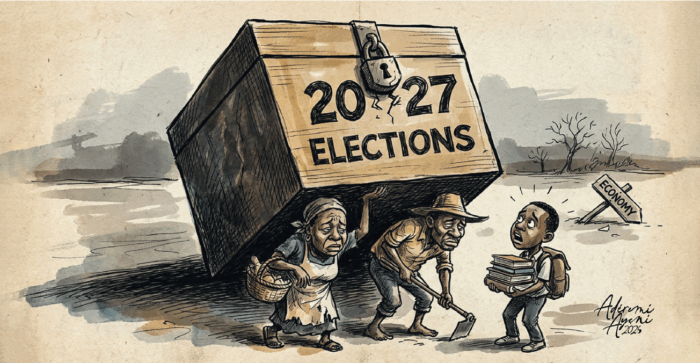
Nigeria stands at the threshold of another defining moment in its democratic journey. The 2027 general elections, now just a year away, are already being described as the “make or mar” polls. The stakes could not be higher. For a country grappling with deepening insecurity, inflation, and widespread hardship, the elections will test not only the resilience of Nigeria’s democracy but also the credibility of its political class.
Preparations are underway across the political spectrum, but it is the ruling party that has dominated recent headlines. Critics argue that the ruling party’s attention has drifted from governance and the urgent problems confronting ordinary Nigerians. Instead of confronting the rising cost of living, worsening insecurity in the North and Middle Belt, and the steady collapse of public services, the ruling party appears increasingly preoccupied with consolidating political power ahead of 2027. State machinery is being deployed to pressure politicians into defecting, swelling the ranks of the ruling party and projecting an aura of inevitability around its electoral prospects.
This strategy is not new to Nigerian politics. The use of incumbency power to tilt the electoral field has long been a feature of the system. What distinguishes the current trend, however, is the scale and coordination of this effort. Control of state governments has become a central pillar of electoral strategy. Governors are widely perceived not merely as subnational executives, but as electoral brokers expected to “deliver” their states during presidential elections. In such a context, the margin between competitive elections and managed outcomes becomes increasingly blurred.
Today, 31 of Nigeria’s 36 governors belong to the ruling party. This dominance is not incidental. Governors wield enormous influence over local political structures, security coordination, patronage networks, and electoral logistics. When governors openly pledge to deliver their states to a presidential candidate, elections risk becoming elite transactions rather than expressions of popular will. The logic is transactional: loyalty during elections is often rewarded with post-office relevance or federal appointments. The widely cited case of Nyesom Wike’s role in Rivers State during the last presidential election, followed by his appointment as Minister of the Federal Capital Territory, reinforces this perception and shapes elite behaviour ahead of 2027.
The implications for democracy are profound. When political outcomes appear pre-negotiated among elites, public faith in elections erodes. For many Nigerians, elections increasingly resemble rituals that change little of the daily realities. Inflation continues to erode incomes, unemployment remains high, and insecurity has displaced thousands, if not millions of citizens. Against this backdrop, aggressive power consolidation reinforces the belief that politics is more about control than service.
Opposition parties are attempting to capitalise on this discontent by framing the elections as a referendum on governance. Yet they remain fragmented, divided by weak coalitions, limited resources, and organisational challenges. Without access to state machinery, opposition campaigns will struggle to compete, particularly in rural areas where elections are often decided. Financial constraints and the strategic deployment of state institutions further sway the balance in favour of incumbents.
Civil society organisations and electoral institutions face their own tests. The Independent National Electoral Commission, (INEC), has promised reforms aimed at improving transparency, including use of technology. However, public scepticism remains high, shaped by memories of disputed outcomes, alleged manipulation, and controversial technical failures in previous elections. For INEC, 2027 represents either an opportunity to restore credibility or a risk of further eroding trust.
Civil society groups are mobilising to monitor the polls and educate voters, but their capacity is constrained by funding shortages and the scale of Nigeria’s electorate. Recent reductions in international democracy-support funding, particularly from Western partners, are likely to weaken election monitoring efforts at a critical moment.
The international community is watching closely. Nigeria’s elections carry regional significance. As Africa’s largest democracy and economy, Nigeria’s stability is central to West Africa’s political balance. A flawed election could embolden authoritarian tendencies elsewhere, while a credible process could strengthen democratic norms. Foreign observers have already raised concerns about the misuse of state institutions to intimidate opposition and skew the political field. History suggests that incumbency power is formidable, but not invincible. The 2015 election demonstrated that Nigerian voters could defy expectations under certain conditions. Whether such a moment can be repeated in 2027 will depend on opposition unity, citizen mobilisation, and the integrity of the process.
Ultimately, the 2027 elections are about more than who wins office. They are a test of whether Nigeria can deepen its democracy or slide further into disillusionment. The ruling party’s reliance on coercion and elite bargaining risks undermining legitimacy, while the opposition must convince Nigerians that the ballot still matters. For ordinary citizens, the elections remain a rare opportunity to demand accountability. Despite its flaws, the ballot box is still the most powerful tool available to the masses. Whether Nigerians seize that opportunity will shape the country’s trajectory for years to come. If the 2027 polls deliver credibility, they could mark a turning point. If they fail, they may deepen despair and further weaken the republic.
As the countdown continues, one truth that stands out is that Nigeria’s 2027 general elections are not just another political contest. They will either make the nation by reaffirming its democratic promise or mar it by exposing the fragility of its institutions. The choice, ultimately, lies not only with politicians, but with the people themselves.

Join BusinessDay whatsapp Channel, to stay up to date
Open In Whatsapp


