

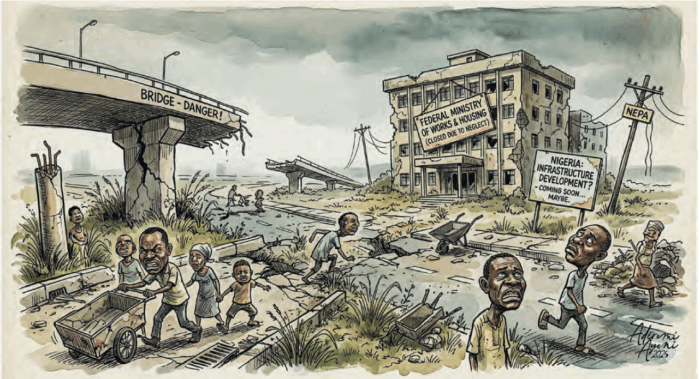
Since independence in 1960, Nigeria has spent trillions of naira on infrastructure and public institutions. Roads have been constructed, power projects commissioned, schools and hospitals upgraded. Much of this investment however has not translated into durable national assets. Across sectors, infrastructure deteriorates far earlier than expected, forcing frequent reconstruction, and significant economic costs. Nigeria loses an estimated $28 billion annually, about 2 per cent of GDP, largely due to power sector failures alone, a problem rooted as much in poor maintenance as in capacity gaps.
What appears as an electricity crisis is in many respects also a maintenance failure. Transmission lines collapse, transformers fail, and distribution network breaks down with alarming frequency. The consequences extend directly to the economy. Businesses now spend between 20 and 30 per cent of their capital on alternative power sources such as diesel and petrol generators. This is capital diverted from expansion, job creation, and productivity. Instead of supporting growth, firms are forced into survival spending, raising the overall cost of doing business and weakening Nigeria’s competitiveness.
This cycle of deterioration and replacement is not limited to the power sector. Public infrastructure across the country reflects the same trajectory of capital erosion. At the University of Ibadan campus, many buildings constructed during the colonial and early postcolonial periods remain structurally sound, even if visibly aged. Meanwhile, newer buildings often show signs of rapid decline within a few years of completion. The newer Faculty of Arts building, for instance, already presents maintenance concerns despite its recent commissioning, with facilities such as lifts reportedly never fully operational. The implication is not simply poor construction, but the absence of a sustained maintenance culture. Assets are commissioned without a functional system for upkeep, allowing them to depreciate prematurely.
There is also evidence of similar dynamics in critical public services. At the University College Hospital, infrastructure challenges have reduced operational efficiency in parts of the facility. Equipment becomes obsolete or unusable, buildings deteriorate, and the overall environment reflects prolonged under-maintenance. For a major tertiary health institution, this has implications beyond service delivery. As public healthcare capacity weakens, households turn to private alternatives or seek treatment abroad, increasing financial pressure and contributing to foreign exchange outflows. What begins as a maintenance issue evolves into a broader economic burden. This situation is the same in almost all major government facilities and establishments nationwide.
Nigeria’s persistent return to reconstruction rather than preservation is closely tied to how public investment is structured. Budgeting practices tend to prioritise new capital projects over maintenance. New construction offers visibility and political returns, while maintenance remains less visible and often underfunded. As a result, infrastructure is allowed to deteriorate until it justifies fresh capital expenditure. This creates a cycle in which government repeatedly spends to replace assets that could have been preserved at a fraction of the cost.
Governance dynamics further deepen this problem. Changes in administration frequently disrupt continuity, with new governments showing little or no commitment to projects initiated by their predecessors. The Mega Schools programme in Ondo State under Olusegun Mimiko illustrates this challenge. Designed as modern educational facilities, several of these schools have since experienced neglect or underutilisation. The economic implication is clear: public funds are invested, but the expected long-term returns are not realised. Infrastructure becomes stranded capital rather than a productive asset.
The broader economic consequences of this maintenance gap are far-reaching. Poor infrastructure reliability increases operating costs across sectors, discourages investment, and limits productivity growth. It slows urban development, as decaying public assets reduce the quality and functionality of cities. It also contributes to inequality, as those who can afford private alternatives — power, healthcare, education — insulate themselves, while others remain dependent on failing public systems. Over time, this undermines both economic efficiency and social stability.
Addressing this challenge requires a shift from episodic intervention to systematic asset management. A national maintenance framework would need to integrate lifecycle costing into all public projects, ensuring that maintenance is planned, funded, and monitored from the outset. Institutional responsibility for infrastructure upkeep must be clearly defined, with measurable standards and accountability mechanisms. Maintenance budgets should be ring-fenced to prevent diversion, while performance tracking systems ensure that assets remain functional over time. Without these structural adjustments, increased spending alone will continue to yield diminishing returns.
A more effective response would also require enforceable maintenance legislation backed by fiscal discipline. Annual infrastructure audits should be mandated across all ministries, departments and agencies, with results tied directly to budget approvals. Dedicated maintenance funds, insulated from political interference, must be created and transparently managed. Public-private maintenance contracts can introduce efficiency where government capacity is weak, while performance-based incentives ensure accountability. At the subnational level, continuity laws should compel successive administrations to sustain existing projects rather than abandon them. Without embedding maintenance into law, finance, and institutional behaviour, reforms will remain rhetorical rather than transformative in Nigeria’s public sector management system.
Nigeria’s infrastructure challenge is therefore not only about building more, but about preserving what already exists. When assets are allowed to decay, the economy absorbs the cost through higher business expenses, reduced productivity, and repeated public spending. A functioning maintenance system is not a technical add-on; it is a core economic requirement. Without it, the cycle of loss and reconstruction will persist, and the gains from public investment will remain short-lived.

Join BusinessDay whatsapp Channel, to stay up to date
Open In Whatsapp


