

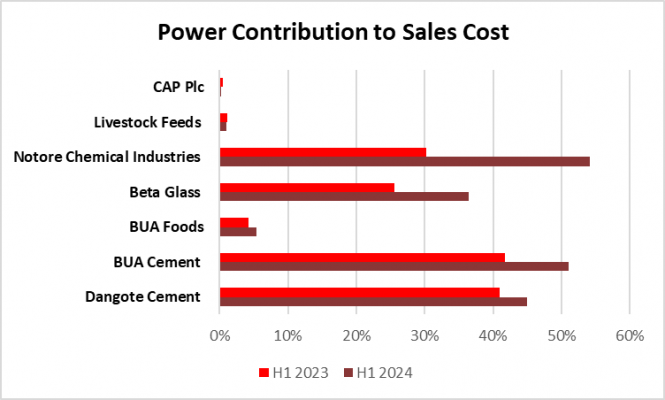
The sharp rise in energy costs has had a profound effect on Nigerian manufacturers, especially as power has now become one of the most significant contributors to production costs. In 2024 alone, the national grid has collapsed eight times, compounding the energy crisis.
Petrol prices have surged by nearly 100 percent, now selling at about N1050 per litre, while diesel prices have also appreciated considerably. As a result, manufacturers reliant on both the national electricity grid and fuel generators have faced unprecedented increases in their operational expenses.
For manufacturers, energy is a critical input and in Nigeria, energy comes from the electricity distribution companies or from fuel generators. The rising costs of fuel have triggered significant increases in energy expenses, with energy now ranking among the most significant production costs in Nigeria’s manufacturing sector. According to data tracked by BusinessDay, energy costs are now the highest cost contributors for some of Nigeria’s top manufacturers.
Assessing the actual energy cost for Nigerian manufacturers can be challenging, as many companies capture these expenses under various line items such as production overheads, utilities, and production variable costs.
For consumer goods companies, it is observed that although the power and energy costs pale in comparison to the raw materials costs, it is still one of the highest direct costs incurred in production. However, for industrial manufacturers like cement makers, the story is different. In these sectors, power is the largest cost component in production.
In the first half of 2024 (H1 2024), Dangote Cement incurred power expenses of N374.8 billion, making up about 45 percent of the company’s sales cost. Year-on-year, the group’s power expenses increased by 139 percent from N157 billion as of H1 2023.
For BUA Cement, the company incurred power costs of N130.5 billion, making up 51 percent of the group’s total sales costs. Compared to H1 2023, BUA’s power expenses increased by 172 percent year-on-year. Concerning Beta Glass, the company’s power costs figure was about N13.9 billion, representing 36 percent of the company’s N38 billion sales cost. This marked a 138 percent year-on-year growth from the N5.8 billion power expense incurred in H1 2023.
For Notore Chemical Industries, the group’s power costs hit N8.2 billion during the half-year, marking a 140 percent year-on-year increase from N3.4 billion as of H1 2023. Power costs also made up 54 percent of Notore’s sales costs during the half-year, in contrast with 30 percent in H1 2023.
BUA Foods, one of the largest consumer goods companies, recorded a 193 percent year-on-year growth in its power costs in H1 2024. The group incurred costs of about N23.4 billion, representing 5 percent of its total sales costs, in contrast with H1 2023 power costs of N8 billion, which was about 4 percent of its sales costs.
The steep rise in energy costs for manufacturers has been reflected in their gross margins, as most of these manufacturers have recorded declines in their gross margins year-on-year. It can also be linked to the decline in expansion activities for these manufacturers, as the capital required for infrastructure upgrades and investing in new technologies have been converted into covering energy costs, leaving these companies with less cash flow to finance growth activities.
The continual collapse of the grid has shown why companies keep relying on expensive fuel-powered generators. Then, the unpredictability around the pricing of fuel in Nigeria makes long-term planning for these companies difficult.
“The average number of outages per day increased marginally to 4.7 times from 4. 4 times in the first half of 2022,” Manufacturers Association of Nigeria (MAN) said in its H1 2023 Economic Review.

Join BusinessDay whatsapp Channel, to stay up to date
Open In Whatsapp


