

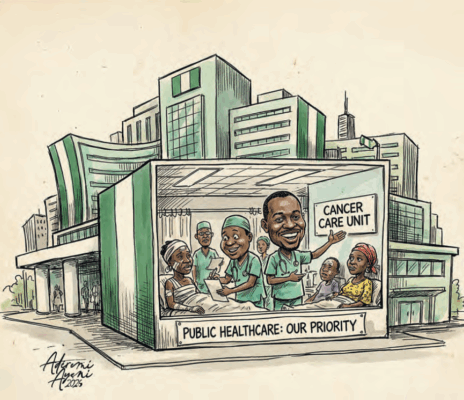
Cancer care remains one of the most under-addressed public health challenges in Nigeria. This is not because the disease is rare, but because the systems meant to respond to it are weak, underfunded, and socially constrained. While Nigeria has established cancer centres and treatment programmes, access to care remains prohibitively expensive for the majority of citizens. The result is a growing disconnect between policy intent and lived reality, where diagnosis often becomes a sentence of financial ruin or silent suffering.
The Federal Government’s Cancer Health Fund (CHF), established under the Ministry of Health, reflects an acknowledgement of this crisis. Since its creation, the fund has reportedly disbursed about N2 billion to 1,616 indigent cancer patients, covering treatment costs of up to N2 million per patient, particularly for breast, cervical, and prostate cancers. While commendable, this intervention remains a drop in the ocean. Studies referenced by the Journal of the West African College of Surgeons and the National Institutes of Health indicate that the average cost of cancer treatment in Nigeria can exceed N20 million per patient.
Recognising this gap, the Nigerian Cancer Society has repeatedly called for increased public investment, including an upward review of cancer allocations to at least N1 billion in the 2025 federal budget. Without such scale, existing interventions remain symbolic rather than transformative. Cancer financing in Nigeria is still treated as an emergency response, not as a long-term public health obligation.
Beyond cost, cancer care in Nigeria is constrained by deeper institutional failures. Public hospitals remain under-equipped, specialist personnel are overstretched, and cancer registries are fragmented or incomplete. Health insurance coverage under the National Health Insurance Authority remains limited, leaving most patients to pay out of pocket. These structural weaknesses mean that even when funding exists, access is uneven and outcomes remain poor. Cancer, in this context, is not only a medical challenge but a governance problem.
While institutional barrier is a major issue, cultural stigma remain one of the most insidious obstacle to cancer patients. Silence and stigma continue to shape how cancer is perceived, discussed, and managed in Nigerian society. Research highlighted by Chukwuemeka Oluoha of the Initiative for Public Health Advancement, Development and Research, published in the Journal of Oncology Navigation and Survivorship, shows that psychosocial stigma which manifests as shame, blame, exclusion, and fear discourages early diagnosis and treatment. In many families, a cancer diagnosis is concealed to avoid social labelling. Patients withdraw, delay care, or suffer in isolation, compounding already dire outcomes.
This culture of silence is not limited to health. It mirrors a broader national pattern where difficult issues are ignored until they become crises. In the case of cancer, this silence costs lives. Early detection is one of the most effective tools against cancer, yet stigma ensures that many Nigerians present at advanced stages, when treatment is more expensive and survival rates lower.
A striking consequence of this silence is the absence of strong local support systems. Many Nigerian cancer patients turn to foreign-based online support groups in the United States or the United Kingdom for information, emotional support, and guidance. While these communities offer hope, their advice is often shaped by healthcare systems that are inaccessible to Nigerian patients. The lack of local support groups deprives patients of culturally relevant guidance, shared experiences, and community solidarity. It also reinforces the perception that cancer care is something to be sought abroad, rather than built at home.
Psychological resilience and social support are critical components of cancer survival. Many long-term survivors credit emotional strength, community, and optimism as central to their recovery. Nigeria’s failure to institutionalise psychosocial cancer care through counselling services, survivor networks, and community education represents a serious gap in treatment strategy.
Encouragingly, generational shifts offer some hope. Younger Nigerians, particularly Gen Z, are increasingly vocal about health issues, mental wellbeing, and stigma. Building on the groundwork laid by Millennials, this generation is pushing conversations once considered taboo into the public space. However, cultural change alone cannot compensate for institutional inertia.
Aligning cancer care with Nigeria’s realities requires deliberate and sequenced reform. First, cancer coverage must be meaningfully integrated into the National Health Insurance Authority, with phased expansion that prioritises early detection, diagnostics, and essential treatment, rather than catastrophic end-stage care. It is also very important for federal and state governments to establish accredited cancer support and psychosocial care units linked to teaching hospitals and oncology centres. These structures need not be expensive, but they must be institutionalised, staffed, and sustained.
Similarly, funding for cancer response must move beyond ad hoc interventions. Dedicated budget lines for cancer research, treatment, and data systems are necessary to move policy from symbolism to impact. Nigeria cannot continue to outsource cancer expertise indefinitely. Investing in local research capacity, oncology training, and reliable cancer registries is essential for long-term planning and accountability. To ensure this, public education must be systematic and decentralised, leveraging schools, religious institutions, community leaders, and the media to dismantle stigma and normalise early testing and open discussion.
Silence and stigma thrive where systems fail. Breaking them requires more than awareness; it requires political will, institutional design, and societal accountability. Cancer care in Nigeria should not depend on charity, concealment, or foreign platforms. It must become a core component of the country’s health governance.

Join BusinessDay whatsapp Channel, to stay up to date
Open In Whatsapp


