

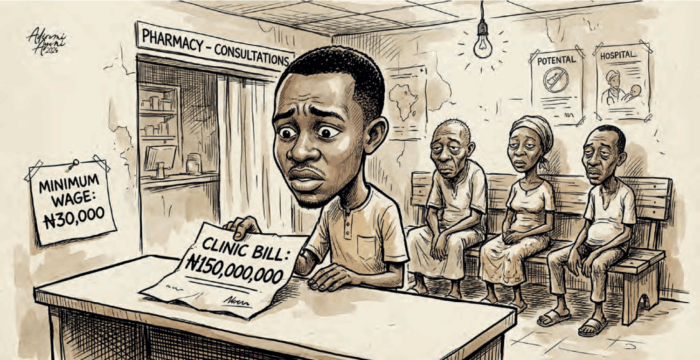
One of the essential necessities a good government should provide for tax-paying citizens is free basic healthcare. In Nigeria, this remains largely a luxury that the majority of citizens cannot afford, resulting in thousands of avoidable deaths every year. A recent visit to a clinic was an eye-opener to the very high cost of basic health services. It showed that a single day of treatment involving checks of vitals, consultation and purchase of medications prescribed by the doctor can easily exceed Nigeria’s minimum wage. One is forced to ask how many Nigerians can realistically afford such a bill.
According to Nigeria Health Watch, only about 10 percent of Nigerians are covered by any form of health insurance, leaving the vast majority to pay for healthcare directly from their pockets. However, within Nigeria itself, there exists a functioning example or model of free basic healthcare in the heart of the country’s premier university – the University of Ibadan (UI).
For those familiar with UI, basic healthcare is free for students at the institution’s Jaja Clinic. What may cost an ordinary citizen between N30,000 and N80,000 for consultation, treatment and medication outside the campus costs students zero naira within the university system. During my master’s programme at the University, I visited the clinic twice. The treatment I received would have cost thousands of naira elsewhere, but it were provided free of charge simply because I was a registered student. One might then ask: how is this possible?
The University of Ibadan operates almost like a small local government with organised administrative systems and skilled personnel. While students pay school fees, the portion allocated to healthcare — typically less than N15,000 per session — is not sufficient to run a full medical facility. The clinic’s operations are supported through a combination of institutional funding and national health insurance mechanisms, ensuring that drugs, medical consultations and nursing care remain available to thousands of students and staff every day. This long-running system reveals that free basic healthcare is not impossible in Nigeria.
The Jaja Clinic model demonstrates that when healthcare financing is pooled and administered through an organised institutional structure, large populations can receive basic medical care without direct payment at the point of service. Meanwhile, outside institutional environments like universities, millions of Nigerians struggle to access even the most basic medical services. In many cases, the problem is not the absence of treatment but the inability to afford it.
Nigeria continues to face one of the most severe maternal health crises in the world. Health experts estimate that about 145 Nigerian women die every day from pregnancy-related complications, many of them preventable with timely and affordable medical care. In 2023 alone, Nigeria recorded over 75,000 maternal deaths, representing nearly a quarter of global maternal mortality cases. Studies has also shown that financial barriers and access to adequate healthcare facilities – which are not usually cheap – play a major role in these deaths. These realities force many Nigerians to rely on informal drug vendors or cheap counterfeit medicines rather than visit properly equipped health facilities resulting in worsening health conditions or avoidable deaths.
This is where the Jaja Clinic model becomes important for national policy thinking. If a federal university can successfully operate a system where thousands of people receive basic healthcare services without direct payment, why has the country not attempted to scale such a model on a national level?
A national adaptation of the “Jaja Clinic model” could begin at the local government level. Nigeria already has 774 local government areas, each theoretically responsible for primary healthcare delivery. Instead of leaving primary health centres underfunded and poorly equipped, government funding combined with citizen tax contributions could support properly managed community clinics that provide free basic services.
Just like the Jaja Clinic requires student identification for access, community clinics could operate using national identification numbers (NIN) or other verified identity systems to ensure services reach registered residents. The federal government’s ongoing tax reforms also create an opportunity. If citizens are expected to comply with taxation obligations, access to basic healthcare should form part of the tangible benefits they receive in return.
Population metrics can guide infrastructure planning. Local governments with larger populations would require more clinics and medical personnel, while smaller communities may require fewer facilities. Local administration is essential for this system to function effectively. UI operates like a local administrative unit, which partly explains why the Jaja Clinic functions efficiently. Decision-making occurs closer to the people it serves, reducing bureaucratic delays that often accompany centralised management.
Nigeria already have many existing public health facilities at state and local levels. Rather than building entirely new structures everywhere, the Jaja model could be integrated into existing primary healthcare centres while expanding community-based clinics in underserved areas.
There are precedents for this approach. During his tenure as governor of Ondo State, Dr. Olusegun Mimiko introduced the “Mother and Child programme”, which provided free maternal healthcare services including natural deliveries and caesarean sections. The programme reportedly saved thousands of lives before it was discontinued after his administration finished its tenure.
What this demonstrates is simple: targeted free healthcare programmes can work in Nigeria when they are properly structured and funded. Of course, scaling the Jaja Clinic model nationally would require detailed policy tweaking, financial planning and careful implementation. But the principle remains clear.
If a university community can sustain free basic healthcare for decades through pooled funding, institutional discipline and structured administration, there is no reason the same logic cannot be deployed across Nigeria’s local governments.

Join BusinessDay whatsapp Channel, to stay up to date
Open In Whatsapp


