

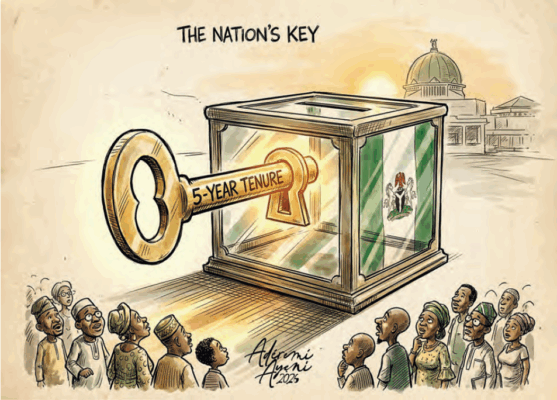
Nigeria’s democratic journey, restored in 1999 after prolonged military rule, has reached a stage where persistent insecurity, uneven development, rising public distrust, and escalating electoral costs have pushed many Nigerians to openly clamour for restructuring and institutional reform. These demands reflect a growing recognition that the country’s governance challenges are not merely a function of leadership quality, but of structural incentives embedded in the political system. In this context, the proposal for a single, non-renewable five-year presidential and gubernatorial tenure deserves serious, evidence-based consideration as a potential mechanism for stabilising governance and aligning political incentives with long-term national development.
Why five years, and why a single term? A five-year tenure provides sufficient time for the planning and early implementation of medium-term reforms, including fiscal consolidation, security sector reorganisation, judicial backlog reduction, and large-scale infrastructure delivery, without the distorting pressure of near-immediate re-election campaigns. Equally important, a single non-renewable term reduces the incentive to personalise power or manipulate institutions for electoral survival. Comparative experience supports this logic. Mexico’s single six-year presidential term (the sexenio) has institutionalised leadership turnover and limited incumbency abuse, demonstrating that political accountability can coexist with non-renewable executive tenures, when checks and balances remain intact.
Nigeria already operates bounded executive tenures in key areas of public administration. University vice-chancellors, for example, serve single five-year terms under statutory rules designed to balance institutional continuity with leadership renewal. While national politics is more complex than university governance, this practice illustrates that Nigeria is administratively and culturally familiar with non-renewable leadership arrangements. Scaling this logic to the presidency is not an act of institutional imitation but an acknowledgement that bounded authority can promote focus and curb entrenchment.
The practical benefits of a single five-year presidency are significant. Nigeria’s electoral cycles are extremely costly. INEC’s budget rose from approximately N189 billion in 2019 to over N355 billion for the 2023 general elections, excluding extensive security deployments and logistical expenditures. These recurrent costs divert scarce public resources from infrastructure, education, and health into electoral administration and political stabilisation. A single-term presidency would reduce the frequency of these high-stakes national elections and dampen the prolonged governance paralysis that typically accompanies second-term campaigns.
Moreover, Nigeria’s experience suggests that second terms often intensify governance distortions, rather than correct first-term shortcomings. The final years of successive administrations, most notably 2005–2007 and 2013–2015, were characterised by intense succession politics, elite defections, policy stagnation, and institutional strain, as political energy shifted from governance to legacy management and power retention. Similar patterns are observable across Africa. Ghana’s two-term system has ensured regular alternation of power, but has also entrenched second-term complacency, while Senegal’s contested term-limit debates generated political instability. These cases underscore that tenure design materially shapes political behaviour.
A common criticism of single-term presidencies is the perceived weakening of accountability. This concern is valid, only if elections are treated as the sole accountability mechanism. Accountability can be strengthened through institutionalised, enforceable alternatives. A single-term system should include a constitutionally mandated mid-term performance review at the end of the third year, conducted jointly by the National Assembly and an independent audit body. Presidents would be required, upon inauguration, to submit pre-registered policy benchmarks against which performance is assessed. Failure to meet minimum thresholds would trigger binding legislative hearings, conditional budgetary approvals, and, in extreme cases, expedited impeachment procedures tied specifically to non-performance, rather than criminal misconduct alone. Judicial oversight would ensure that these processes are insulated from partisan manipulation.
Policy continuity is another concern. This risk can be mitigated by embedding major reforms in legislation rather than executive discretion, and by empowering technocratic institutions to anchor long-term projects beyond individual administrations. Stability, in this sense, is produced, not by prolonged tenure, but by durable institutions.
Any redesign of presidential tenure must also engage Nigeria’s federal structure. A single-term presidency raises legitimate questions about subnational governance: whether governors should retain renewable terms, adopt similar single tenures, or operate under differentiated arrangements. While asymmetry could generate coordination challenges, federal diversity may also allow experimentation that enable states to pilot tenure reforms to achieve the same goal by the following general elections. Acknowledging this complexity strengthens, rather than weakens, the reform argument.
Adopting a single five-year presidential or governorship tenure would require a constitutional amendment, a demanding but achievable process, if framed as democratic deepening rather than partisan advantage. Reform advocacy should be anchored in measurable governance commitments, statutory timelines, and transparent transition arrangements that prevent power vacuums. Crucially, any change must apply prospectively and uniformly, avoiding personalization that distracts from institutional goals.
The argument for a single five-year presidency is pragmatic, not nostalgic. Nigeria needs an executive calendar that aligns political incentives with the sustained, technical work of state-building. If paired with enforceable accountability mechanisms, strengthened legislative oversight, judicial independence, and transparent public finance management, a single-term presidency and governorship could reduce cycles of patronage, policy short-termism, and electoral panic. The question is no longer whether Nigeria should debate its leadership architecture, but whether it can do so with the seriousness required for long-term national renewal.

Join BusinessDay whatsapp Channel, to stay up to date
Open In Whatsapp


