As Nigeria gravitates toward the 2027 general election, there are mounting signs that competitive democracy- once a hallmark of the Fourth Republic- is quietly losing its edge. Civil society observers warn that party pluralism is under strain, with opposition parties weakened by defections and institutional pressures that threaten genuine electoral choice rather than mere electoral activity.
Across the country, debates over voter registration integrity, electoral reforms, and declining public trust in the Independent National Electoral Commission (INEC) reflect a deepening democratic malaise. Recent surveys show that while 71% of Nigerians still see elections as the best way to choose leaders and 69% believe multiple parties are essential for choice, trust in INEC sits near historic lows and confidence in the process wavers.
“… We cannot talk about the vitality of Nigerian democracy without talking about the vitality of the political opposition. For there is no democracy without diversity in substantive opinion and political affiliation”- Bola Ahmed Tinubu.
Thus, as Nigeria approaches 2027, the deeper question is no longer whether elections will hold- but whether voters will still be choosing between real alternatives, or merely ratifying outcomes already decided elsewhere.
The Numbers Tell a Quieter Story
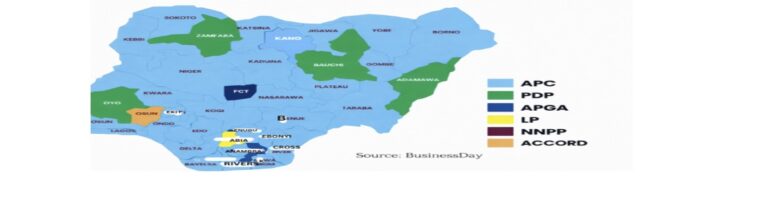
Nigeria’s democratic squeeze is most visible in the data. Across recent election cycles, victory margins have widened especially at the subnational level, competitive races have thinned, and opposition presence at state and local levels has steadily eroded. INEC results show a growing share of governorship and legislative contests decided by double-digit margins, while by-elections increasingly produce predictable outcomes shaped by incumbency advantage rather than voter swing. In several states, opposition parties have struggled to field viable candidates at all, creating de-facto uncontested or low-competition races.
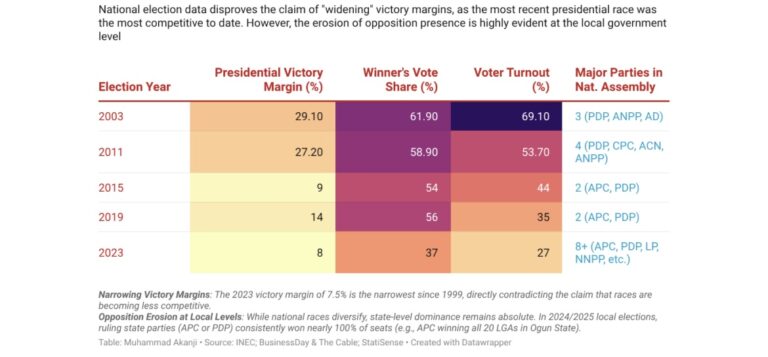
Defections amplify the pattern. High-profile cross-carpeting- often just months before elections-has hollowed out opposition structures and transferred electoral machinery to the ruling party without a single vote cast. Meanwhile, voter turnout continues to trend downward, falling well below historical averages, signalling disengagement rather than satisfaction. When elections feel foregone, participation becomes rationally optional.
Taken together- wider margins, shrinking opposition, elite defections and declining turnout- the numbers point to a system where elections still occur, but competitive uncertainty, the lifeblood of democracy, is quietly fading.
Nigeria’s Political Faultline: Opposition Without Oxygen
Nigeria’s multiparty democracy is increasingly constrained not just by institutions, but by identity-driven political fault lines. Despite the aspirations of the country’s founding fathers, national unity remains fragile, shaped by enduring ethnic, regional, religious and indigeneity divides.
These cleavages- reinforced by the informal North–South power rotation and the six geo-political zones- now structure political competition as much as policy or performance.
As the 2027 election approaches, intensifying debates over zoning and presidential rotation are reshaping alliances and fragmenting opposition coalitions. Rather than coalescing around issue-based platforms, opposition parties are pulled apart by regional calculations and elite bargaining, weakening their national appeal. This fragmentation compounds funding asymmetry, regulatory pressure and elite defections, leaving opposition parties organisationally thin and electorally brittle.
The outcome is a system where multiple parties exist, but few can compete credibly at scale. Identity politics crowds out programme-driven campaigns, narrowing voter choice and deepening the paradox of elections with plurality, but diminishing competition.
Absence of Institutionalised Party System
Nigeria’s shrinking electoral contest is increasingly driven by voter withdrawal rather than voter choice. Turnout data tells the story: participation has fallen from above 50% in the early Fourth Republic to about 27% in the 2023 general elections, one of the lowest rates globally for an emerging democracy. This decline reflects not apathy alone, but a rational response to a system where outcomes feel pre-determined.
At the core is Nigeria’s weakly institutionalised party system. Political parties remain poorly differentiated, ideologically thin, and heavily shaped by ethnic, regional and elite interests. While the 2013 merger that birthed the APC briefly promised national integration, both dominant parties- the APC and PDP- now exhibit similar traits: elite capture, patronage-driven mobilisation, internal instability and limited policy coherence. As a result, elections increasingly substitute mobilisation with inevitability, where defections, zoning calculations and incumbency power overshadow voter persuasion.
Economic stress deepens disengagement. Persistently high inflation, unemployment and declining real incomes erode trust in political actors’ capacity to deliver change. Weak oversight by INEC, civil society and the media further dilutes accountability. The consequence is a democratic paradox: elections persist, parties multiply, yet citizens quietly exit—leaving competition thinner, accountability weaker, and democracy more procedural than participatory.
Threats to 2027 General Elections
As Nigeria edges toward the 2027 general elections, the danger is no longer the absence of elections, but the hollowing out of their meaning. The threat landscape is layered and mutually reinforcing. Insecurity—from insurgency and banditry to election-day violence—continues to shrink civic space, silently disenfranchising communities before ballots are even printed. Institutional fragility, marked by uneven enforcement of electoral rules and delayed reforms, weakens confidence in the referee meant to guarantee fairness.
Equally corrosive is the collapse of competitive politics. Weak party institutionalisation, elite defections, and identity-driven alliances are turning elections into elite negotiations rather than citizen choices. When outcomes feel settled upstream, voter participation becomes optional—and turnout declines become rational, not accidental. Add economic distress—high inflation, unemployment, and declining trust in governance—and democratic withdrawal accelerates.
Yet the gravest risk is normalization. When low turnout, uncontested races, and muted opposition become routine, democracy erodes quietly, without crisis headlines. The 2027 elections will therefore test not just logistics or technology, but Nigeria’s commitment to political competition itself. Without urgent action-security guarantees, party reform, credible oversight, and citizen re-engagement- Nigeria risks elections that are procedurally sound, but substantively empty. The danger is not breakdown, but democratic thinning by design and neglect.
Interventions ahead of 2027 General Election
Nigeria’s democratic journey is not a fixed destination but a fragile continuum—and in an era of global democratic backsliding, there are no quick or painless fixes. The gradual erosion of electoral competition, institutional credibility and citizen participation signals deeper structural stress, not temporary malfunction. If left unaddressed, these pressures risk hardening into a new political normal where elections endure, but democratic choice thins. As the 2027 general elections draw closer, the challenge before stakeholders is no longer incremental reform, but democratic preservation. Without deliberate, coordinated and early intervention, the coming polls may entrench existing weaknesses rather than correct them.
The following measures are therefore essential- not as guarantees of renewal, but as minimum safeguards against further democratic contraction.
Safeguarding Nigeria’s 2027 Elections: Priority Interventions
1. Close the Reform Window: Finalize Electoral Act amendments early to eliminate uncertainty and pre-empt disputes.
2. Protect INEC’s Independence: Enforce transparent, merit-based appointments for Electoral Commissioners.
3. Lock in Electoral Technology: Legally safeguard BVAS and iREV against suspension or selective use.
4. Test the System Early: Use the 2026 Ekiti & Osun off-season elections to rebuild confidence and fix weaknesses.
5. Re-engage the Voter: Scale civic education to counter apathy and restore electoral agency.
6. Secure the Ballot: Deploy intelligence-led, non-partisan election security frameworks.
7. Fight Digital Distortion: Counter fake news, disinformation and deepfakes through rapid-response coordination.
8. Build Lasting Institutions: Strengthen electoral bodies, courts and civil society beyond 2027.

Join BusinessDay whatsapp Channel, to stay up to date
Open In Whatsapp