Nigeria’s real estate securities are entering a decisive phase as macroeconomic stabilisation, infrastructure expansion, and asset repricing combine to reshape returns across the property market.
While the real estate sector accounted for roughly 4.23 percent of Nigeria’s GDP in the second quarter of 2025, highlighting its macroeconomic significance, institutional investment still represents less than 10 percent of the total property market, revealing substantial room for capital market expansion, according to the 2026 Nigeria Real Estate Market Outlook Report by Panterra.
The report also estimates Nigeria’s housing deficit at about 28 million units, underscoring the depth of latent demand that continues to underpin long-term property valuations.
Against that backdrop, listed property funds are becoming a focal point for investors seeking exposure to the country’s urbanisation and infrastructure cycle without the illiquidity of direct property ownership.
Read also: Expert offers insights on why global funds elude Nigerian property market
Infrastructure corridors reshape asset valuations
The strongest structural driver of real estate returns is no longer simply population growth or inflation hedging, but infrastructure geography. The 2026 outlook report emphasises that transport investments and urban regeneration projects are now directly influencing rental growth, asset absorption rates, and land values, particularly in districts linked to logistics routes and commercial corridors.
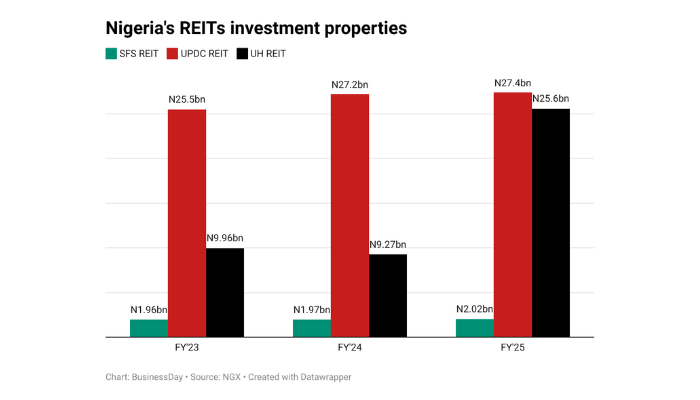
This shift is already visible in portfolio data. According to the full-year 2025 financial statement of three listed real estate investment funds (REIT), UPDC REIT reported the highest investment property portfolio value at N27.4 billion in FY25, from N25.5 billion in FY23, followed by UH REIT, which increased its holdings from N9.96 billion to N25.6 billion over the same period, and SFS REIT expanded its investment property portfolio steadily from N1.96 billion in FY23 to N2.02 billion in FY25.
These funds have tilted allocations toward growth districts benefiting from new road networks, mixed-use developments, and logistics-driven demand.
The implication is that infrastructure is not merely supporting the real estate sector; it is actively redistributing value within it.
Earnings divergence signals structural repricing
Financial performance across listed funds confirms that Nigeria’s real estate market is entering a phase of selective repricing rather than uniform expansion.
Earnings per share trends illustrate this divergence clearly; SFS REIT’s EPS surged by 32.8 percent to N31.72 in FY25, reflecting consistent income growth and possibly favourable revaluations. UH REIT also posted steady gains, rising by 11.8 percent to N6.22 across the same period.
UPDC REIT, however, recorded a different trajectory. After edging up from N1.43 to N1.76 between FY23 and FY24, its EPS fell to N0.84 in FY25. Such a decline often signals asset write-downs, refinancing costs, or occupancy challenges and mirrors broader sector findings that secondary assets face greater pressure than prime properties.
The outlook report notes that prime commercial buildings continue to attract tenants and maintain rent resilience, whereas lower-grade properties are more exposed to vacancy risk and are more likely to have leases renegotiated.
“This divergence suggests that Nigeria’s property cycle is becoming quality-driven, rewarding funds that hold modern, strategically located assets,” the report said.
Total income figures reinforce that interpretation. UH REIT’s revenue surged from N884 million in FY23 to N1.39 billion in FY25, an increase that likely reflects major acquisitions, revaluation gains, or income reclassification. SFS REIT’s growth was more gradual but stable, rising from N395 million to N716 million. UPDC REIT remained the largest earner at N3.02 billion in FY25, though its growth slowed significantly, indicating maturity or restructuring.
The dispersion indicates that size alone is no longer the dominant determinant of performance. Asset positioning, financing strategy, and tenant mix now play a greater role in determining returns.
Read also: Rising commercial property demand signals economic rebound
Rental markets show early recovery signals
Rental income trends suggest that Nigeria’s property market may be stabilising after several years of macroeconomic volatility. Combined rental income across the three listed funds rose to N2.6 billion last year from N2.1 billion reported in 2024, driven by higher occupancy levels and improved pricing.
Individually, SFS REIT increased rental income from N205 million in 2024 to N219 million last year, UPDC REIT from N1.44 billion to N1.73 billion, and UH REIT from N454 million to N723 million. The pattern indicates broad-based strengthening rather than isolated gains.
Industry data attributes this recovery to structural supply constraints. The Risevest’s Cost of Living Report 2025 explains that rising construction costs and currency depreciation have slowed new development, limiting fresh supply while demand continues to expand. In such conditions, existing property owners gain pricing power because replacement costs for new buildings rise sharply.
“Currency movements have reinforced this effect. Depreciation increases the cost of imported materials, making new construction more expensive and, in turn, boosting the value of completed buildings. For listed property funds, whose portfolios consist primarily of finished assets, this dynamic functions as a natural hedge against inflation and exchange-rate volatility.” It said,
At the same time, corporate leasing activity has begun to recover as businesses adjust to the post-reform economic environment. The report notes that demand for high-quality space is now outpacing supply in key urban centres, a trend that is gradually restoring landlords’ negotiating leverage.
Market performance reflects investor repositioning
Equity market performance suggests investors are already repositioning portfolios toward real estate funds expected to benefit from the next property cycle.
Insight from Risevest’s Cost of Living Report shows that real estate emerged as the most preferred investment asset among respondents in Nigeria, Ghana, Kenya, and Uganda in 2025.
The report revealed that real estate captured the largest share of investment allocations among 19,000 surveyed respondents. Stocks and mutual funds followed, reflecting continued reliance on traditional financial instruments.
Real estate accounted for 22.32 percent of investment allocations. Stocks made up 20.51 percent, while mutual funds represented 18.10 percent. Fixed deposits captured 7.54 percent, cryptocurrency 5.28 percent, agritech 0.60 percent, and other investments 10.71 percent. Overall, 85.1 percent of respondents were active investors, while 14.93 percent did not engage in any investment activity during 2025. It said.
In Nigeria, REITs such as SFS REIT, UPDC REIT, and UH REIT, along with the MOFI Series 2 Real Estate Investment Fund, provide liquidity and long-term value.
Data from the African Stock Exchange, a market analytics platform, showed that SFS REIT posted a 52-week high gain of 112 percent, while UH REIT recorded a 52-week high gain of 89.2 percent. UPDC REIT trailed at 28.2 percent. Year-to-date data as of February 12, 2026, shows continued momentum: UH REIT is up 33.6 percent, and UPDC REIT is up 15.2 percent.
Market capitalisation figures also highlight shifting investor preferences. UPDC REIT remains the largest listed fund at roughly N21.2 billion, followed by UH REIT at N17.3 billion and SFS REIT at N8.38 billion. Yet SFS REIT’s stronger price appreciation suggests investors are rewarding growth prospects over sheer size.
Why macro reforms matter
In Nigeria, the statistical rebasing of inflation improved how the numbers are calculated, but did not ease the burden of high food prices.
According to the National Bureau of Statistics, the headline inflation rate for December 2025 stood at 15.15 percent, using a 12-month index reference period where 2024 is equated to 100.
However, analysts at FMDA, in its January inflation forecast, have disclosed that headline inflation is expected to rise mechanically to around 18.98 percent year-on-year, reflecting base effects rather than renewed price acceleration.
Inflation typically causes rents to rise as landlords raise rates to cover higher property taxes, maintenance, and utility costs. This upward pressure often leads to annual rent hikes, reducing tenants’ purchasing power and forcing them to allocate a larger share of their income to housing, thereby tightening their budgets.

Join BusinessDay whatsapp Channel, to stay up to date
Open In Whatsapp