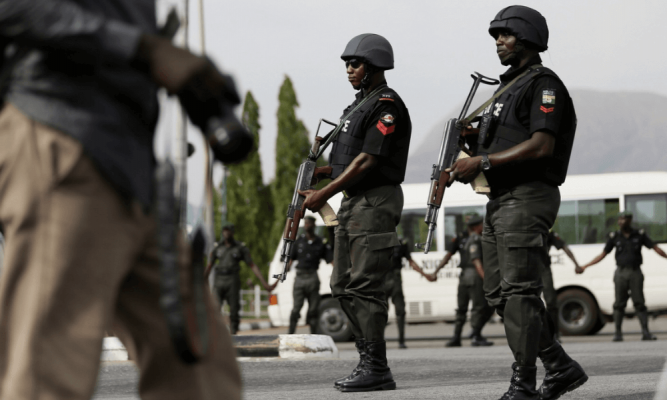
The conversation currently dominating the Nigerian airwaves is no longer about politics—it is about survival. My recent appearance on News Central TV centred on a document that could fundamentally redefine the Nigerian state: the 75-page framework for state policing submitted by the Inspector General of Police to the Senate to anchor a new policing system of Africa’s most populous Black nation.
As a political scientist observing from the United States and having cut my teeth in the trenches of student unionism at Obafemi Awolowo University (OAU), I see this moment as a definitive “readjustment” of our national trajectory. We are living in a 2026 reality that the 1999 Constitution was never built to sustain. To continue clinging to a purely centralised security model is not just an administrative choice; it is a structural failure.
A relic of the past vs. the demands of the present that loom
During my interview, I was clear: “The idea to readjust or make an amendment [to the constitution] is not just an option; it is a fundamental and structural need.” Our current policing system remains an artefact of the Exclusive Legislative List—a colonial and military hangover that treats a nation of over 200 million people as a single, manageable monolith.
The truth is that security is inherently local. Whether we are discussing the United States or the United Kingdom, the most effective policing happens when those wearing the uniform are woven into the fabric of the community they protect. As I noted on air, “Security itself is a very pervasive topic,” but to solve it, we must “localise what is one of our major problems in Nigeria today. ” You cannot effectively mitigate a communal clash in the Middle Belt or an insurgency in the Northeast from a centralised command in Abuja that is disconnected from local intelligence and cultural nuances.
The innovation chokehold
Beyond the immediate loss of life and property, the centralised security failure is an economic anchor. I highlighted that the current polarised security state has “actually made a lot of people stay away from development, growth, and innovations in Nigeria.” We are in an era where technological innovation should be driving our economy, but innovation requires stability. When a farmer cannot reach their field and a tech hub cannot guarantee the safety of its infrastructure, the “Renewed Hope” agenda becomes a distant dream. By decentralising police, we aren’t just fighting crime; we are unlocking the economic potential of 36 states.
Navigating the “Political Misuse” minefield
Critics, including my co-panellist Dr Ashim, rightfully point to the risks. They fear “ethnic police” or that state governors will use these forces as personal political tools—much like the perceived manipulation of State Independent Electoral Commissions (SIECs). These fears are not unfounded, but they are also not an excuse for inertia.
My response to these concerns is rooted in a single word: ‘accountability’. In my final remarks on News Central, I stated that “Accountability has been one basic problem that is lacking when it comes to policing in Nigeria.” To move forward, we must ensure:
• Constitutional Guardrails: The framework must insulate state police from the direct whim of the State House.
• A-Political Modalities: Recruitment and promotion must be merit-based and overseen by independent boards, not political appointees.
• Federal Oversight: The federal government should keep a “standardising” role, ensuring that human rights and national cohesion are never sacrificed at the altar of state autonomy.
From #EndSARS to a new social contract
We must also acknowledge the ghosts of our recent history. The #EndSARS movement was a cry for a police force that serves the people rather than oppressing them. As I mentioned during the interview, the demands of the Nigerian student and the youth are for a system that is visible, reachable, and accountable. State policing offers a path to a new social contract where the “policeman is your friend” isn’t just a hollow slogan but a community reality.
The 2027 Horizon
With the 2027 general elections on the horizon, the temptation to use security as a political football is high. But we must rise above the fray. I told the viewers of News Central that if these modalities are implemented with sincerity, “I actually see a safer and better Nigeria.” The 75-page IGP document is a starting point, but the finish line is a Nigeria where every citizen, regardless of their state of origin, can move, work, and sleep in peace. The time for the Senate to move from debate to implementation is now. Our survival depends on it.
Louis Awode is a current MBA student at Georgia State University, a political scientist, and a former student union leader (OAU) who joined News Central TV virtually from Atlanta, Georgia.

Join BusinessDay whatsapp Channel, to stay up to date
Open In Whatsapp