This week’s discussion highlights a fundamental reshaping of the global workforce, from the specific skills required in the boardroom to the pathways needed for millions of young people to enter it. The conversation covers the strategic integration of human and technical skills, the urgent need for educational reform, and a viral moment that underscores the public’s demand for financial transparency.
1. The New Career Capital: Why “Integrated Skill Stacks” Define the 2026 Workforce
LinkedIn’s annual “Skills on the Rise” report has developed from a simple list into a strategic guide for the modern professional. The 2026 edition marks a significant shift: AI proficiency is no longer a differentiator; it is the standard. The real competitive advantage now lies in the ability to combine essential human skills with technical expertise, resulting in what experts call an “integrated skill stack.”
The 2026 Landscape: AI is the Tool, Human Skills are the Craft.
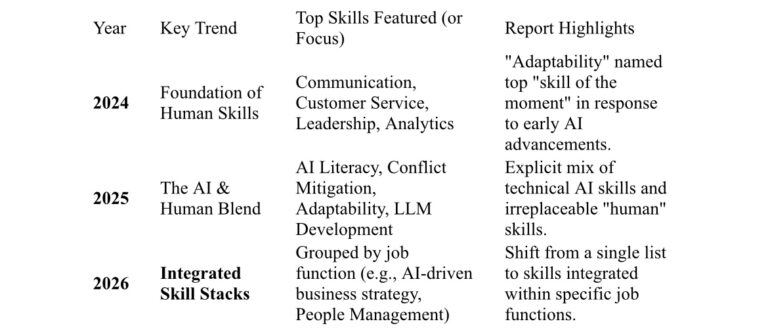
This year’s data, published on 24 February, moves away from a single, monolithic list. Instead, it groups high-growth skills by job function, demonstrating how AI is woven into the fabric of specific roles. The top rapidly expanding skill areas in the U.S. illustrate this blend perfectly.
• AI Engineering & Implementation: Data annotation; FastAPI; Google Gemini; LangChain; Model training and fine-tuning; OpenAI API; Prompt engineering; Retrieval-Augmented Generation (RAG); Vector databases; XGBoost.
• Operational Efficiency: logistics management; process optimisation; programme improvement; real-time monitoring; workflow automation.
• AI-Driven Business Strategy: AI for commerce; AI for design; Data governance; Responsible AI; Technology-enabled business transformation.
• Executive & Stakeholder Communication: client engagement; cross-functional coordination; leadership communication; project stakeholder management; public speaking; relationship development; shareholder communications.
• Financial Operations & Reporting: managing capital and expense budgets; reporting cash flow; analysing financial data; controlling inventory and pricing; reconciling reports; preparing U.S. GAAP reports.
• Leadership & People Management: Cross-functional team management; Leading distributed teams; Mentorship & coaching; Performance optimisation; Talent development; Team management.
• Business & Revenue Growth: Account development; Go-to-market strategy; Marketing plan development; New market expansion; Sales negotiation.
• Risk & Compliance Management: Federal & state regulatory compliance; Internal & external investigations management; Policy compliance; Quality assurance & control; Safety monitoring.
The Evolution of Value: From Novelty to Necessity
A look back at the report’s trajectory reveals a clear narrative about the workplace’s transformation:
Why This Matters: Three Key Takeaways
• AI is the Baseline, Not the Differentiator: AI literacy has moved from a niche skill to an expected prerequisite. The focus now is on its application to drive results in fields like marketing, finance, and sales.
• Human Skills are Your “Hard Currency“: As AI automates routine tasks, uniquely human abilities—conflict mitigation, cross-functional collaboration, and strategic communication—are becoming more valuable. Companies recognise that technology cannot replicate nuance, trust-building, and authentic leadership.
• Adopt a “Skills-First” Mindset: With nearly half of all recruiters now using skills data to find candidates, your specific capabilities are your most valuable asset. They often matter more than your job title or degree alone.
Methodology Note: LinkedIn ranks these skills by year-over-year growth, combining (a) members adding skills to their profiles and (b) hiring success for members with those skills, comparing the period of Dec 1, 2024–Nov 30, 2025 to the prior year.
2. The Learning Gap: A Global Imperative to Reskill a Generation
The demand for these new skill sets exposes a significant challenge: a deep disconnect between education and employability. According to Chris McCahan, IFC Sector Lead for Health and Education Services, this gap not only limits individual potential but also actively hampers global economic growth.
Writing on 18 February, McCahan presents a stark picture of the future. Over the next decade, approximately 1.2 billion young people in emerging economies will reach working age. Yet, with only about 420 million new jobs projected, and 480 million entering education or training, a staggering 300 million young people risk being left without opportunities for a decent livelihood.
To prevent this crisis, McCahan advocates for a fundamental reform of how skills are taught, focusing on three key innovations:
1. Connecting Learning to Livelihoods: Technology is swiftly redefining skills. By 2030, automation and AI could replace up to 92 million jobs, with developing markets—home to the largest skills mismatches—being most at risk. The solution involves directly linking education to market demands. Programmes like the IFC’s Vitae initiative, which helps higher education institutions create pathways for graduate success, serve as a model; it has already been adopted by over 200 institutions, reaching nearly three million students worldwide.
2. Making Digitalisation an Engine of Opportunity for All: Digital access is the new gateway to skills, yet it remains deeply unequal. With 2.5 billion people still offline—including a disproportionate number of women—progress risks widening inequalities. In 2024 alone, 189 million more men than women used the internet. Bridging this gap requires targeted investment and partnerships focused on inclusive access.
3. Pioneering New Forms of Global Collaboration: The scale of the challenge requires moving beyond siloed, short-term efforts. A united approach is essential, where:
o Private education providers supplement public efforts by expanding access to market-relevant training, especially in high-demand fields such as AI.
o Strong industry partnerships enable curricula to adapt swiftly to market needs, reducing skills mismatches.
o Governments enact policy reforms that encourage innovation, promote technology use, and embed work-based learning.
McCahan concludes with a compelling warning: without substantial investment in human capital, economies will fail to reach their potential. The decisions made today—in financing, policy, and partnership—will determine whether a generation prospers or is left behind.
3. The Dangote Mirror: Why 11,000 Indians in Nigeria is a Wake-Up Call for All of Africa
Some truths do more than just bruise our egos. They shatter our comforting illusions, strip away our hypocrisy, and leave us staring, exposed, at the reality we have created. The Dangote refinery situation is one of those truths.
The stark reality is this: 11,000 Indian technicians were brought in to build and operate a world-class refinery, reportedly because Nigeria couldn’t find 100 qualified locals. This is not an isolated incident in Africa’s most populous nation and largest economy. It is a clear symptom of a disease that has metastasised across the entire African continent.
Many will cry foul, calling it a scandal. But look closer. What we are witnessing is not a scandal; it is a reflection. And a mirror never lies.
1. Africa Wasn’t Conquered by Armies, but by Polytechnic Institutes
Aliko Dangote is not “anti-Nigerian.” He is pro-competence. He needs people who can operate a $20 billion refinery. Period. The real humiliation isn’t that he chose Indians; it’s that he had no choice. It is not India that has defeated us, but our own systemic failure to develop the skills needed to match our ambitions.
The story is painfully familiar: while Africa hosts numerous summits, national dialogues, and conferences on youth empowerment, India has been quietly building classrooms. While we politicise and underfund technical education, they have been professionalising it. While our universities produce graduates with theoretical degrees but lacking practical skills, India’s training institutes generate tens of thousands of operational, job-ready technicians.
Indians didn’t take our jobs by force. They arrived with their skills, tools, and training. They filled a vacuum we created.
Without Skills, Even Our Billionaires Become Dependent
Dangote isn’t the issue; he is the result. His situation demonstrates that enormous wealth cannot compensate for a lack of human talent. A country may have oil, cobalt, lithium, and gold, but without skilled people to extract, process, and add value to them, we remain merely tenants in our own land.
Our role in this global economy has become predictable: we provide the land, raw materials, and tax incentives. Others supply the brains, technology, and expertise. And when the project ends, they take the lion’s share of the value—and the knowledge.
We can build a world-class port in 18 months using foreign labour, yet it takes us 25 years to reform the curriculum of a single technical high school. That stark contrast should wake us up.
Technical Education: Our Silent Waterloo
The fight for our economic future is not won in the boardrooms of Lagos, but in the dusty, run-down workshops of our technical colleges. Where they still exist, these institutions are often mere shadows of what they should be, operating on:
• Machinery from the 1980s.
• Teachers who haven’t received training in decades.
• Curricula that are frozen in time, irrelevant to modern industry.
• Workshops that have been repurposed into storage rooms.
• A societal stigma that labels technical students as “less brilliant” than their peers on the university track.
This is where India outperforms us. It starts in the classroom. As long as African parents aim for their children to become lawyers and doctors but look down on careers in industrial mechanics, mechatronics, or petrochemical engineering, we will remain dependent. The modern world relies on these skills, yet we continue to see them as second-class disciplines.
The Nigerian Problem is the African Problem
What is happening in Nigeria today reflects the future of every African nation that fails to learn the lesson. The Democratic Republic of Congo, Kenya, Cameroon, Senegal—we are all fighting the same battle.
Take a moment and look around:
• Foreigners repair and maintain our power plants.
• Our mines are calibrated by foreign engineers.
• Our dams are built by foreign contractors.
• Our data centres are configured by foreign technicians.
• Our roads are paved by foreign companies.
We cut ribbons, take inaugural photos, and applaud progress, as if development were a photo opportunity. True, sustainable development begins the day we are able to carry out these fundamental, vital operations ourselves.
The Mental Revolution: Transforming Technical Schools into Talent Factories
There is no quick fix. We don’t require another “Vision 2030” or empty slogans displayed on billboards. What we need is a fundamental change in mindset and a large-scale, coordinated investment in human capital.
Development is built by:
• Qualified welders who can pass international certification.
• Certified electronics technicians who can build and repair our digital infrastructure.
• Industrial mechanics who can keep our factories running.
• Petrochemical technicians who can operate our refineries.
• IT professionals who don’t just use software, but can code, repair, program, and assemble hardware.
Africa must professionalise its technical education on a large scale. Not training 200 students a year, but 50,000 to 100,000 per country annually.
Only then will the next Dangote—and all the Dangotes across the continent—find the talent they need locally.
The Dangote Truth: It’s Not a Scandal, It’s a Reckoning
Africa will never command respect on the global stage as long as we must outsource the very thinking and doing that defines a modern economy. Dangote does not humiliate Africa; he is holding up a mirror to our failures.
The question we should be asking is not, “Why does he employ 11,000 Indians?” The real, urgent question is, “Why have our education systems failed to produce 11,000 Nigerians who could take those jobs?” This question resonates from Lagos to Kinshasa, from Nairobi to Accra. It applies to all of us.
We must take a page from the Indian playbook. They invested in their people. We must do the same. It is time for us to take our jobs back—not with anger or protest, but with competence and skill.
Copied.
4. The Anambra N100m Mystery: A Test of Public Trust in the Digital Age
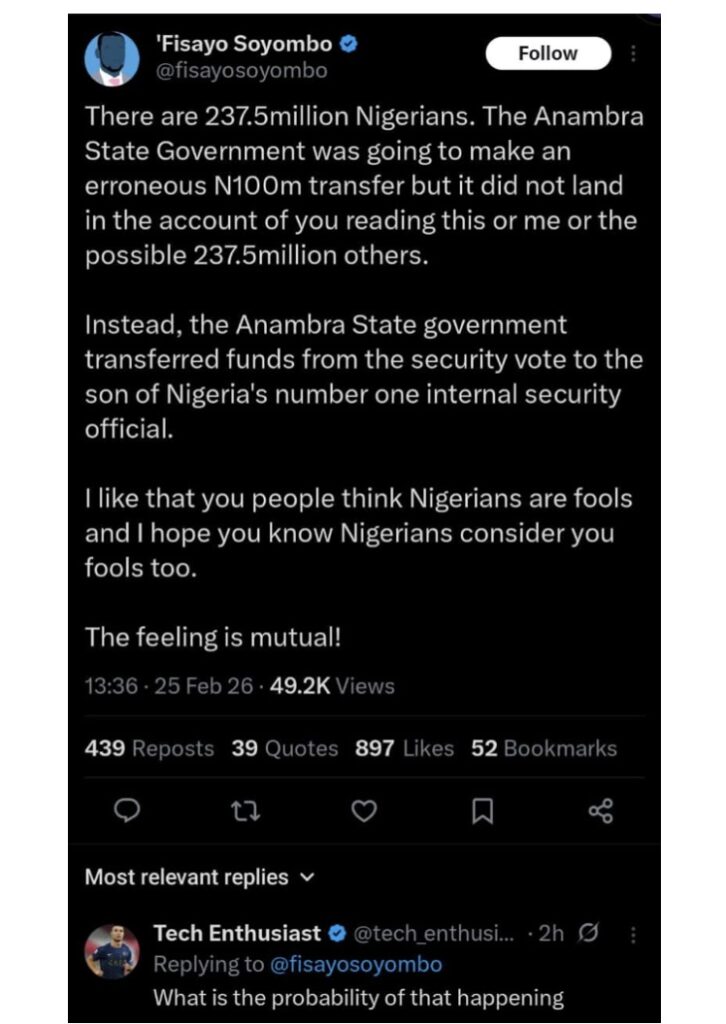
Absent from international trends, a local story in Nigeria has captured the public’s imagination and scepticism, serving as a compelling example of the demand for governmental transparency. The controversy involves an alleged erroneous transfer of ₦100 million from an Anambra State Government account to Victor Egbetokun, son of the retired Immediate Past Inspector General of Police, Kayode Egbetokun.
The Narrative and the Dispute:
• The Allegation: Online reports claimed the Anambra State Government mistakenly transferred ₦100 million from its security vote to Victor Egbetokun’s account in four tranches of ₦25 million each in September 2025.
• The Police Confirmation: The Nigeria Police Force, through spokesperson Benjamin Hundeyin, confirmed the transfer to Mr. Egbetokun’s account but dismissed the state’s involvement, calling it a “banking error.”
• The Action Taken: According to police, Mr Egbetokun noticed the funds, immediately instructed his accounts officer to reverse the transaction, and the full amount was returned. He reportedly closed the account and filed a petition with the EFCC to investigate the source of the erroneous payment.
• The State’s Denial: Anambra State Governor’s Press Secretary, Mr. Christian Aburime, firmly denied the responsibility of the state government, insisting it was an “honest error” not of their making.
• Public Outcry: The incident has triggered widespread outrage and deep scepticism. The main concern among the public is a question of plausibility: how can a sum equivalent to the annual budget of a small local authority be mistakenly transferred from a state security vote to the son of the nation’s former top police officer? Critics are calling for a thorough investigation and clear explanations from both the bank and the Anambra State Government, highlighting deep-rooted anxieties about the management of public funds.
In summary, while the money has been returned, the core mystery—who or what caused this “error”—remains unsolved, leaving a cloud of suspicion and a powerful lesson in the public’s insistence on accountability.

Join BusinessDay whatsapp Channel, to stay up to date
Open In Whatsapp