The Passion Week is the most critical week in Christendom, as it marks the suffering, crucifixion, death and, ultimately, the resurrection of Jesus Christ on Easter.
Christianity would have been ‘nothing’, as Gumi’s father audaciously declared, if not for the resurrection. For those of you who are ‘new’ to the Nigerian side of the planet, Gumi’s father said worse things than the current Gumi, who continued and continues from where his father stopped because his father got away with it! Imagine what would have happened if a Christian had said that Islam was NOTHING!
I had argued a long time ago that the Bible is the foundation of management principles and practices. The history of management generally starts with F. Taylor and his treatise on scientific management as published in 1911 and vociferously defended before a special house committee in 1912. Henry Fayol is also acknowledged as the father of modern management. However, Moses was the earliest manager, and his father-in-law, Jethro, was the first management consultant. Moses was single-handedly managing the affairs of the newly independent Israeli community and was thus on duty from AM to PM. His visiting in-law felt that it was a very suicidal task for one man. He therefore advised Moses to divide the people into groups and sub-groups and appoint capable leaders over them who would manage their problems and refer only difficult cases to him (Exodus 18:13-24). An analysis of this consultancy package shows that it was indeed Jethro who “invented” the currently popular management principles and practices of departmentation (alphanumeric), delegation, empowerment, and management by exception.
Of course, everything is in the Bible, including eye shadow/mascara (2 Kings, 9:30), fashion madness by women (Isaiah, 3:24), wealth of nations (Isaiah, 60:5; 60:11; 61:6), and events management (Esther, 1:5-7). Millo (2nd Chron, 32:5), STAY of execution (Daniel, 2:16), cross-examination (Ps 35:11), human rights (Lamentations, 3:35), lip service & eye service (Mt, 15:8; Isaiah, 29:13; Colossians, 3:22), murder and manslaughter (Exodus, 21:12-13), kidnapping (Exodus, 21:16), area boys and false witnesses (Acts, 17:5; Acts, 6:8-14) and isolation centre (2 Kings, 15:5)
Today, my focus is on ‘people-pleasing’, a managerial practice that usually yields disastrous outcomes because, in an attempt to please ‘the people’, leaders end up not pleasing anybody and committing unpardonable and regrettable blunders. This is what our people mean when they talk about nwanyi-obioma (the kind-hearted woman), who ‘distributes’ alarmingly (opens up to everyone) because she does not want to offend anyone by saying no!
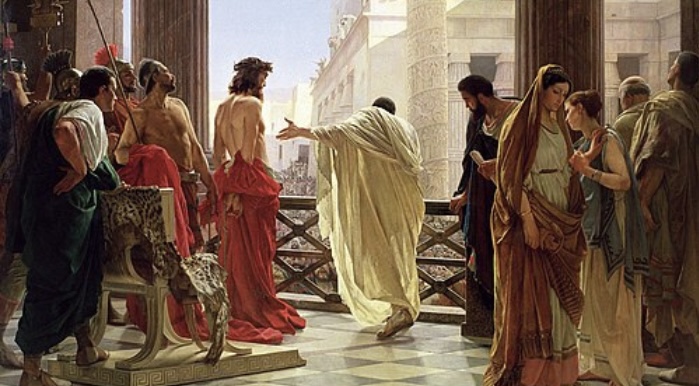
Today, 2/4/26, is Maundy Thursday, the day when Pilate handed Jesus to ‘the people’. The Jews and other defenders of the status quo, because of jealousy, bruised ego, and fear, decided to kill Jesus. They found no legal infraction (MT, 26:60) and thus accused him of threatening to demolish and rebuild the temple within 3 days. It was not in the law, and in any case, he had not even attempted to demolish the temple. Pilate knew that they were acting out of jealousy (Mt, 27:18); that he committed no offence (Mt, 27:23) and certainly not one that deserved death (Luke, 23:13-21); that it was an arranged matter because they brought conflicting witnesses (Mark, 15:56); and that his wife had advised him not to have anything to do with ‘this innocent man’s death’ (Mt, 25:19).
However, in order to please and placate the people (Mark 15:15), who had been mobilised by the elders to call for his head (sounds familiar?), he released Barabbas, a certified criminal and public enemy, washed off his hand, declared himself innocent and handed Jesus over to them to kill. Well, washing off his hand notwithstanding, anytime and anywhere Catholics gather, they recall that Jesus was killed under Pontius Pilate.
Incidentally, Pilate had precedence! Herod had ‘acquired’ his brother’s wife, and John the Baptist, the forerunner of Jesus, told him plainly that it was wrong. The woman in question would have wanted the ‘final treatment’ for him, but the king knew that the man was right and, most importantly, he feared the people, and so he was kept in jail. Then one day, in a mood driven most likely by drunkenness, he promised the daughter ANYTHING she wanted, even if it is half of his kingdom… just because she danced! The evil woman, who was highly rated in the other room and coquettish gymnastics, seized the opportunity and demanded through the daughter, the head of John the Baptist, ‘here and now’! The king was in a fix. He knew it was quite wrong, but because he could not renege on his public promise before the people, he ordered John’s head and handed it to the girl who handed the ‘trophy’ to her mother. (Mark 6:14-29). I still wonder what that vain woman did with the ‘head’. And what did Herod gain beyond the applause as a man who kept his promise? And today, the story of how he beheaded John just to be seen as a promise-keeper is being retold regularly.
These two instances resulted in death, but there were also other, less-deadly examples of people-pleasing in the Bible. The authorities kept Paul in prison so as to please the people (Acts 24:27), and when Herod saw that the beheading of James pleased the people, he went on to arrest Peter (Acts 12:2-3). And long before all this. The king threw Daniel into prison despite his best instincts so as to please his officials. (Daniel 6:11-28)
As in the days of old and as it is today, people-pleasing is not the best at the individual, corporate or social level. At the corporate level, a people-pleaser CEO will run the organisation aground because he does what pleases his people rather than what leads to the attainment of organisational objectives. There will be no discipline, and everybody does his own thing his own way. This does not mean that there should be no empathy. At the individual level, the people-pleaser is taken for granted, and his interests are abandoned as he is trying to please others. A society run on a people-pleasing paradigm will be extremely disorderly. Even in government, it leads to a very strange order of priorities, like building burial grounds and conducting mass weddings rather than working for the people’s concrete welfare.
Ik Muo, PhD, Dept. of Business Admin, OOU, Ago-Iwoye. 08033026625

Join BusinessDay whatsapp Channel, to stay up to date
Open In Whatsapp