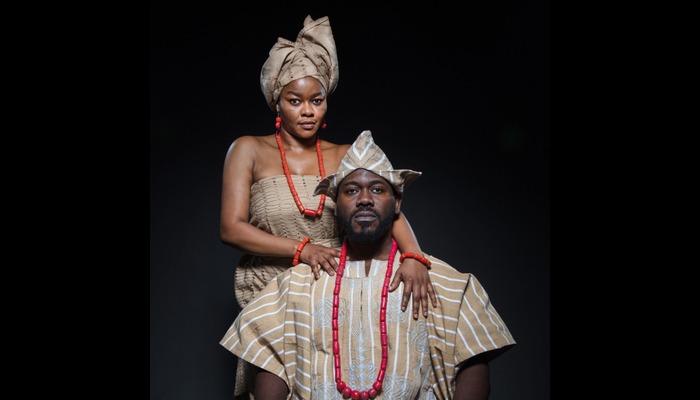
Watching Crown of Blood, a Yoruba reimagining of Shakespeare’s Macbeth, I found myself thinking about its implications for education. Written by Oladipo Agboluaje and directed by Mojisola Kareem, the production reworks Shakespeare’s tragedy within the cultural and historical world of nineteenth-century Yorubaland. I find myself thinking more strongly now about the educational possibility such a production opens for African students who encounter Shakespeare through global curricula such as GCSE and IGCSE, especially when that possibility is carried with such discipline and conviction by actors like Deyemi Okanlawon, Kehinde Bankole, and Tunji Falana, among others.
For many students, Shakespeare is compulsory and distant at the same time. They are expected to interpret texts shaped by histories, settings, and social contexts far removed from their own lives. Mediaeval castles, feudal loyalties, and the strange world of the “Weird Sisters” may be intellectually rich, yet for many African students, they can also feel culturally remote. In such situations, students may memorise quotations and themes for examinations without entering fully into the emotional and moral world of the play. This is because, when literature remains at that distance, engagement often becomes mechanical. Students learn how to answer questions, but not always how to think through the text itself. They identify symbols and repeat critical points, while the play remains something external, something inherited but not fully entered.
A production like Crown of Blood offers another route into Shakespeare by placing the tragedy within a cultural world that many African students can approach with greater familiarity. The central questions remain intact: ambition, prophecy, power, loyalty, and moral consequence. Yet these questions now unfold through Yoruba cosmology, social structures, and performance traditions. Ifa divination replaces the witches, and kingship is expressed through cultural contexts that do not feel as distant.
The effectiveness of this approach depends significantly on performance. Okanlawon’s Aderemi carries both authority and vulnerability with a presence that gives weight to the character’s rise and unravelling. Bankole’s Oyebisi brings intelligence and emotional force to her role, allowing her words to move with both persuasion and consequence. Falana’s versatility across multiple roles, particularly as the Ifa priest Awosika, sustains the spiritual and political texture of the production with notable control. Through such performances, Shakespeare’s dramatic world is presented in ways that audiences can hear, see, and feel within a familiar cultural frame.
For students, this kind of encounter can reshape how the text is received. Shakespeare no longer appears solely as a distant European classic but as drama capable of engaging with their own cultural imagination. The ethical questions at the centre of Macbeth begin to feel more immediate when they are embodied through characters and structures that resonate more closely with the learner’s world.
This stance points to a broader consideration in education. If African students are to engage meaningfully with global literature, then access must extend beyond exposure to include pathways into understanding. Teaching methods, classroom discussion, and performance all play a role in making complex texts more accessible without reducing their depth.
The place of theatre within literary education deserves closer attention. Performance allows students to encounter character, motive, and moral tension in ways that the printed page alone may not fully convey. When that performance is grounded in cultural contexts familiar to the audience, the experience becomes even more immediate.
There is also a wider cultural dimension. African reinterpretations of canonical works place African performance traditions in conversation with global literature in ways that are intellectually assured and artistically grounded. They demonstrate that these texts can be carried and reimagined within African cultural worlds without losing their depth or complexity.
My position is not to replace Shakespeare’s original texts. Rather, I would say that students benefit from reading Macbeth alongside productions like Crown of Blood, as this invites comparison and encourages deeper engagement with how literature travels across contexts.
For schools, curriculum planners, and arts organisations, this points to a broader educational responsibility. Supporting culturally grounded interpretations of global texts offers students a more meaningful way into literature. Students can engage with Shakespeare with greater confidence and interpretive depth when it is encountered through worlds that feel closer to home.
Adeola Eze is a writer, educator, researcher, and publisher dedicated to literacy, education, and the transformative power of communication. She is the co-founder of Jordan Hill Creative Writing & Reading Workshop, Jordan Hill Publishing, and Learning Unleashed Magazine.
Join BusinessDay whatsapp Channel, to stay up to date
Open In Whatsapp