A new report has revealed that sectors dominated by women continue to lag in perceptions of gender equity, despite growing public acceptance of female leadership in Nigeria.
The 2025–2026 Reykjavík Index for Leadership, presented during a press briefing by Shirley Ewang, Advocacy Lead at Gatefield measured perceptions of women and men’s suitability for leadership across 23 sectors.
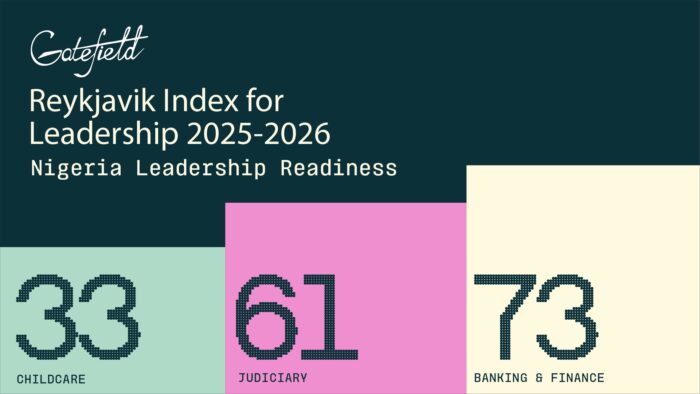
It found Nigeria’s lowest scoring sectors to be childcare scoring the lowest with 33 points, and Fashion and Beauty (46), reflecting enduring bias in industries perceived as female-dominated.
In contrast, the highest scoring sectors are Banking and Finance (73), Education (72), and Pharmaceutical/Medical Research (70).
The report showed that while Nigerians broadly view women as capable leaders, structural and cultural gaps prevent this perception from translating into actual leadership representation.
Overall, the Index score for Nigeria rose slightly to 59 out of 100, up from 57 in 2024, driven primarily by changing attitudes among men. For the first time since Nigeria joined the Index, improvements were largely male-driven: women’s scores remained at 61, while men’s scores increased from 53 to 56, narrowing the perception gap from eight points to five.
Despite the progress in perception, representation remains low. The report shows that while most Nigerians are comfortable with a woman leading, women occupy only 12% of CEO roles and 4% of National Assembly seats highlighting a stark disparity between comfort levels and actual representation.
The survey also found that 89% of Nigerians are comfortable with a woman CEO, and 77% with a woman as Head of Government.
Workplace equality beliefs, however, have hit a five-year low. The proportion of respondents who believe equality has been achieved at work fell from 62% in 2024 to 55% in 2025, with men more likely to report that equality has not been achieved.
The survey highlighted the influence of upbringing and personal experience on leadership perceptions: 30% of respondents cited family and upbringing, 18% education, and 16% personal experience. Media and religion each accounted for 9%, with no significant differences between men and women.
Nigeria’s overall score of 59 places it just below Germany (60) and ahead of Kenya (56), but below the G7 average of 68 and far behind global leader Iceland (86).
Experts say societal attitudes alone are no longer the barrier. Blessing Adesiyan, CEO of Caring Africa, said, “We expect women to carry the burden of care, but hesitate to see them as leaders shaping care systems. When care is treated as private, informal work rather than public infrastructure, women’s leadership in that space is systematically undervalued.”
According to Ekemini Akpakpan of WISCAR, public support exists, but institutional barriers prevent women from claiming leadership. Akpakpan said banking, finance, education, and medical research rank highest for gender equity, demonstrating that intentional policies, such as the Central Bank of Nigeria’s quota for women in leadership, can drive measurable progress.
Itunu Hunga of WILAN emphasised that government and political leaders must enforce merit, set targets, and hold each other accountable stressing that without women in leadership, democracy cannot reach its full potential.
The Reykjavík Index for Leadership, the first international measure of societal perceptions of women’s suitability for leadership, surveyed 1,082 working-age Nigerians and is weighted to reflect national demographics.
Join BusinessDay whatsapp Channel, to stay up to date
Open In Whatsapp