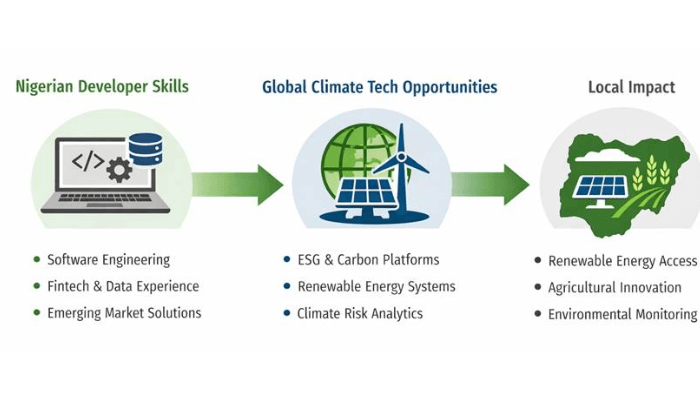
Five years ago, climate technology was largely absent from discussions within Nigeria’s software industry. Most graduates entering the tech sector focused on fintech, digital payments, or e-commerce platforms. Climate data systems, carbon accounting tools, and renewable energy management software rarely appeared in conversations about engineering careers.
That landscape is changing.
Climate technology goes mainstream
Investment in climate-related technologies exceeded €10 billion in 2024, while ESG analytics continues to expand rapidly. The sector includes carbon accounting platforms, renewable energy management systems, climate risk assessment tools, and sustainable supply-chain software.
Read also: NiMet engages global stakeholders on climate action at UN conference in Tokyo
Each relies on robust data infrastructure, software architecture, and engineering capacity, skills already familiar to many developers trained in Nigeria’s tech ecosystem.
Skills from fintech and logistics translate
For developers with experience in fintech or logistics platforms, the transition is straightforward. Fintech engineers are accustomed to operating within strict regulatory environments where data accuracy and system reliability are essential. Those skills translate directly to ESG analytics platforms that support regulatory reporting and compliance for institutional investors.
Engineers experienced in logistics or marketplace platforms already handle distributed networks, real-time data processing, and optimization problems—technical structures similar to those in renewable energy management systems and electricity distribution platforms.
Experience in emerging markets also carries relevance. Nigerian developers frequently design systems that operate under infrastructure constraints, including unreliable connectivity and limited computing resources. These design approaches align closely with the requirements of software used in energy access platforms, agricultural technologies, and environmental monitoring in developing economies.
Cross-disciplinary knowledge is key
Climate technology projects often demand collaboration across disciplines. Engineers work alongside climate scientists, energy engineers, financial analysts, and regulatory specialists.
Developing software for sustainability reporting may require understanding frameworks such as the EU taxonomy for sustainable activities or disclosure rules tied to sustainable finance regulations. Accuracy is critical, as climate analytics platforms inform investment decisions involving substantial capital allocations.
Software powers energy access and infrastructure
Companies deploying solar micro-grids or battery-powered energy systems rely on digital infrastructure to manage equipment performance, track energy usage, and coordinate payment systems. These platforms connect hardware with financial and operational monitoring, enabling reliable energy delivery.
Policy developments in advanced economies have accelerated demand for these systems. The European Union and the United Kingdom have introduced regulations requiring companies and financial institutions to measure and disclose environmental risks.
Compliance with these rules has created demand for software capable of tracking emissions, modeling climate transition risks, and producing regulatory reports.
Global opportunities for Nigerian engineers
Global demand is expanding opportunities for engineers familiar with data infrastructure and financial analytics. Climate risk platforms analyze building performance data, energy consumption patterns, and regulatory targets to estimate exposure to future environmental constraints.
Renewable energy software manages distributed electricity networks that combine solar generation, battery storage, and consumption forecasting. Nigerian engineers are increasingly contributing to these global projects, leveraging remote work and international hiring arrangements to participate in platforms serving Europe and North America.
Read also: Decarbonising Africa: An urgent response for holistic climate action
Climate tech and Nigeria’s development challenges
The relevance of climate technology extends beyond employment trends. Nigeria faces environmental pressures, including gaps in electricity access, urban flooding, and agricultural disruption linked to changing weather patterns.
Many technological responses to these challenges depend on software systems capable of managing environmental data, monitoring infrastructure, and coordinating resources.
A growing intersection between digital and physical systems
Climate technology represents a growing intersection between digital systems and physical infrastructure. Software increasingly supports energy networks, agricultural systems, buildings, and financial markets adapting to environmental constraints.
As these sectors expand, the demand for engineers capable of building reliable data systems and scalable digital infrastructure is likely to grow. Developers trained in Nigeria’s technology sector are well positioned to contribute as climate technology becomes embedded in the global digital economy.
Kelvin Oigiangbe is a Senior Software Engineer at BuildingMinds in Berlin, where he builds ESG analytics infrastructure for institutional investors. He previously led engineering teams at Reeddi, developing energy access platforms in Nigeria.

Join BusinessDay whatsapp Channel, to stay up to date
Open In Whatsapp