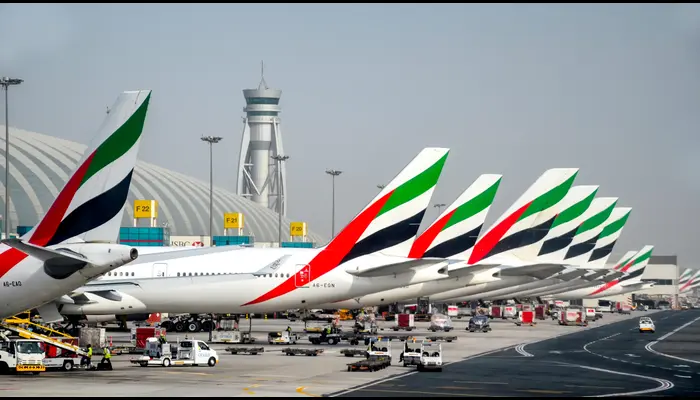
The United Arab Emirates (UAE) has successfully established safe air corridors in collaboration with neighbouring Gulf nations, currently facilitating a handling capacity of 48 flights per hour.
During a government media briefing on Tuesday, Abdulla bin Touq Al Marri, minister of Economy and Tourism, announced the activation of these emergency routes.
He noted that the capacity was determined by current security ratings but hinted at potential expansions.
“The capacity as of today, based on the emergency routes available, is 48 flights per hour, with a possibility of increasing this figure at a later stage according to the latest developments and security measures,” Al Marri stated.
Read also:UAE intercepts 137 missiles, 209 drones, urges public to rely on official sources
According to data, between March 1 and March 3, 17,498 passengers travelled across 60 flights. Looking ahead, the government has scheduled a further 80 flights with national carriers, expected to transport 27,000 passengers.
While flydubai has initiated limited operations, major carriers such as Emirates, Etihad, and Air Arabia are yet to resume full commercial schedules.
Minister Al Marri explained that the General Civil Aviation Authority is meticulously monitoring the situation to ensure a gradual and safe return to standard air navigation.
“Airspace safety and human safety will always remain our first priority,” Al Marri affirmed.
The Minister urged passengers to remain away from airports unless specifically contacted by their airline to prevent overcrowding. To support those affected by the disruption, he confirmed that the government has agreed to cover accommodation and meal expenses for stranded tourists.
Read also:Dubai International Airport records just 20 flights, down from over 1,200
Despite the regional geopolitical tensions, the Minister reassured the public that the UAE’s economic stability remains intact. He highlighted the country’s proactive strategies in absorbing external shocks, drawing parallels to its successful management of the Covid-19 pandemic.
Regarding domestic supplies Al Marri described the nation’s food security as a “red line.”
“The UAE has sufficient stockpiles of essential goods, and strategic reserves of key commodities which are adequate to cover domestic needs for a period of four to six months,” he maintained.
He further noted that import activities are proceeding without disruption and that authorities are monitoring stock levels daily to ensure continued availability through a broad international trade network.
The UAE’s tourism sector, comprising over 1,260 hotels, remains in a state of high preparedness. The Ministry of Economy and Tourism is reportedly working in tandem with local authorities to maintain service quality and guest safety.
By managing the current crisis through a structured institutional framework, the UAE aims to ensure business continuity while upholding the highest safety standards for all residents and visitors.
Join BusinessDay whatsapp Channel, to stay up to date
Open In Whatsapp