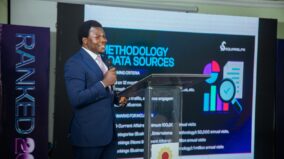
Sterling Bank has reaffirmed its position as a front-runner in sustainable agribusiness financing, pledging stronger investment in green and inclusive food systems to help Africa reclaim its food future.
At the Agricultural Summit Africa (ASA) 2025, holding November 6-7th in Abuja, Abubakar Suleiman, managing director and CEO of Sterling Bank, represented by Garba Muhammad, executive director, Alternative Banking, said Africa’s prosperity depends on its ability to “innovate, adapt and finance agriculture sustainably.”
“Feeding Africa is not just a moral imperative; it’s a business opportunity,” Muhammad said. “The future will belong to those who grow sustainably.”
He noted that Africa holds 60 percent of the world’s uncultivated arable land yet spends billions of dollars annually importing food.
“Our goal is to make agriculture profitable — from the smallest farmer to the largest agribusiness,” he added.
Sterling Bank’s strategy, he explained, centres on three priorities: unlocking green and innovative finance, driving digital transformation across value chains, and empowering smallholder farmers through access and inclusion.
“Agriculture remains at the heart of our mission to enable prosperity through purposeful investment in the real economy,” he said
The National Agricultural Development Fund (NADF) announced an on-lending partnership with Sterling Bank to derisk agricultural lending and attract private capital to high-impact but traditionally high-risk segments.
Mohammed Ibrahim, executive secretary, NADF said the Fund would deploy blended-finance tools and climate-smart frameworks to crowd in commercial investors.
“Our partnership with Sterling shows that catalytic finance can turn agriculture from a high-risk venture into a bankable, investor-friendly sector,” he noted.
Read also: Sterling bank rallies resources for Africa’s food security on World Food Day 2025
Also at the summit, Idi Mukhtar Maiha, minister of Livestock Development praised Sterling’s leadership in agrifinance and revealed plans to grow Nigeria’s livestock industry from $32 billion to $74 billion by 2035 under the National Livestock Growth Acceleration Strategy.
He urged banks to establish dedicated livestock desks to expand funding for pastoralists and processors.
“We are 230 million lions — Nigerians eat meat. It’s time financial institutions treat livestock as the engine of Africa’s food future,” he said
Muhammad concluded by calling for policy coherence and private-sector leadership to drive food sovereignty across the continent.
“Agriculture is no longer charity; it is enterprise. We must finance it sustainably and profitably,” he said.

Join BusinessDay whatsapp Channel, to stay up to date
Open In Whatsapp