..says Fund resilient despite headwinds

The Nigeria Sovereign Investment Authority (NSIA) has seen its net assets climb to a record N4.88 trillion, proving that the fund’s structural integrity remains intact even as the windfall from 2024’s currency volatility begins to evaporate. While the headline profit for 2025 took a sharp 91 percent dive to N161.1 billion, management remains adamant that the dip is an accounting byproduct of a stabilising Naira and temporary global market jitters rather than a sign of operational fatigue.

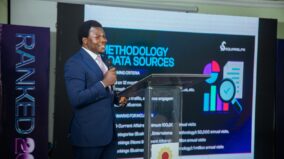
Aminu Umar-Sadiq, NSIA Managing Director, speaking Thursday in Abuja, characterised the year-on-year drop from N1.89 trillion as a return to reality after a period of exceptional, FX-driven gains. Much of the 2024 performance was padded by a massive N859.4 billion gain from the Naira’s depreciation—a figure that effectively flipped into a N322.4 billion net unrealised loss in 2025 as the currency found its footing. When these paper fluctuations are stripped away, the fund’s core operating income actually grew to N525.3 billion, up from N498 billion the previous year, marking the highest core comprehensive income since the authority’s inception.

The fund also had to navigate a brief but aggressive storm in the U.S. capital markets triggered by tariff announcements early in the year. Umar-Sadiq noted that while these shocks initially dragged down valuations for institutions with global exposure, the market corrected itself within months as investor confidence returned and trade negotiations matured. He dismissed the first-quarter weakness as a momentary lapse that has since been fully reversed, pointing to the fund’s 13-year streak of consecutive earnings expansion as proof of its long-term durability.

Read also: NSIA, UK’s Asset Green ink $496m deal to revolutionise Nigeria’s dairy sector

Beyond the balance sheet, the NSIA’s $3.4 billion net asset value reflects a disciplined growth strategy that has turned an initial $2.06 billion in contributions into a diversified powerhouse. This capital is increasingly being deployed into “boots-on-the-ground” economic development. Through its MedServe platform, the authority is currently scaling oncology and diagnostic services nationwide, backed by a $24.3 million boost from the World Bank and IFC.

The energy sector is seeing similar momentum. The NSIA is deepening its footprint in renewables with a 400MW solar PV assembly plant in Ogun State and a gas-fired power project in Victoria Island, both aimed at weaning the country off expensive diesel. On the innovation front, a new $50 million impact fund has been launched in partnership with the Japanese government to back high-growth startups in agriculture and water management, further cementing the authority’s role as a catalyst for private capital.

Even as it expanded its reach into housing initiatives with a N15 billion loan and transitioned the Presidential Fertiliser Initiative to a more sustainable, market-led model, the NSIA kept a tight grip on its internal wallet. Its cost-to-income ratio saw only a marginal increase to 4.2 percent, despite the inflationary environment and the one-off costs of hosting the Africa Sovereign Investors Forum. For Umar-Sadiq, the 2025 results are a testament to an institution built to weather the rainy days of global macroeconomics while consistently delivering on its dual mandate of profit and progress.

Join BusinessDay whatsapp Channel, to stay up to date

Open In Whatsapp