Being a speech delivered by Akinwumi A. Adesina, president and chairman of the Boards of Directors, African Development Bank (AfDB) Group, on the 20th Anniversary Dinner of Chapel Hill Denham, titled: ‘Reimagining Nigeria by 2050.’
Good evening everyone!
It is a great honor to be asked by Bolaji Balogun to speak to you tonight, as you join him and the rest of the wonderful partners and staff of Chapel Hill Denham to celebrate 20 years of the establishment of the company.
I congratulate you, Bolaji, and all your partners for your collective, inspiring and visionary leadership in establishing and growing Chapel Hill Denham.
I am impressed with how much the firm has grown. You have all grown into a first-rate independent investment bank; one that has won multiple awards and accolades including Euromoney awards.
Hearty congratulations to you all and your families!
Africa is proud of you.
Today, I have been asked to speak to you on ‘Reimagining Nigeria by 2050.’
If you are my age, we’d be 90 years old then!
So, let’s do a forward look.
As I travel around Africa, one common issue that never fails to come
up is when will Nigeria wake up and take its place in leading Africa.
As one Head of State told me ‘the day Nigeria develops, it will lift all of Africa with it.’
That development requires that we raise the bar on our economic growth and development. Nigeria needs more rapid economic growth to lift its people out of poverty. Nigeria unfortunately today has the highest number of extremely poor people in the world.
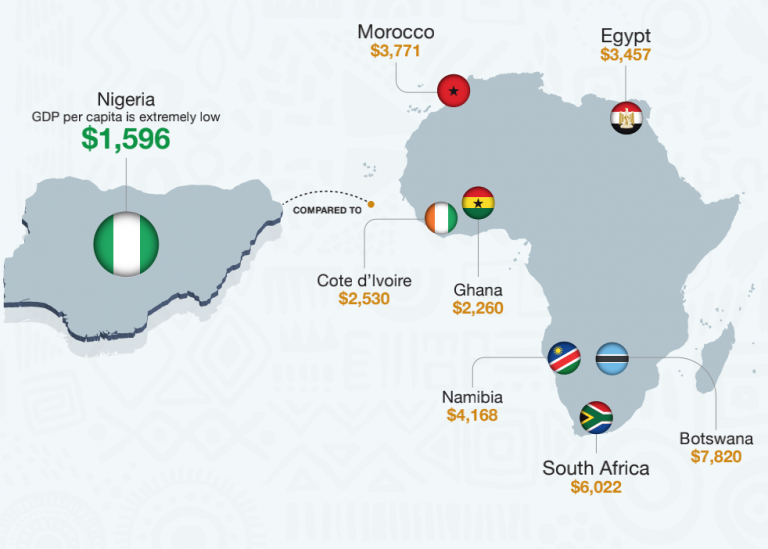
Nigeria’s GDP per capita is extremely low ($1,596) putting the nation in the bottom rung of African countries, compared to Ghana ($2,260), Cote d’Ivoire ($2,530), Namibia ($4,168), South Africa ($6,022), Egypt ($3,457), Morocco ($3,771) and Botswana ($7,820).
Nigeria’s economic growth is anemic. What is especially worrying is that Nigeria is retrogressing; as its wealth per capita declined since independence, when it was $1,847.
Read also: Akinwumi Adesina urges bold reforms for Nigeria’s economic future
If we are to look into the future 25 years, then let’s look back into each of the 25 years since independence. By 1985, 25 years after its independence, Nigeria’s GDP per capita declined to $868. By 2010, the GDP per capita grew to $2,120, but by 2024, GDP per capita had plummeted to $824, the lowest since independence.
So essentially Nigerians were much better off at independence than they are today.
Several factors contribute to this trend, including:
• Lack of bold economic growth policies;
• Frequent policy reversals due to the politicization of economic growth;
• Weak economic governance;
• Poor fiscal discipline;
• Very weak institutions that have been subordinated to politically enabled rent seekers;
• Glaring disconnects in macro and fiscal policies to spur high and sustainable growth;
• Over reliance on crude oil and limited diversification of the economy which subjects it to global volatility of oil prices;
• Extremely poor quality of infrastructure;
• Limited industrial manufacturing;
• Persistent devaluation of the currency that has eroded earning power;
• And stagflation, with high inflation, slow growth and high unemployment.
To see what Nigeria should be like in 2050, we must compare Nigeria with other developed economies, especially those that started at lower levels of wealth than Nigeria and are now global economic powerhouses.
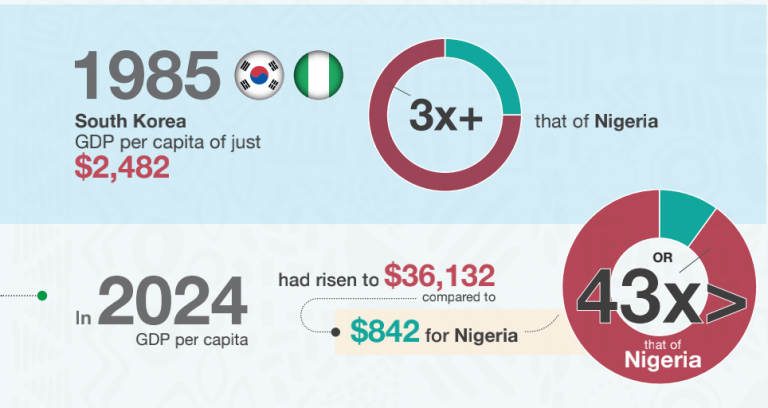
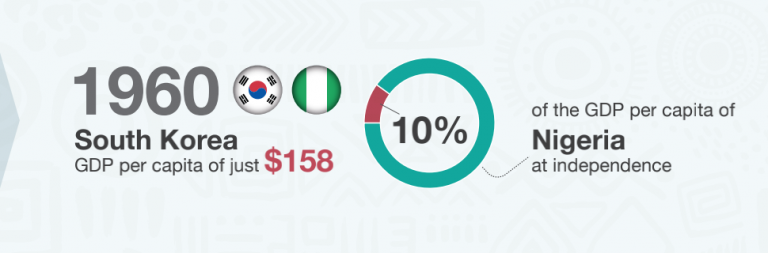
South Korea in 1960 had a GDP per capita of just $158 which was 10% of the GDP per capita of Nigeria at independence. But its GDP per capita rose $2,482 in 1985 (3 times that of Nigeria), and by 2024 its GDP per capita had risen to $36,132 compared to $842 for Nigeria or 43 times that of Nigeria.
Domestic savings pool boosted the economic growth of South Korea. With no pension fund in place until 1988, South Korea’s pension fund size grew to $830 billion by 2024, making it the third largest pension fund in the world.
Nigeria, which started its pension fund in 1951 and eventually transformed it to the Nigerian Social Insurance Trust Fund in 1993, saw its pension fund size rise to N22.5 trillion by 2024., which translates to only $13 billion.
We are just not growing Nigeria’s wealth fast enough.
Nigeria belongs in the developed league of nations. Nigeria in the next 25 years must therefore power itself to become a developed country. Anything short is unacceptable.
To achieve this, we must first have a change of mindset.
Nigeria can no longer see underdevelopment as a reality its people must get used to; but determine to put itself on a fast-tracked trajectory for wealth creating growth for its population.
Here, I wish to make five points.
First, we must achieve universal access to electricity.
Without reliable power Nigeria’s economy will be locked in a neverending slow growth trajectory, without transformation. Access to electricity will power industries, drive down the cost of running businesses, and allow the powering of artificial intelligence, data centers, which are essential to rapidly grow the digital economy.
The private sector should be strongly encouraged to invest in Nigeria’s energy sector to develop more efficient utilities, strengthened by cost-reflective tariffs, transparent and binding power purchase agreements and access to blended finance from multilateral financial institutions.
The Mission 300 launched by the African Development Bank and the World Bank, which seeks to connect 300 million people to electricity by 2030, should be tapped into by Nigeria to accelerate its electrification.
Second, Nigeria must build world-class infrastructure, from highways, to railways, speed trains, airports, seaports, digital and
telecoms, and health, water and sanitation.
The development of infrastructure should be done via making the
country attractive for investors to get market rate of returns from
investing in infrastructure. It will also allow Nigeria to compete in
the Africa Continental Free Trade Area.
We must rapidly scale up the investment of pension and sovereign
wealth funds in infrastructure as an asset class, shift to using originate to distribute models on infrastructure, de-risk infrastructure projects, scale up local currency financing of infrastructure; and develop much deeper capital markets.
Third, Nigeria must rapidly industrialize and boost its manufacturing sector.
As was the case for South Korea, Singapore, Japan, China, Vietnam, Indonesia and Malaysia, all of which have become global giants in manufacturing, Nigeria must establish a viable and competitive industrial manufacturing sector.
The weak contribution and performance of Nigeria’s manufacturing sector stands in sharp contrast to the dynamic and rapid performance of Asian countries such as Malaysia and Vietnam.
These countries have used aggressive horizontal and vertical industrial manufacturing diversification to move from low-value products to high-value exports.
While manufacturing export value per capita is $7,100 for Malaysia and $3,600 for Vietnam, it is only $160 for Nigeria.
While Malaysia and Vietnam moved to “global manufacturing growth” creating massive wealth and jobs for themselves, Nigeria remains in a “survival” mode, still unable to substitute the imports of its petroleum products, yet it is one of the largest exporters of crude oil.
If Nigeria had kept up the pace of assembly of vehicles that it had in the 1980s, encouraged purchase of locally manufactured vehicles, it would have rapidly developed the engineering skills of its labor force and turned itself into a globally competitive manufacturer of vehicles. The leading vehicle manufacturing country would have been Nigeria, not South Africa. To succeed in the next 25 years, Nigeria must manufacture steel to support industrial manufacturing.
Fourth, we must build a science and innovation-driven Nigeria.
This must be enabled by research and innovation, training, developing, utilizing and retaining world class human capital that will innovate and power the economy, especially in science, technology, engineering and mathematics, as artificial intelligence and the fourth industrial revolution reshape the world’s economies.
We must tap into our massive diaspora population for talents and skills needed to build a science and innovation-driven Nigeria.
We must reverse the brain drain, with well skilled labor force from Nigeria now helping other countries to thrive.
Fifth, Nigeria must become a globally competitive powerhouse in agriculture. This is critical for diversifying the economy and exports. At the core of this is the development of the Special Agro-industrial Processing Zones, which will attract the private sector food and agribusinesses to locate close to high potential zones of food and agricultural production.
The African Development Bank and its partners (Islamic Development Bank and the International Fund for Agricultural Development) are currently supporting with $512 million the development of these zones in eight States of the Federation and the Federal Capital Territory.
At the Africa Investment Forum held in Rabat, Morocco in December 2024, the African Development Bank and investors mobilized an additional $2.9 billion for the development of the Special Agro-Industrial Processing Zones in 28 more States in Nigeria.
These zones will allow the processing and value addition to all of Nigeria’s agricultural products, develop competitive value chains and become the platforms to launch Nigeria competitively into global food and agricultural markets.
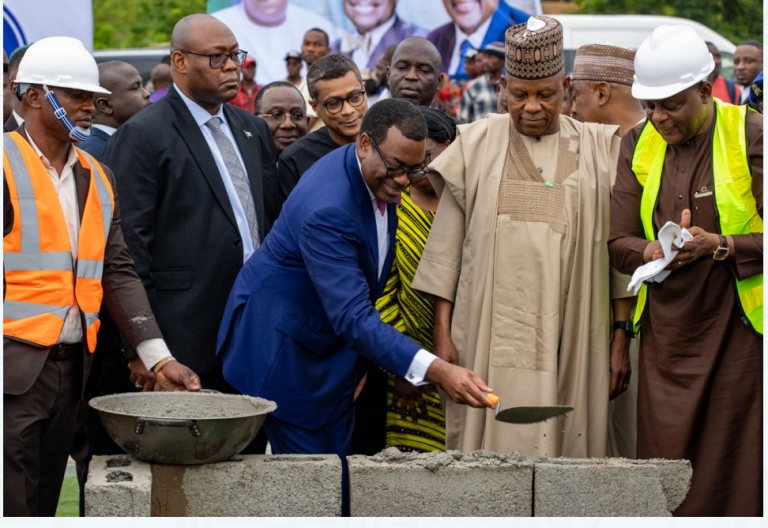
As Vice President Shettima said when he and I recently launched the special agro-industrial processing zones in Kaduna and Cross Rivers States, “the special agro-industrial processing zones will change Nigeria.”
Yes, change Nigeria is exactly what we need.
The Nigeria of 2050 must be purposefully designed.
We must reimagine that transformed Nigeria.
Reimagine a Nigeria that has freed itself from decades of underperformance.
Reimagine a Nigeria that’s become Africa’s industrial giant, building more global industrial platforms such as the $24 billion Dangote refinery complex.
Reimagine a Nigeria that has transitioned into a rule-of-law based prime investment destination, attracting global capital to develop its cities, infrastructure, agriculture, blue economy, oil, gas and critical minerals.
Reimagine a Nigeria where private capital thrives.
Reimagine a corruption-free Nigeria; a nation the world flows to.
A nation that has transformed into a developed country.
Reimagine a developed Nigeria pulling up the rest of Africa!
Then reimagine Chapel Hill Denham, from that new Nigeria, transforming Africa!
So shall it be!

Join BusinessDay whatsapp Channel, to stay up to date
Open In Whatsapp