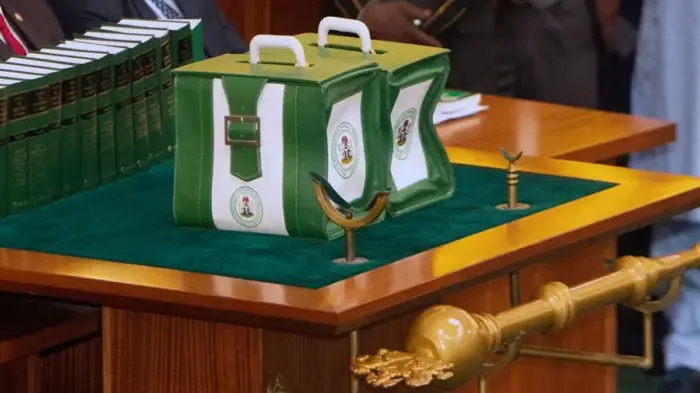
The National Assembly has initiated moves to reform Nigeria’s budgeting system and has convened a high-level national policy dialogue to close persistent gaps between budget implementation and development plans, a move that’s expected to drive growth in Africa’s most peopled nation.
Gboyega Isiaka, chairman of the House Committee on National Planning and Economic Development, disclosed this on Monday during a press briefing at the National Assembly.
Isiaka, speaking on behalf of a joint committee of the Senate and House of Representatives, said a two-day dialogue has been scheduled for April 14 and 15, 2026, aimed at addressing long-standing gaps between national development plans and budget implementation, a challenge widely regarded as a constraint to sustainable economic growth.
The legislator said the dialogue would bring together stakeholders across ministries, departments, and agencies (MDAs), the private sector, and policy institutions to develop a more coherent development framework for the country.
He stated that the initiative aims to align Nigeria’s development agenda with its fiscal strategy.
He noted that Nigeria’s current growth rate of about 3.54 percent remains insufficient to meet its long-term economic ambitions, particularly the target of a $1 trillion economy.
Isiaka stressed that economic expansion must outpace population growth, estimated at 2.7 percent, to deliver meaningful progress. “We cannot continue on a business-as-usual trajectory. Our growth must not only accelerate but must also be deliberately tied to a well-structured and implementable national plan,” he said.
“We are bringing everyone to the table to build consensus around a planning and budgeting system that delivers real, measurable results for Nigerians,” he said.
Also speaking, Clement Jimbo, deputy chairman of the House Committee on Budget and National Planning, emphasised the importance of strategic planning for national development, warning that weak frameworks could continue to undermine economic progress.
He said even marginal improvements arising from the dialogue could have significant effects on Nigeria’s development trajectory.
On Nigeria’s current budgeting approach, particularly the envelope system, Jimbo acknowledged concerns but said every system has its limitations. He noted that while alternatives such as zero-based budgeting offer advantages, they may be difficult to fully implement given the scale of government operations.
“With over a thousand MDAs, adopting zero-based budgeting wholesale could be time-consuming and impractical. What we need is a system that reflects our realities while improving efficiency and accountability,” he said.
He added that the dialogue would explore options such as performance-based budgeting, with breakout sessions designed to enable MDAs to share experiences and propose reforms tailored to Nigeria’s context.
Responding to questions on managing potential oil windfalls, Jimbo said the responsibility lies primarily with the executive but outlined measures to ensure fiscal stability, including saving excess revenues and adjusting budgets in response to changing economic conditions.
“There are multiple pathways to managing windfalls effectively, and I am confident that with the right framework, Nigeria can better optimise such opportunities,” he said.
The lawmakers expressed optimism that the dialogue would mark a turning point in Nigeria’s approach to development planning, laying the groundwork for a more responsive, coordinated and results-driven budgeting system capable of supporting sustained economic growth.

Join BusinessDay whatsapp Channel, to stay up to date

Open In Whatsapp