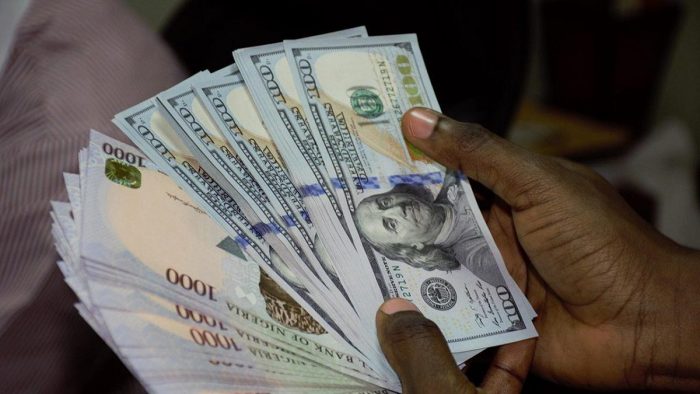
The naira declined over three trading sessions in the official foreign exchange market as Nigeria’s external reserves fell below the $50 billion threshold, even as global oil prices strengthened.

Data from the Central Bank of Nigeria (CBN) showed the currency depreciated by N9.48 to N1,353.90 per dollar on Wednesday the last trading day for the week due to the holiday, compared with N1,344.42 on Tuesday at the Nigerian Foreign Exchange Market, representing a 0.7 percent loss.

In the parallel market, the naira held steady at N1,400 per dollar. The spread between the official and parallel market rates narrowed to N47 from N56 a day earlier, suggesting improved alignment across currency segments.

External reserves have now declined for five consecutive sessions, reflecting sustained outflows linked to heightened geopolitical tensions in the Middle East.

Figures from the Central Bank showed reserves fell to $49.83 billion as of March 17, 2026, down from $50.02 billion recorded on March 11.

Read also: Naira holds gains as rising oil prices support FX market

Higher oil prices have continued to bolster market sentiment. A report by Coronation Merchant Bank Research said Brent crude prices advanced by 11.16 percent week on week, rising from $91.00 per barrel to close at $101.16 per barrel amid escalating geopolitical tensions in the Middle East.

The Bank noted that developments in the region have heightened concerns about potential disruptions to global oil supply, increasing volatility in energy markets. Brent crude briefly surpassed the $100 per barrel threshold last week as traders priced in a higher geopolitical risk premium.

The Central Bank, however, maintains a more optimistic outlook. In its 2026 macroeconomic projections, it expects reserves to rise to $51.04 billion, supported by stronger oil receipts, continued foreign exchange reforms, and improved external inflows.

Olayemi Cardoso, governor of the CBN said recent policy changes have enhanced transparency and liquidity in the foreign exchange market. He noted that reforms, including the removal of multiple exchange rate windows and legacy capital controls, have simplified trade and investment processes.

Despite global risk aversion driven by geopolitical tensions, including the Iran-related conflict, Nigeria has continued to attract modest portfolio inflows. According to the Financial Markets Dealers Association, investors are drawn to relatively higher yields, helping to underpin the currency.

Cardoso said the Central Bank’s commitment to a transparent and well-functioning market is evident in ongoing reforms. He noted that the elimination of multiple exchange rates has reduced distortions and narrowed the parallel market premium from about 50 percent in 2022 to less than 2 percent on average in 2025.

He added that improved liquidity has cleared unmet demand in the foreign exchange market, reducing reliance on Central Bank interventions, while capital and investment inflows have increased significantly between 2023 and 2025.

According to the CBN governor, the relative stability seen in the naira in recent periods reflects deliberate policy actions aimed at rebuilding trust and strengthening investor confidence, with external reserves recently rising above the $50 billion mark before the latest decline.

Hope Moses-Ashike is an Associate Editor, Banking and Finance, with more than a decade of experience reporting on Nigeria’s financial system and broader economy. She closely tracks market movements, monetary policy decisions, company disclosures, regulatory actions, economic indicators, and global developments, and interprets what they mean for businesses, investors, policymakers, and households. Her reporting helps readers understand complex issues such as inflation trends, foreign exchange market dynamics, interest rate decisions, bank performance, and investment risks. She also covers major international events and periodically travels to Washington, D.C., to report on the World Bank/IMF Spring and Annual Meetings. Her dedication to financial journalism has earned her multiple recognitions and invitations to high-level professional development programmes. She is an alumna of the International Visitors Leadership Programme (IVLP) in the United States and holds an Advanced Financial Journalism Certificate from the Press Association Training in London, UK. Her other notable achievements include completing the Lagos Business School CMC Programme, the Bloomberg Media Africa Initiative Programme, and a Master Class in Journalism at Rhodes University in South Africa.

Join BusinessDay whatsapp Channel, to stay up to date

Open In Whatsapp