For many years, leadership in politics, business, and even the media followed a familiar pattern. Most of the people sitting at the decision-making table looked the same. They often came from similar backgrounds and viewed the world through similar lenses. While this arrangement may have seemed normal for a long time, it also meant that many perspectives were missing.
Today, it is increasingly clear that leadership based on only one perspective cannot fully address the needs and realities of a diverse society. Inclusive leadership is no longer just a matter of fairness; it is a matter of national strength.
At the centre of this conversation is the growing realisation that women are among a nation’s most precious assets. Their experiences, insights, and leadership approaches bring depth and balance to institutions that shape the direction of society. In this light, women are not just active participants in national development; they are a national treasure.
The idea of women as a national treasure resides in the contributions they make across different sectors. In business, women leaders often promote collaboration, strengthen stakeholder relationships, and focus on long-term organisational growth. In governance, women frequently highlight community impact, social wellbeing, and the human consequences of policy decisions. These perspectives are not exclusive to women, but they have historically been underrepresented in many leadership structures.
When these perspectives are absent, institutions risk developing policies that overlook large segments of society. Inclusive leadership corrects this imbalance by ensuring that diverse voices contribute to the design of solutions that affect everyone.
Encouragingly, this situation is starting to evolve. An increasing number of women are taking on leadership positions in business, public service, and media. Their involvement is meaningful, not just symbolic. It enhances institutions by bringing in diverse ideas and experiences that shape better decisions.
Leadership is not only about authority. It is about judgment, empathy, and an understanding of how decisions affect real lives. Women often bring a strong awareness of social realities into leadership spaces, particularly when issues such as healthcare, education, economic opportunity, and community wellbeing are being considered.
In business organisations, diverse leadership teams tend to approach challenges from multiple angles. This often leads to more thoughtful decision-making and stronger organisational resilience. In politics, women leaders frequently broaden the policy conversation, bringing attention to issues that directly affect families and communities.
The same principle applies in the media. When women occupy editorial and leadership roles, they influence which stories are told and how societies understand themselves. Their presence ensures that national conversations reflect a wider range of voices.
Despite these contributions, women are still underrepresented in many leadership roles. This disparity signifies more than just a matter of equality; it also reflects a missed opportunity for countries aiming to build stronger institutions and improve governance. Women represent a vast reservoir of talent, experience, and insight. When their voices are included in leadership, institutions gain a richer understanding of the societies they serve.
In many ways, women are a national treasure that has long existed in plain sight. Their contributions to families, professions, and communities have sustained societies for generations, often without recognition. As more women step into positions of influence, that value is becoming clearer.
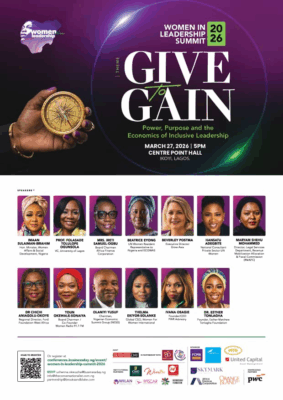
This is why conversations around inclusive leadership remain important. The Women in Leadership Summit scheduled for March 27 offers an opportunity for leaders from business, government, and development institutions to reflect on how organisations can broaden leadership and strengthen their impact.
The goal is not only to celebrate progress, but to examine how institutions can build systems where talent is recognised, and opportunity is expanded. When more voices are welcomed into leadership spaces, institutions become more thoughtful, more responsive, and more resilient.
A nation does not become stronger by narrowing the circle of leadership. It becomes stronger by widening it. And when women are fully included in shaping decisions, the future becomes richer with possibilities.

Join BusinessDay whatsapp Channel, to stay up to date
Open In Whatsapp