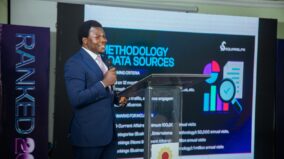
Nigeria needs to enhance safety nets, build human capital, and improve healthcare quality in order to overhaul its rather stunted health systems, according to Kelechi Ohiri, director-general of the National Health Insurance Authority (NHIA).
Ohiri made this known at the 2025 BusinessDay CEO Forum held on Thursday in Lagos.
The DG, citing Nigeria’s troubling healthcare statistics such as high infant mortality, excessive out-of-pocket payments for healthcare services, and minimal economic returns, emphasized the urgency of targeted equity reforms.
Read also: Nigeria’s health reforms target human capital, economic growth — NHIA’s DG Ohiri
“There’s a need to implement policies that reduce infant mortality, cut out-of-pocket payments, and catalyze private sector reforms to unlock its full potential,” he said.
“This can only be achieved through enhancing the safety net, building human capital, and improving quality healthcare.”
Currently, nearly 1 million Nigerians are pushed into poverty annually due to healthcare expenses, while over $2 billion is spent on outbound medical tourism, he noted.
Read also: Nigeria’s health emergency capacity swells as US injects $2m in seven years
Ohiri highlighted NHIA’s efforts in improving access, especially for vulnerable groups. “About 3,000 women with fistula have received free care, 5,000 pregnant women have had their hospital bills covered, and 97 percent of 20 million enrollees are now covered under health insurance,” he stated.
He stressed the need to scale up investments in the healthcare sector. “The goal is wider coverage and equity reforms across the healthcare value chain, while attracting more investments into the sector.”
Drawing inspiration from global examples, Ohiri stated: “We need to build human capital just like Indonesia has done. That’s the foundation for a resilient healthcare system.”

Join BusinessDay whatsapp Channel, to stay up to date
Open In Whatsapp