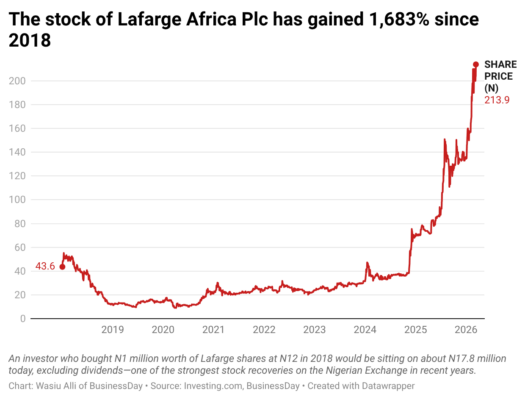
When Lolu Alade-Akinyemi took the helm of Lafarge Africa Plc in July 2023, the cement maker had already survived a bruising decade. Debt had once threatened its survival, investors had fled, and the stock had collapsed to around N12 in 2018.
Three years later, the company has delivered its strongest performance since inception, crossing N1 trillion in annual revenue for the first time and nearly tripling profit in a single year, a turnaround that has sent its shares surging to about N226.
For Alade-Akinyemi, a finance-trained executive with more than two decades of international corporate experience, the record year marks the culmination of a restructuring journey that began with balance-sheet repair and has now evolved into aggressive expansion.
Read also: Lafarge Africa commits to building sustainable impact through women
From crisis to comeback
Lafarge Africa’s troubles date back to an ambitious 2014 restructuring that merged several African assets into the Nigerian entity. The move, orchestrated by parent company Lafarge, brought operations in South Africa into the business in a bid to create a continental rival to Dangote Cement, Africa’s biggest cement maker.
Instead, the South African operations became a drag on earnings. Losses mounted and foreign-currency borrowings ballooned as the naira weakened. By 2018, Lafarge Africa had accumulated about N266 billion in debt and posted a N8.1 billion loss, triggering a collapse in investor confidence.
The decisive turning point came in 2019 when the company sold its South African operations for $317 million. The proceeds were used to eliminate foreign-exchange debt and slash financing costs, allowing Lafarge Africa to swing back to a N15.5 billion profit that year.
Read also: Lafarge Africa declares 600 kobo dividend as profit jumps 173%
While the move stabilised the company, it left management with the task of rebuilding growth and restoring shareholder confidence.
A leadership shift
Alade-Akinyemi joined Lafarge in 2014 and was appointed executive director in 2020 before becoming chief executive in 2023, succeeding Khaled El-Dokani.
Before joining the cement maker, he served as finance director at PZ Cussons Nigeria Plc and spent 16 years at The Coca-Cola Company, where he held roles across finance, supply chain, business development, and sales in markets including the UK, Belgium, Ghana, and Nigeria. He began his career as a trainee at ExxonMobil.
Read also: Lafarge Africa targets 5.5m metric tons annual cement production
Industry experts say the breadth of experience helped shape a leadership style focused on operational discipline and profit accountability, key priorities that would soon define the company’s performance.
Record financial performance
The numbers tell the story.
After several years of gradual recovery, Lafarge Africa’s earnings surged in 2025. Revenue jumped from N696 billion in 2024 to N1.066 trillion, pushing the company past the trillion-naira threshold for the first time in its history.
Profit after tax climbed even faster, rising from N100.19 billion to N273 billion, nearly a threefold increase.
The strong earnings translated into a generous shareholder payout. Lafarge declared an interim dividend of N4 per share and a final dividend of N6, bringing the total to N10 per share. Total dividend payments reached about N97 billion, up sharply from N19.32 billion a year earlier.
Read also: Lafarge plans new expansions in boost for Nigeria’s infrastructure
Investors rewarded the performance. The stock, which traded around N58 before December 2024, climbed to roughly N130 by August 2025 and reached N213.90 by March 2026, close to its all-time high.
A strategic ownership shift
Another key development came in December 2024 when Holcim agreed to sell its 83.81 percent stake in Lafarge Africa to Huaxin Cement in a deal valued at about $1 billion.
The transaction brought in a new strategic investor with deep expertise in cement manufacturing and a track record of scaling production in emerging markets.
For Lafarge Africa, the ownership change reinforced market confidence and strengthened expectations that the company could accelerate its growth strategy.
Preparing for the next phase
Despite the record profits, the Alade-Akinyemi-led management’s focus has already shifted to the next phase of expansion.
In February 2026, the cement manufacturer announced plans to increase production capacity at its Sagamu plant in Ogun State and its Ashaka facility in Gombe State. The projects will lift the company’s capacity from 10.5 million metric tonnes per annum to about 14 million tonnes.
Read also: Lafarge Africa’s profit rises 4-fold on cement sales growth
The Sagamu plant is expected to expand from 1 million tonnes to 3.5 million tonnes annually, while Ashaka will double to about 2 million tonnes.
Industry estimates suggest the investment programme could exceed N400 billion, a sign that Lafarge is preparing to compete more aggressively in Nigeria’s cement industry.
The market remains dominated by Dangote Cement with about 52 million tonnes of capacity and BUA Cement with roughly 20 million tonnes.
Lafarge’s expansion, analysts say, signals a renewed push to close the gap.
From survival to resurgence
The company’s trajectory over the past eight years can be summarised in four phases: crisis in 2018, balance-sheet repair in 2019, profit acceleration in 2025, and an expansion push beginning in 2026.
Under Alade-Akinyemi, Lafarge Africa has moved beyond recovery into a phase of strategic growth.
Read also: Dangote, BUA, Lafarge: Which is the most profitable in H1 2025?
Shares of Lafarge Africa have returned 1,683 percent since 2018. That means an investor who bought N1 million worth of Lafarge shares at N12 in 2018 would be sitting on over N18 million today, excluding dividends — one of the strongest stock recoveries on the Nigerian Exchange in recent years.
For investors who watched the stock plunge to N12 during its darkest days, the climb to more than N200 represents more than a market rally. It reflects the revival of one of Nigeria’s oldest industrial companies and the leadership that helped steer it to its best year yet.

Join BusinessDay whatsapp Channel, to stay up to date
Open In Whatsapp