Insurers quoted on the floor of bourse continue to report premium growth in spite of the testing market landscape, although claims payment continue to rise and it is expected to climb in the month ahead.
 
For the year ended December 2016, 12 firms under our coverage grew net premium income by 37.04 percent to N91.12 billion while gross premium income moved by 32.12 percent to N127.84 billion.
 
The growth at the top lines (revenue) can be attributed to contributions from products such as general accident, motor vehicle and oil and gas amid a harsh operating environment.
 
While insurers have maintained stable premium, they are however buffeted by huge claims caused by foreign exchange volatility and effects of climate change and its attendant effect on damages to insured assets.
 
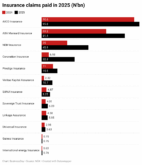
The cumulative claims expenses of the 12 firms spiked by 83.88 percent to N44.78 billion in December 2016 from N37.56 billion the previous year.
 
Analysts say during the renewal of 2015, insurance operators settled claims based on an exchange rate of N196 but today, they pay such claims using the prevailing exchange rate of N400.
 
Indeed 2016 was an horrendous year for insurers in Africa’s largest economy as a combinations of heavy rains in the
Northern part of the country that destroyed farms and properties, pipe line vandalism in by militants in the Niger Delta region and the destruction of lives and properties by Boko Haram exposed insurers to huge claims payment.
 
The naira lost 40 percent of its value against the U.S currency after the central bank adopted a flexible exchange rate last year after pegging the naira at N197-1999 for 15 months.
 
In spite of the currency volatility, insurers were maintained an efficient underwriting performance as underwriting profits were up 18.83 percent to N25.73 billion.
 
They also remained profitable despite stock price stuck at an average of 0.65 kobo as cumulative combined ratio (CR) stood at 80.83 percent as at December 2016, lower than the 100 percent threshold.
However, some of the firms exceeded the threshold on the back of mounting obligations.
 
Wapic Nigeria insurance Plc and Lasco Nigeria insurance Plc recorded CR of 133.12 percent and 1.19 percent respectively.
Underwriters are planning on a scheme of mergers and consolidation in order to bolster capital levels so that they can take on more risks as debt and equity capital remains inaccessible in a country going through its first contraction in 25 years.
 
The cumulative total assets of the 12 firms under our coverage increased by 8.31 percent to N298.33 billion in December 2016 from N276.60 billion the previous year.
 
This compares with N834.14 billion total assets of Tier 2 lender- Sterling Bank.  
South Africa’s Mutual Liberty acquired 75 percent of UNIC Insurance Plc, a Nigerian insurer for a deal worth $12 million (N3.60 billion).
 
Analysts are of the view that industry can thrive and increase its contribution to the economy if operators develop a market penetrating products especially for the low income earners.
 
The insurance industry grew 1.1 percent in the fourth quarter versus 5.1 percent year on year, accounting to data from the National Bureau of Statistics (NBS).
 
 According a recent report by KPMG on the insurance sector, there are 32 non-life insurers, 17 life insurers, and 10 mixed companies catering for a total market of $1.6 billion (N320 billion).
 
The aforementioned figures are low when compared with South Africa, the continent most developed economy that has 179 insurance companies, but it serves the market of $51.6 billion (N10.2 trillion).
 
The average company size is also more than 10 times bigger than Nigeria, according to the report.
“You still have the top six insurance companies owning and controlling more than 60 per cent of the market and that means the other 50 companies are not doing as much,” said Kabir Okunlola, Head insurance audit group KPMG.
 
Aigboje Aig-Imoukhuede, Chairman of Wapic Insurance, during the KPMG Insurance conference for 2017, called for increase in the capital base of insurance companies in the country to N100 billion.
 
There is light at the end of the tunnel as Stakeholders in the insurance industry are of the view that the successful implementation of the risk-based supervision-solvency 11 can help spur insurance industry to growth,
 
It will help you to decide and carry out activities to insure product,” said Thierry Mibimi, Partner & Head West-Africa, Financial Risk Management & A Leader of Regulatory Center of Excellence.
BALA AUGIE

Nigeria's leading finance and market intelligence news report. Also home to expert opinion and commentary on politics, sports, lifestyle, and more

Join BusinessDay whatsapp Channel, to stay up to date

Open In Whatsapp