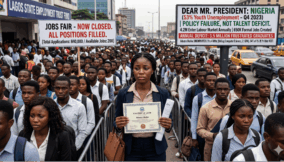
Across offices in Lagos, Abuja, Port Harcourt, and Kano, a quiet anxiety is spreading. Bankers reviewing loan files, civil servants processing memos, and private‑sector staff repeating the same tasks daily are all asking the same question: Will AI take my job? The global narrative is loud and unsettling. Artificial Intelligence(AI) is coming for certain white‑collar work. But beneath the panic lies a more grounded truth: every industrial revolution has disrupted labour, yet each has also created new forms of opportunity. AI is no different.

Artificial intelligence is often misunderstood as a machine that “thinks” like a human. In reality, AI identifies patterns from massive datasets and automates predictable tasks. It is more advanced than traditional automation because it replaces routine cognitive work, not just physical labour. But disruption does not automatically mean disappearance. History offers a clearer lens.

In 1957, the Soviet Union launched Sputnik 1, shocking the United States and triggering a national awakening. The American response was not fear but investment. The National Defence Education Act poured resources into science, engineering, and mathematics. Within a decade, the U.S. had produced the talent that would drive the semiconductor industry, space exploration, and the early internet. The lesson is timeless: technological shocks do not eliminate opportunity; they shift it toward new skills.

A similar pattern emerged during the rise of the internet in the late 1990s. Traditional industries feared collapse. Retailers predicted the death of physical stores, publishers worried about the end of print, and office workers wondered whether email would erase entire job categories. Instead, the internet created new professions — web development, cybersecurity, digital marketing, and e‑commerce management. Millions now work in roles that did not exist 25 years ago. AI will follow the same trajectory. It will automate tasks but also create industries and job categories we cannot yet fully imagine.

Some roles, however, are clearly vulnerable. Jobs built on predictable, repetitive tasks — data entry, basic bookkeeping, routine legal drafting, and even some coding — are already being automated globally. Nigeria will not be exempt. Entry‑level roles, which traditionally serve as stepping stones for young graduates, may shrink as businesses adopt AI.

But not all work is equally exposed. Jobs requiring empathy, judgment, creativity, or complex problem‑solving remain resilient. Skilled trades, healthcare workers, relationship‑driven sales teams, and leadership roles cannot be replaced by algorithms. Human context, cultural nuance, and interpersonal intelligence still matter — and in Nigeria’s relationship‑oriented economy, they matter even more. Adaptability, not fear, will determine who thrives.

A more immediate concern is underemployment. With youth unemployment already high, the reduction of entry‑level roles could widen inequality. Junior analysts, clerks, and support staff may feel the pressure first. Without deliberate upskilling, many could be left behind. But this challenge also presents an opening: those who retool early can position themselves for emerging opportunities.

AI will create new roles in Nigeria. In the finance sector, traditional roles like manual bookkeeping and repetitive data entry are being rapidly reduced as AI systems take over the heavy lifting of ledger reconciliation. However, this shift is supercharging the demand for AI fintech developers and risk analysts in Nigeria. These professionals are now essential for building secure, automated payment gateways and using predictive modelling to detect fraud in real-time, ensuring that the digital economy remains robust and scalable.

Within Healthcare, AI is automating basic triage and medical transcription, reducing the need for administrative staff to handle routine patient intake. This transition has birthed the role of the Health-Tech Implementation Specialist, who ensures that diagnostic AI tools are integrated seamlessly into clinics. By leveraging AI to analyse medical imagery and patient data, these specialists allow Nigerian doctors to focus more on complex cases and personalised patient care rather than paperwork.

The Creative and Marketing industries are seeing a decline in roles like production artists and stock photographers, as generative AI can now produce high-quality visual assets in seconds. Yet, this has created a massive opening for AI Content Strategists and Prompt Designers who can steer these tools to maintain brand authenticity. These “new-collar” creatives act as curators, using AI to prototype a hundred ideas in the time it used to take to sketch one, effectively becoming directors of machine-driven output.

In the Legal and Administrative fields, junior document reviewers and contract clerks are seeing their roles diminish as AI handles the bulk of discovery and compliance checks. Consequently, there is a surge in demand for AI Compliance Leads and Legal Strategists who provide the high-level judgment that machines lack. These professionals oversee the “human-in-the-loop” process, ensuring that AI-generated legal briefs are accurate and that the firm remains compliant with evolving global and local AI regulations.

For Nigerian professionals, the path forward is clear. Learn AI tools. Strengthen analytical thinking. Cultivate creativity. Combine domain expertise with digital fluency. Invest in lifelong learning. Treat AI as a partner, not a rival. Those who blend human judgment with technological competence will lead the future of work.

Government and universities must also act. Curriculum reform, research funding, digital infrastructure, and public‑private partnerships are critical. Without coordinated investment, Nigeria risks becoming a consumer of AI solutions rather than a creator. Preparing the workforce for AI is not just a private responsibility; it is a national priority.

AI will replace tasks, not entire humans. The pattern from past technological revolutions is repeating itself: disruption is inevitable, but so is opportunity. Nigerian professionals who adapt early will gain a competitive edge, while those who resist may be left behind. With our youthful population and culture of resilience, Nigeria can do more than survive the AI revolution — it can shape it.

AI will not replace Nigerians. Nigerians who master AI will replace those who ignore it. The future of work is not man versus machine; it is man with machine. The real question is no longer whether AI is coming — it is whether we are preparing.

Esho is an experienced Software Engineer with over 15 years of experience across the financial, consulting, educational, and public sectors, nationally and internationally. He holds a master’s degree in Advanced Computer Science.

Join BusinessDay whatsapp Channel, to stay up to date

Open In Whatsapp