Since COVID, the Church has taken the initiative to disseminate the gospel message more to a digital audience.
This is so because with digital adoption, the Church can reach far more people outside the four walls of its buildings.
However, there is a growing concern about leveraging the digital space for evangelism and getting viral online.
More than ever before, the digital space thrives on virality, which is the rapid, widespread, and exponential diffusion of content, ideas, across online networks, usually driven by user sharing and social media.
While getting viral with the gospel message is good – there is also a huge challenge of losing the message in a plethora of other demanding content.
Today, there are virality metrics that measure how successful an article is compared to other articles on the same website and on the internet.
It mirrors biological virus transmission, often creating immense popularity within a short period. Key drivers include high emotional engagement that mirrors humour, joy, inspiration and social sharing.
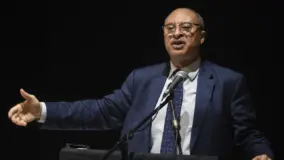
“A priest may have followers, but he must never become one. He may use platforms, but he must never stand on them as if they were an altar,” Adewale Martins, Archbishop of the Metropolitan See Lagos, said during the recent Chrism Mass at the Holy Cross Cathedral.
According to Martins, priests must be very careful not to get carried away by online traffic, but remain faithful to the centrality of Christ’s message to the world.
“He may speak online, but he must never forget that his first word is spoken over bread and wine that become God.
“For the priest is not an Influencer. The priest is a sacrament. And sacraments do not advertise themselves, they revea! Christ,” Martins said.
Virality as a marketing tool
While the Church is not going online to market or sell the ‘Good news’; virality is however a marketing technique that encourages people to pass on a message to others through word of mouth, email, or social networks.
Therefore, understanding the concept of virality in Social Media from users’ perspective will help to guide the preacher against losing his/her gospel message in the digital space.
So, in creating a viral video, meme, tweet, or Tik Tok video spreading rapidly among social media users; the preacher also has to be careful not to distort the message in a bid to get viral.
“Well, the Church or the priests, and indeed everyone, needs to be interested in doing online evangelism, because that is where people are these days,” Martins said.
According to him, online evangelism is
important for the sake of winning souls and spreading the message of salvation. “And if people are there, they must be reached. They must be reached in such a way as to help them to accept Jesus and the values of Jesus.”
On the back of this, priests and other content creators have been urged to guard the mystery of the gospel, by staying true to their calling as men of the altar in a world that prefers stages.
Similarly, it is expected that clerics will remain as men of silence in an age intoxicated by noise, and seized by God in a culture obsessed with being noticed.
“If posts receive more preparation than homilies, priorities have quietly shifted. The altar must always weigh more than the algorithm,” Martins said.
Chidi Anthony, president, Pentecostal Ministers’ Forum (PMF) stated that pastors and others who promote digital evangelism must balance their adoption of technology to deepen and grow the gospel of Christ.
While adoption has been on the increase over the years, Anthony believe many still do not understand how to effectively deploy technology for ministry work.
According to him, many preachers are finding it difficult to manage their image on social media before they have been unable to draw a line between going viral and deepening the gospel message.
The thin line between the gospel and virality
Priests and preachers of the gospel were not simply given responsibilities, but configured to Christ Himself.
Hence, in designing their digital content they must bear in mind that Christ did not anoint any preacher to become visible, rather He anointed them to become faithful.
Today, the world is searching for priests who are impressive, priests who can command attention; gather audiences and hold them.
However, the lord searches for something quieter and far more demanding. He searches for priests who belong entirely to Him.
“For the priest will stand before the Lord whose Body he held with trembling hands.
“And in that moment the question will not be how widely he was seen, but how faithfully he served; not how loudly he spoke, but how deeply he loved: not how carefully he managed his irnage; but how sincerely he carried the mystery entrusted to him,” Martins revealed.
The Archbishop also urged preachers to be conscious of the fact that the measure of the impact is not digital, but eternal.
Therefore, the priest must always have it at the back of his/her mind that one day, the preacher like every other person will stand before the Lord whose Body he held with trembling hands.
“And here is a truth we must never forget: The world may measure reach, God measures surrender. The world counts followers while God counts fidelity. The world asks how many listened, He asks whether we loved.
“Christ will not ask how many watched his words, He will ask whether the hungry were fed with truth, the wounded guided toward mercy, and the sacraments celebrated with reverence,” he said.
Choices before priests
The priest stands between two worlds: the altar and the crowd, the silence of God and the noise of men.
However, one of these must form him, while the other must never define him.
Accordingly, it is believed in Christendom that the day of ordination was not merely a ceremony that passed like many others.
“Oil was poured upon our hands, but more than oil was given. A claim was made upon our lives, heaven placed a mark upon a human soul.”
But, Martins said clearly that none of this requires abandoning the digital world, rather it requires the priest to self examine by anchoring his message and faith in Christ.
“A priest rooted in prayer, obedient to his bishop, accountable to spiritual direction, and measured by sacramental fruit can use these tools well.
“Without such anchors, the algorithm will form him faster than the Gospel for the deeper issue is identity,” Martins said.

Join BusinessDay whatsapp Channel, to stay up to date
Open In Whatsapp