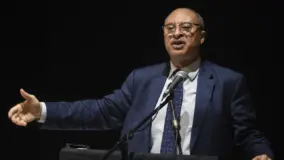
A Professor of Broadcasting and Media Studies at the University of Uyo, Uwem Udo Akpan, has called for the establishment of a truly independent public service broadcasting model in Nigeria to strengthen democracy and better serve the people.
Akpan made the call while delivering the 129th Inaugural Lecture at the University of Uyo titled “Between the Gulag of Government Control and the Jaws of Commercialism: Wither Public Service Broadcasting in Nigeria?” held at the 1000-Seater Auditorium of the institution’s main campus.
He noted that since the establishment of the National Broadcasting Commission in 1992, Nigeria’s broadcasting landscape has undergone significant changes, with both government and private stations increasingly driven by the pursuit of advertising revenue.
According to him, while private operators aggressively seek advertisements, government-owned stations continue to struggle under the heavy weight of government control, a situation he said has left audiences largely dissatisfied.
Akpan, a former broadcast journalistvm observed that under the current system, effective participation in the communication process often depends on influence or financial capacity.
He therefore recommended the introduction of an additional broadcast model, an independent public service broadcasting system free from both government interference and commercial pressure, similar to the structure of the BBC.
He stressed that such a model would help ensure that broadcasting truly serves the public interest and contributes meaningfully to democratic development in Nigeria.
According to him, government ownership of the majority of broadcast stations has resulted in excessive influence over editorial policies, thereby limiting the independence of media organisations.
“Government controls more than 80 percent of broadcast channels in Nigeria, and the multiplication of stations does not necessarily translate to diversity of voices,” he said, noting that such control often leads to the dominance of a single official narrative that is mistaken for public opinion.
He also criticised the increasing commercialization of broadcasting, describing it as a situation where profit considerations overshadow professional ethics and public responsibility.
He noted that under commercial pressure, advertisers and sponsors increasingly dictate media content, with news selection sometimes influenced by financial capacity rather than public relevance.
“News in the media is dictated more by the content and size of the pocket than by newsworthiness,” he warned, adding that such trends undermine the integrity of journalism and weaken the role of the media as society’s watchdog.
Akpan further highlighted the phenomenon of media capture, where external political or economic interests influence editorial decisions, leading to what he described as the blurring of boundaries between the media and the political establishment.
According to him, when media institutions align excessively with government or powerful economic actors, their traditional role as the Fourth Estate becomes compromised.
He pointed out that the commodification of news has resulted in superficial coverage of elite social events while issues affecting ordinary citizens receive limited attention.
To address the challenges, Akpan proposed the establishment of a truly independent public service broadcasting model in Nigeria, similar to that of the British Broadcasting Corporation.
He suggested that such a broadcaster should operate under an independent charter rather than direct government legislation and be funded through public licence fees to ensure operational autonomy.
According to him, the proposed model would guarantee impartial news coverage, promote diverse viewpoints and strengthen democratic engagement.
“If broadcasting is to contribute effectively to genuine democracy, public interest must coexist with government and commercial interests,” he said.
Akpan concluded that by establishing an independent public service broadcaster, this would liberate Nigeria’s broadcast system from political manipulation and excessive commercial influence, while ensuring that the media truly serves people interest.

Join BusinessDay whatsapp Channel, to stay up to date
Open In Whatsapp