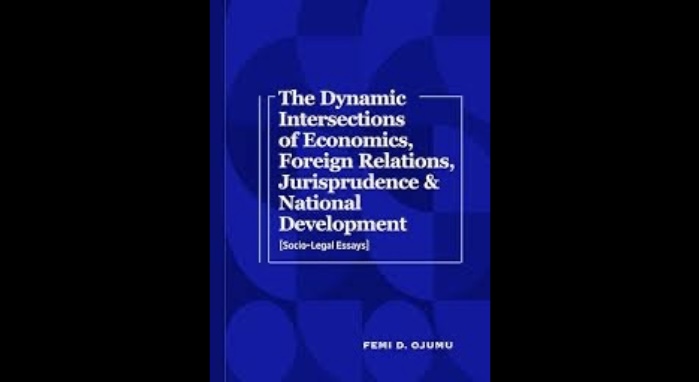
Femi D. Ojumu (2023), The Dynamic Intersections of Economics, Foreign Relations, Jurisprudence and National Development – Socio-Legal Essays. Lagos: Guardian Newspapers Limited, Nigeria. ISBN: 9789787819418. 316 pages.

Femi D. Ojumu’s 2023 collection is a rich, interdisciplinary anthology that masterfully weaves together economics, foreign relations, jurisprudence, and national development through a socio-legal lens. With a sharp focus on Nigeria, the book dissects the intricate ways these fields collide, converge, and shape the country’s progress — or stagnation.

Reading this book today is strikingly serendipitous and poignantly paradoxical. It opens with themes of foreign affairs and international jurisprudence, as Israel-Iran-USA tensions continue to ripple across the globe through oil price shocks, inflation, and disrupted supply chains. As everyday prices for food, fuel, and essentials climb, Ojumu’s opening essay,

“Advancing Global Peace and Security,” feels eerily prescient. It examines the United Nations Charter (1945), particularly the UN Security Council’s powers under Articles 24, 25, and Chapter VII, arguing for a rules-based collective security framework over unilateral action.

Ojumu highlights how international law, multilateral institutions, and state sovereignty must intersect to foster stability — a stability that directly underpins economic growth, trade, and sustainable development.

He balances idealism with realism by acknowledging the veto powers, great-power politics, enforcement gaps, and tensions between sovereignty and intervention that often paralyse the UN. The essay makes a compelling case that genuine global peace requires binding commitments and adaptive legal and diplomatic tools, not utopian dreams. The question lingers: “Where is the United Nations when the world needs it most in the Gulf?” The passage of time since publication only deepens the book’s resonance.

Structured for Depth: Five Thematic Parts
The 316-page volume is organised into five cohesive parts, each blending rigorous legal analysis with practical policy insights:

• Part 1: Foreign Affairs & International Jurisprudence — Covers global peace mechanisms, the African Continental Free Trade Agreement (AfCFTA), foreign direct investment in Sub-Saharan Africa, NATO’s dilemmas, the International Criminal Court, and UN Security Council reform.

• Part 2: Constitutionalism & Domestic Jurisprudence — Explores options for constitutional reform in Nigeria, including land use, parliamentary democracy, and the rotational presidency.

• Part 3: National Development & Nigeria’s Political Currents — Tackles national security, criminal law, electoral reform, meritocracy versus partisanship, and the persistent petroleum subsidy challenge.

• Part 4: Corporate Law, Governance, Leadership & Technology — Delves into boardroom dynamics, minority shareholder protection, private equity, artificial intelligence’s impact, and adaptive leadership.

• Part 5: Socio-Economic Analysis — Evaluates “trickle-down” economics, public-private partnerships (PPPs), digital inclusion, and the insurance sector’s contribution to GDP.

Standout essays further underscore the book’s currency. “Nigeria’s Petroleum Subsidy Quagmire and Considered Policy Options” meticulously analyses the subsidy’s massive economic burden (then estimated at around ₦7 trillion or USD 15.1 billion) and its distortionary effects. Published just before the Tinubu administration removed the subsidy, the piece was timely — yet three years on, it invites reflection: Was the subsidy itself the core problem, or were deeper governance and distribution issues at play? Increased funds in the federation account have not translated into visible relief for ordinary citizens at the local, state, and federal levels.

Another highlight is “Imaginative Thinking in Police Devolution,” which weighs the merits of decentralising Nigeria’s centralised police force to address local security threats more effectively.

Reading it against the evolving policy landscape — from former IGP Kayode Egbetokun’s institutional caution to the current push under President Bola Tinubu and the new IGP’s declaration that state police “has come to stay” — reveals how quickly policy goalposts shift. Ojumu’s earlier analysis remains a valuable benchmark for navigating the political, funding, and constitutional complexities still surrounding implementation.

The sections on electoral politics, governance, and the “toxic necessities” of election financing probe the high stakes of the 2023 elections and the tension between meritocracy and political patronage. Ojumu’s legal background shines through in his grounded examination of the “contract of Nigerian citizenship,” diaspora voting, and public-sector agreements. His approach is pragmatic rather than purely academic: he offers actionable insights for policymakers, lawyers, and leaders.

A Socio-Legal Lens on Nigeria’s Challenges
At its core, The Dynamic Intersections argues that jurisprudence is not an abstract discipline but a vital instrument for national development.

Law must underpin economic policies, mediate foreign relations, and address governance weaknesses if Nigeria is to achieve sustainable progress. Ojumu repeatedly highlights the frictions: weak enforcement, institutional resistance, geopolitical spillovers, and the rapid pace of technological and global change (including AI and digital inclusion).

The book’s strength lies in its Nigeria-centric focus paired with global awareness — drawing lessons from international precedents while rooting recommendations in local realities. It critiques silos and calls for integrated thinking: strong legal frameworks enable sound economics; stable foreign relations create space for development; and robust institutions bridge the gaps.

Final Verdict

Even for non-lawyers, Ojumu’s clear, layered insights make the book accessible and rewarding. The socio-legal approach breathes life into dry policy debates, showing how law, economics, geopolitics, and development are inextricably linked. Published in 2023, the collection has gained even greater poignancy with the swift march of events — from subsidy removal and shifting security policies to ongoing global conflicts.

Buy and read this book. It offers thoughtful, forward-looking analysis for anyone interested in Nigeria’s future — policymakers, legal practitioners, economists, students, or concerned citizens. In a time of rapid change and uncertain intersections, Femi D. Ojumu provides a valuable map for navigating the dynamic forces shaping national development.

Whether you agree with every conclusion or not, the essays provoke reflection, challenge assumptions, and underscore a vital truth: sustainable progress demands deliberate coordination across law, economics, and international relations — rather than treating them as isolated domains.

Socio-Political

Join BusinessDay whatsapp Channel, to stay up to date

Open In Whatsapp